
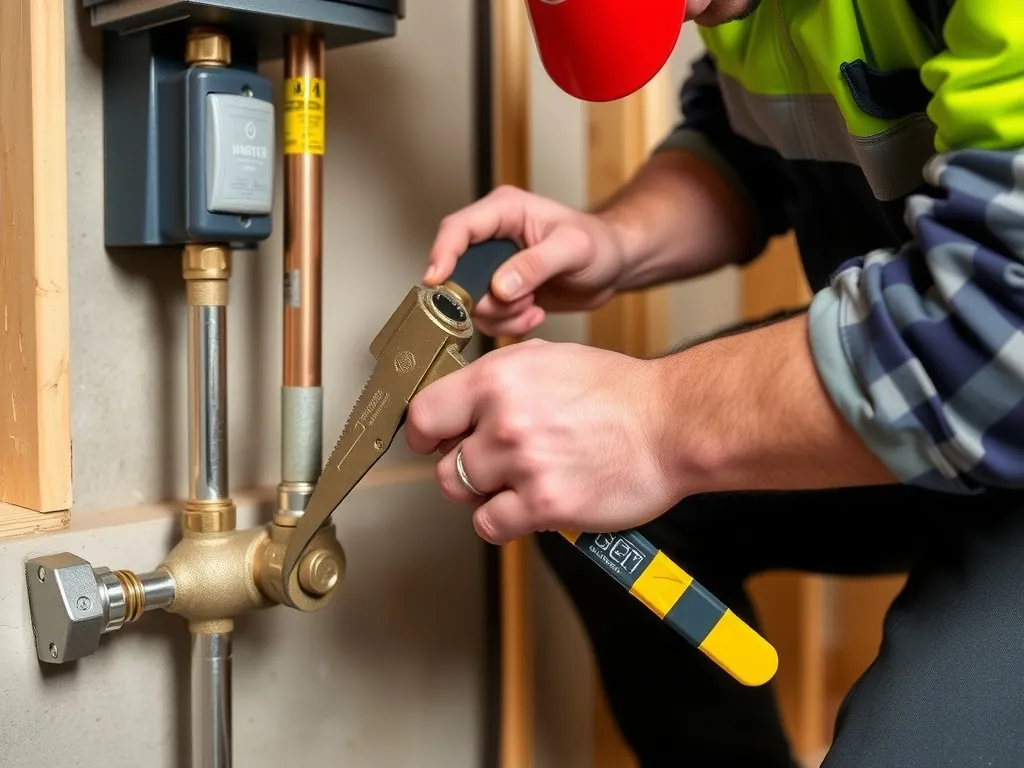
Tankless Water Heater vs Water Heater: Complete Performance and Cost Comparison Guide
Tankless water heaters heat water on demand at 2-5 gallons per minute using gas burners or electric elements, while traditional tank heaters continuously maintain 40-80 gallons at 120-140°F. Tankless units last 20+ years and save 24-34% on energy costs but cost $2,500-4,500 installed, versus $1,200-2,500 for tank units that last 8-12 years. This guide compares efficiency, installation requirements, costs, and performance to help you choose the right system for your home.
What Exactly Is a Traditional Tank Water Heater and How Does It Work?
Traditional tank water heaters store and continuously heat 30-80 gallons of water in an insulated steel tank with glass or plastic lining. Cold water enters the bottom, gets heated by gas burners below the tank or electric elements inside, then rises to the top for distribution when hot water taps open. The thermostat maintains your set temperature 24/7, reheating whenever water drops 10-15 degrees below the target.
These systems operate on simple principles: heat rises, insulation prevents heat loss, and a pressure relief valve prevents dangerous buildup. Gas models use atmospheric or power-vented burners ranging 30,000-75,000 BTU input, while electric units use 3,000-5,500-watt upper and lower elements. The tank’s anode rod sacrifices itself to prevent rust, typically lasting 3-5 years before needing replacement.
What Is a Tankless Water Heater and How Does On-Demand Heating Work?
Tankless water heaters eliminate storage by heating water instantly as it flows through copper or stainless steel heat exchangers. When you open a hot tap, flow sensors trigger gas burners (150,000-199,000 BTU) or electric elements (10-36 kW) that heat water to your exact temperature within seconds. The unit modulates flame or element intensity based on incoming water temperature and flow rate, maintaining consistent output temperatures.
These systems achieve 82-98% efficiency through condensing technology that captures exhaust heat to pre-warm incoming water. Gas models require Category III stainless steel venting for 480°F exhaust, while electric units need 240V/60-150 amp circuits. Advanced models feature computerized controls, remote monitoring, and can link multiple units for whole-house demand exceeding 10+ gallons per minute.
How Do Energy Efficiency Ratings Compare Between Tank and Tankless Systems?
Tankless water heaters achieve 8-34% higher efficiency through elimination of standby heat losses and modulating operation. Gas tankless units carry 0.82-0.98 Uniform Energy Factor (UEF) ratings versus 0.58-0.62 for standard tank heaters, translating to $80-150 annual savings for typical families. Electric tankless models reach 0.99 UEF but require massive electrical upgrades.
Energy savings vary dramatically by usage patterns: households using 41 gallons or less daily save 24-34%, while heavy users (86+ gallons) save 8-14%. Condensing tankless units capture exhaust heat to achieve 0.95+ efficiency but cost $300-500 more. Tank heater efficiency improvements include heat pump hybrids (2.0+ UEF, $1,200 premium) and condensing gas models (0.80 UEF, $600 premium).
Which System Costs More: Tankless or Traditional Water Heater Installation?
Traditional tank water heaters cost $1,200-2,500 installed including unit ($400-1,200), basic installation ($300-800), permits ($50-200), and disposal ($50-100). Standard gas replacements take 2-3 hours using existing connections, while electric tank swaps require minimal electrical work beyond proper grounding and circuit sizing.
Tankless installations range $2,500-4,500 due to extensive modifications: gas line upgrades ($500-1,500 for ¾-1″ lines), stainless steel venting ($800-1,800), electrical circuits for ignition ($200-500), and water line reconfiguration ($300-800). Whole-house electric tankless needs 120-200 amp dedicated service, often requiring $1,500-3,000 electrical panel upgrades. Regional pricing varies 15-25% between high/low cost-of-living areas.
How Long Do Tankless vs Tank Water Heaters Actually Last?
Tankless water heaters last 20-25 years with proper maintenance, double the 8-12 year lifespan of tank units. This longevity stems from replaceable components: heat exchangers, flow sensors, and control boards versus integrated tank systems where corrosion ends service life. Premium brands like Rinnai and Navien offer 15-year heat exchanger warranties versus 6-year tank warranties.
Actual lifespan depends on water quality, usage patterns, and maintenance frequency. Hard water (15+ grains/gallon) reduces tankless life to 12-15 years without annual descaling, while soft water areas see 25+ year lifespans. Tank heaters fail catastrophically when internal rust penetrates the tank wall, while tankless units gradually decline through mineral buildup reducing flow and efficiency.
What Maintenance Requirements Differ Between These Systems?
Tank water heaters require annual tasks: testing temperature-pressure relief valves, flushing sediment buildup, replacing anode rods every 3-5 years, and checking gas connections. Sediment removal takes 30-45 minutes using the tank drain valve, while anode rod replacement requires 1-2 hours and basic tools. Neglecting these tasks reduces efficiency 10-15% and lifespan 2-3 years.
Tankless maintenance involves quarterly filter cleaning, annual descaling with food-grade vinegar or commercial solutions, and burner inspection. Descaling a tankless unit takes 1-2 hours using a submersible pump and 3-4 gallons of solution. Hard water areas need descaling every 6-12 months, while soft water areas extend to 18-24 months. Professional service costs $150-300 annually versus $100-200 for tank units.
How Do Flow Rates and Hot Water Delivery Compare?
Tank heaters deliver 40-80 gallons initially, then 30-70% recovery rates per hour depending on model size and energy input. A 50-gallon gas heater provides 80-90 gallons first hour rating, while electric units deliver 55-65 gallons. Multiple simultaneous uses (shower + dishwasher) deplete reserves in 15-25 minutes, requiring 30-60 minute recovery periods.
Tankless systems provide endless hot water but limited simultaneous flow: 2-5 GPM for single units, 8-10+ GPM for linked systems. Gas models handle 2-3 simultaneous showers in warm climates (65°F incoming) but only 1-2 showers in cold climates (40°F incoming). Temperature rise calculations show northern installations need 199,000 BTU units for two bathrooms, while southern homes manage with 140,000 BTU models.
Which System Works Better for Different Household Sizes?
Single-person households benefit most from tankless systems: minimal standby losses match low usage patterns, and the $100-150 annual energy savings justify higher installation costs over 10-15 years. Point-of-use electric tankless units ($200-400) serve remote bathrooms or kitchens without heating water for entire homes.
Families of 4-6 people face complex decisions: heavy simultaneous use (multiple showers, laundry, dishwasher) may exceed single tankless capacity, requiring multiple units ($4,000-7,000) or accepting flow limitations. Large families often prefer 75-80 gallon high-recovery tank heaters ($1,800-2,500) providing reliable capacity without complex installations. Heat pump hybrids offer middle ground: 2-3x efficiency at $1,500-2,000 premium.
What Installation Challenges Will You Encounter with Each System?
Tank replacements involve straightforward swaps in existing spaces: matching dimensions (tall/short configurations), connecting to existing plumbing, and verifying proper venting. Challenges arise when upgrading capacity: larger tanks may require space modifications, gas line sizing verification, and floor reinforcement for 500-700 pound filled weights. Electric upgrades need 240V/30-50 amp circuits and proper bonding.
Tankless installations present multiple hurdles: gas line sizing often requires upgrading ½” to ¾-1″ lines over 30-50 foot runs, Category III stainless steel venting through walls or roofs with proper clearances, condensate drainage for high-efficiency models, and electrical circuits for controls. Electric tankless needs 120-200 amp dedicated service, frequently requiring panel upgrades and utility service increases. Professional installation takes 6-10 hours versus 2-4 for tank swaps.
How Do Regional Climate and Utility Costs Affect System Choice?
Northern climates (40-55°F groundwater) favor high-capacity tankless units or large tank heaters due to 70-80°F temperature rise requirements. Cities like Minneapolis, Boston, and Denver see tankless efficiency drop 15-25% in winter, requiring 199,000 BTU gas or 36 kW electric models for whole-house coverage. Annual heating costs run $400-600 for gas tankless versus $600-900 for electric tank units.
Southern regions (65-75°F incoming water) maximize tankless advantages: lower temperature rises (45-55°F) enable smaller, cheaper units with higher efficiency. Areas with expensive electricity (California, Northeast) favor gas systems despite higher installation costs. Utility rebates favor high-efficiency choices: $300-1,000 for ENERGY STAR tankless, $150-500 for heat pump hybrids, varying by local programs.
What Problems Might You Encounter with Tankless Water Heaters?
Cold water sandwich effects plague early tankless installations: intermittent hot-cold-hot water during brief usage cycles. Modern units minimize this through buffer tanks and improved controls, but user education remains necessary for optimal operation. Flow rate minimums (0.5-0.8 GPM) prevent activation during low-flow activities like shaving or handwashing.
Mineral buildup reduces efficiency 10-25% annually in hard water areas without treatment, eventually blocking heat exchangers completely requiring $800-1,200 replacement. Ignition failures from gas pressure fluctuations, venting problems causing shutdowns, and complex electronic control failures require specialized technicians. Delayed hot water delivery (10-30 seconds) wastes 1-3 gallons daily versus instant tank delivery.
What Problems Are Common with Traditional Tank Water Heaters?
Tank failures cause catastrophic flooding: 40-80 gallons plus continuous supply can release 500-2,000 gallons during failures. Rust-through typically occurs at welds after 8-10 years, accelerated by neglected anode rods and soft water conditions. Insurance claims average $4,500-15,000 for water damage, making leak detection and pans essential.
Sediment buildup reduces efficiency 5-15% annually, creating popping sounds and extending recovery times. Failed heating elements in electric units require 1-2 hour replacement ($150-300), while gas valve failures cost $400-600. Thermal expansion without proper tanks stresses plumbing systems, causing premature fixture failures and potential relief valve discharge requiring expansion tank installation ($200-400).
How Much Do Operating Costs Differ Over 20 Years?
Twenty-year operating costs favor tankless systems despite higher installation prices. Gas tankless: $4,000-6,000 total ($2,500-4,500 install + $1,500-2,500 operating) versus gas tank: $5,500-8,000 ($1,200-2,500 install + $4,300-5,500 operating). Annual energy savings of $80-150 compound to $1,600-3,000 over 20 years.
Electric comparisons show smaller advantages: tankless systems cost $6,000-10,000 total versus $4,500-7,000 for tank units, factoring in panel upgrades. However, maintenance costs reverse over time: tankless units need $3,000-4,000 in descaling and component replacement versus $2,000-3,000 for tank heater replacements every 8-12 years. Net present value calculations show 3-7% annual returns on tankless upgrades.
Which System Provides Better Return on Investment?
ROI calculations depend on usage patterns, energy costs, and installation complexity. Moderate-use households (40-60 gallons daily) achieve 8-12% annual returns on gas tankless upgrades in average energy cost areas. High installation costs ($3,000+ premium) require 15-20 year payback periods, though system longevity ensures positive returns.
Low-usage households (20-30 gallons) see fastest payback: 10-15 years for gas tankless, 5-8 years for point-of-use electric units. Heavy users (80+ gallons) may see negative ROI due to multiple unit requirements. Regional energy costs dramatically affect returns: expensive electricity markets (HI, CA, NY) show poor electric tankless economics, while cheap natural gas areas (TX, PA) accelerate payback to 7-10 years.
FAQ
#### Can you install a tankless water heater yourself or do you need a professional?
DIY installation voids most warranties and creates safety hazards with gas line modifications and venting requirements. Professional installation costs $1,000-2,500 but ensures code compliance, proper permits, and warranty protection. Only experienced DIYers with plumbing and electrical licenses should attempt installation, and even then, local codes often require professional gas connections. The complexity of vent sizing, condensate management, and electrical upgrades makes professional installation cost-effective long-term.
#### What size tankless water heater do you need for a family of four?
Families of four typically need 7-9 GPM gas tankless units in southern climates or 9-10 GPM models in northern regions. Calculate based on peak simultaneous usage: two showers (2.5 GPM each) plus dishwasher (1.5 GPM) and washing machine (2 GPM) equals 8.5 GPM maximum demand. Size for winter conditions: 199,000 BTU gas or 36 kW electric units handle most 2-3 bathroom homes. Consider multiple smaller units for large homes or staggered usage patterns to reduce capacity requirements.
#### Why does my tankless water heater go cold during showers?
Temperature fluctuations stem from overloaded capacity, mineral buildup, or flow rate issues. When demand exceeds unit capacity (multiple fixtures), temperature drops 20-30°F causing cold bursts. Mineral buildup restricts flow through heat exchangers, reducing heating effectiveness. Flow rates below 0.5 GPM trigger shutdown cycles, common with water-saving showerheads. Solutions include reducing simultaneous usage, annual descaling, or upgrading to higher capacity units. Buffer tank installations eliminate short-cycle temperature variations.
#### How often should you flush a tankless water heater and what does it cost?
Flush tankless units annually in normal water conditions, every 6 months in hard water areas (15+ grains/gallon), and every 18-24 months with soft water. DIY flushing costs $30-50 for food-grade vinegar or descaling solution, taking 1-2 hours with a submersible pump. Professional service runs $150-300 including inspection and filter cleaning. Skip maintenance and efficiency drops 10-25% annually, eventually requiring $800-1,200 heat exchanger replacement from mineral blockage.
#### Which brands make the most reliable tankless water heaters?
Top gas tankless brands include Rinnai (20+ year lifespans, 15-year heat exchanger warranty), Navien (excellent condensing models, great support), and Noritz (commercial-grade components). For electric units, Stiebel Eltron leads efficiency and reliability, followed by EcoSmart and Rheem. Avoid budget brands lacking certified service networks. Premium brands cost 20-30% more upfront but provide better parts availability, longer warranties, and proven longevity records in the field.
#### What are the electrical requirements for whole-house electric tankless?
Whole-house electric tankless requires 240V service with 120-200 amp dedicated circuits depending on capacity. A typical 27 kW unit needs three 40-amp double-pole breakers and #8 AWG wire, while 36 kW models require four 40-amp breakers. Most homes need panel upgrades ($1,500-3,000) and utility service increases to 200-400 amps. Installation must follow NEC Article 422 with proper disconnects, GFCI protection, and load calculations showing adequate service capacity.
#### Do tankless water heaters qualify for tax credits or rebates?
Federal tax credits offer $300-600 for ENERGY STAR certified gas tankless units (0.82+ UEF) through 2032. State and utility rebates vary: California provides $200-1,000, New York offers $400-800, and local utilities add $100-500 more. Heat pump water heaters qualify for higher incentives: up to $1,750 federal tax credits plus state rebates. Check DSIREusa.org for current programs, and ensure professional installation with proper certifications for rebate eligibility.
#### Why does it take longer to get hot water from a tankless heater?
Tankless units require 10-30 seconds to ignite, reach operating temperature, and deliver hot water versus 5-10 seconds for tank systems. The “cold water sandwich” occurs when residual water in pipes cools between uses, requiring purging before hot water arrives. Distance from heater to fixtures adds 5-15 seconds per 10 feet of pipe. Recirculation systems ($800-1,500) provide instant hot water but eliminate some energy savings through increased operation.
#### Can tankless water heaters work with hard water conditions?
Hard water (15+ grains/gallon) severely impacts tankless performance without treatment, reducing efficiency 25% annually and causing premature failure. Install water softeners ($800-1,500) for best protection, or use scale inhibitors ($200-400) as minimum protection. Increase descaling frequency to every 6 months, and consider units with built-in scale detection. Some manufacturers void warranties in untreated hard water areas. Calculate water hardness through local utility reports or $20 test kits before installation.
#### What maintenance does a traditional tank water heater need compared to tankless?
Tank heaters need annual tasks taking 2-3 hours: test temperature-pressure relief valve ($0), drain and flush sediment ($0-50), inspect anode rod every 3 years ($30-50 replacement), and check gas connections. Professional service costs $150-250 annually. Tankless maintenance requires quarterly filter cleaning (15 minutes), annual descaling ($30-150), and burner inspection. Total annual effort: 4-6 hours for tankless versus 2-3 hours for tank, but tankless maintenance prevents more expensive repairs.
Conclusion
Tankless water heaters deliver superior long-term value through 20+ year lifespans and 24-34% energy savings, justifying $1,000-2,000 higher installation costs over time. Traditional tank systems remain attractive for lower upfront investment, simpler installation, and proven reliability. Your choice depends on household size, usage patterns, installation complexity, and budget timeline. Calculate your specific hot water demand, get quotes for both system types, and factor in local energy costs and rebate opportunities. Professional assessment of your home’s gas capacity, electrical service, and venting options ensures optimal system selection and performance.
—