Tankless Water Heater vs Tank Water Heater: Complete Cost, Performance, and Installation Guide
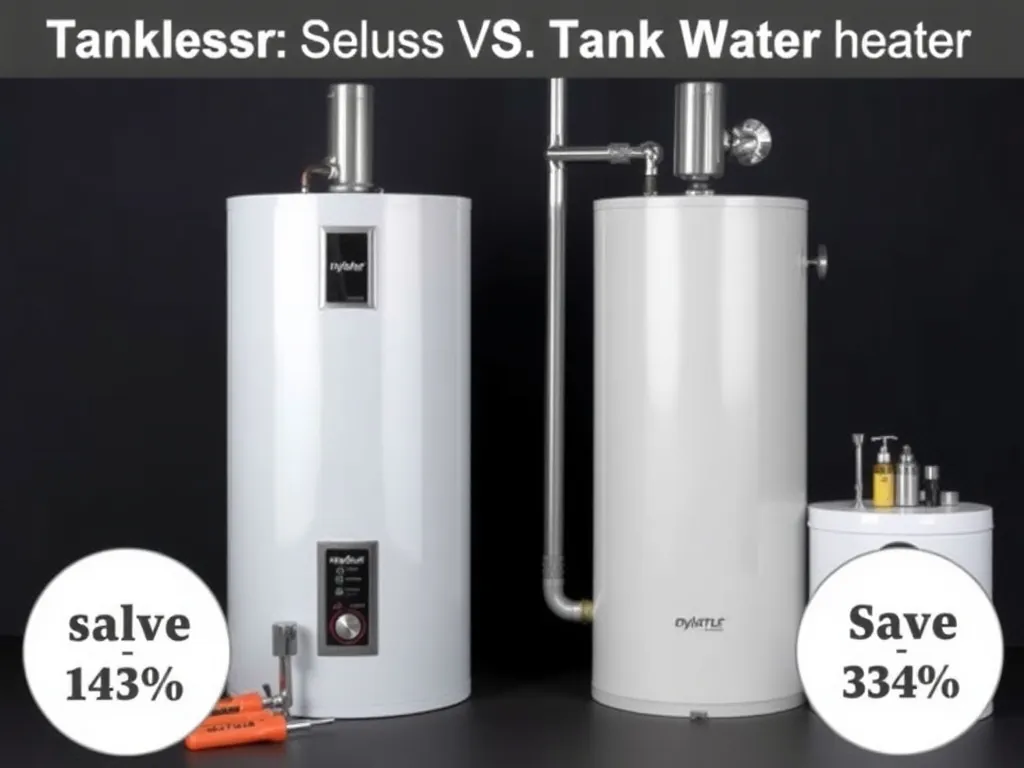
Tankless water heaters provide continuous hot water on demand and use 24–34% less energy than tank models for households using 41 gallons or less daily, while tank water heaters store 30–80 gallons of heated water and cost $300–$1,500 to install. Tankless units last 20+ years but require higher upfront investment ($1,000–$3,500), while tank models need replacement every 10–15 years. This guide compares efficiency, installation, maintenance, costs, and performance for both systems.
What Is the Difference Between Tankless and Tank Water Heaters?
Tankless water heaters heat water instantly as it flows through the unit, eliminating storage, while tank water heaters store and maintain a reservoir of hot water. This fundamental design difference affects energy use, space requirements, and hot water availability. Tank models use continuous heating to maintain temperature, leading to standby heat loss, whereas tankless systems activate only when a hot water tap opens.
Tankless units deliver unlimited hot water during use but have flow rate limitations—typically 2–5 gallons per minute (GPM)—which may not support multiple simultaneous appliances in large households. Tank heaters can supply higher peak demand temporarily but risk depletion during extended use. Cold climate regions reduce tankless efficiency due to lower incoming water temperatures requiring more energy to reach set points.
Gas-powered tankless models require Category III stainless steel venting and larger gas lines (¾” minimum), increasing installation complexity. Electric tankless units need upgraded electrical service (up to 120 amps for whole-house models), often involving panel replacement. In contrast, standard tank heaters connect to existing ½” gas lines or 30-amp electric circuits with Type B venting.
The U.S. Department of Energy confirms that households using 40 gallons or less daily save 24–34% on energy with tankless systems, while high-use homes (85+ gallons) see only 8–14% savings. For most average families, the break-even point on investment occurs after 12–22 years depending on fuel type and usage patterns.
How Do Tankless and Tank Water Heaters Work?
Tankless water heaters activate when a hot water tap opens, triggering a flow sensor that signals the heating element or gas burner to engage, heating water within 0.25 seconds as it passes through a heat exchanger. Tank models use thermostats to monitor stored water temperature and cycle burners or elements to maintain preset levels between 120°F and 140°F.
In gas tankless units, combustion occurs in a modulating burner that adjusts flame intensity based on incoming water temperature and desired output. The heat exchanger transfers thermal energy to the water without storing it. Cold inlet water enters at 40–60°F depending on region, and the unit calculates required BTUs to raise it to 120°F.
Electric tankless models use copper or stainless steel heating elements wrapped around a flow chamber. When water flows, sensors activate solid-state relays that power multiple elements in sequence. These units require precise voltage regulation and are sensitive to hard water scaling, which reduces efficiency by up to 30% over five years without maintenance.
Tank water heaters rely on convection for heat distribution. Heated water rises to the top of the tank, while colder water settles at the bottom for reheating. Sediment accumulation over time insulates the bottom of the tank, reducing heat transfer efficiency by 15–20% after five years. Annual draining mitigates this issue.
Per the Uniform Plumbing Code (UPC) Section 510, all tankless installations must include a pressure relief valve, scale inhibition system (for hard water), and accessible shut-off valves. Tank models require similar safety components but are subject to additional corrosion protection standards under ANSI Z21.10.1.
How Much Does It Cost to Install a Tankless vs Tank Water Heater?
Installing a tankless water heater costs $1,000–$3,500, while a standard tank water heater installation ranges from $300–$1,500, with regional labor rates and retrofit requirements significantly affecting final prices. The $700–$2,000 price gap stems from venting, gas line, and electrical upgrades required for tankless systems.
For gas tankless units, installation includes:
- Replacing ½” gas line with ¾” CSST or black iron pipe: $300–$800
- Installing Category III stainless steel venting: $500–$1,200
- Adding condensate drain line and neutralizer kit: $150–$300
- Upgrading combustion air supply per International Residential Code (IRC G2407.6): $200–$600
Electric tankless models often require:
- Upgrading electrical panel to 200-amp service: $1,500–$3,000
- Running 3–4 #6 AWG copper wires: $600–$1,200
- Installing double-pole 60–120 amp breaker: $150–$300
Tank water heaters connect to existing infrastructure. Gas models use standard ½” line and Type B (double-wall) aluminum venting costing $100–$300 installed. Electric tanks require only a 30-amp double-pole breaker and 10/2 NM-B cable, adding $150–$300 if circuit exists.
Labor costs vary by region:
- Northeast (NY, MA): $80–$150/hour
- Midwest (OH, IL): $60–$100/hour
- South (TX, FL): $50–$90/hour
- West (CA, WA): $90–$160/hour
Retrofitting a tankless unit in a home built for a tank heater adds $1,000–$2,500. New construction installations reduce this premium by 40–60% due to planned infrastructure.
Energy.gov provides detailed cost and savings estimates for tankless systems.
What Benefits Does a Tankless Water Heater Provide?
Tankless water heaters offer 20+ year lifespan, 24–34% energy savings for low-to-moderate users, continuous hot water supply, and compact wall-mounted design freeing floor space. They eliminate standby heat loss, which accounts for 10–20% of energy consumption in tank models, and reduce carbon emissions by 1,000–3,000 lbs annually in gas-powered homes.
Units like the Rinnai RLX Series and Navien NPE-A achieve AFUE (Annual Fuel Utilization Efficiency) ratings of 96–98%, compared to 60–70% for standard atmospheric vented tank heaters. Condensing tankless models capture exhaust heat to preheat incoming water, increasing efficiency but requiring condensate drainage.
Space savings are significant: tankless units measure 18”x14”x6” and mount on exterior or interior walls, while 50-gallon tanks occupy 20 sq ft including clearance. This makes them ideal for small homes, apartments, and remodels where utility space is limited.
With proper maintenance, tankless heaters deliver consistent performance for decades. Scale buildup is the primary failure mode, but annual descaling with vinegar or citric acid restores efficiency. Units with self-cleaning features like Rheem’s HydroShield reduce maintenance labor by 50%.
Federal tax credits under Inflation Reduction Act Section 25D provide up to $2,000 for qualifying ENERGY STAR tankless installations through 2032. Some states offer additional rebates—California’s CSI-Thermal program offers $300–$500 incentives.
What Benefits Does a Tank Water Heater Provide?
Tank water heaters cost $300–$1,500 installed, work with existing plumbing and electrical systems, support high simultaneous demand, and require minimal maintenance beyond annual flushing. Their simplicity ensures wide contractor familiarity, reducing repair wait times and costs.
Standard 40–50 gallon tanks supply 6–8 gallons of hot water per hour at recovery rates of 35–45 GPH, sufficient for back-to-back showers or dishwasher + washing machine use. High-recovery models like AO Smith Vertex deliver 100+ GPH using 75,000 BTU burners, outperforming most single tankless units.
Installation compatibility is a major advantage. Over 85% of U.S. homes have infrastructure supporting tank replacement without modifications. Electric tanks connect to standard 240V/30A circuits, and gas models use ½” supply lines and Type B vents—common in residential construction.
Repair costs are lower: replacing a heating element ($20–$50) or thermostat ($30–$80) takes under an hour. Anode rod replacement every 3–5 years ($50–$100) extends tank life by preventing internal corrosion.
Heat pump hybrid tanks like the Rheem RTE 7.5 achieve EF (Energy Factor) of 3.5+, using 60% less energy than standard electric models. These qualify for federal tax credits up to $2,000 and utility rebates averaging $500.
Despite shorter 10–15 year lifespan, tank models offer predictable replacement cycles and lower initial investment, making them cost-effective for renters, low-budget homeowners, or temporary housing.
How Do You Choose Between Tankless and Tank Based on Household Size?
For 1–2 person households using ≤40 gallons/day, tankless water heaters maximize efficiency and space savings; for families of 3+ or homes with simultaneous high demand, dual tankless units or high-recovery tank heaters perform better. Flow rate requirements determine feasibility.
Single-family tankless units (5–7 GPM) suffice for one bathroom with concurrent shower and sink use (combined draw ≈ 3.5 GPM). However, two showers + dishwasher exceed 6 GPM, causing temperature drops unless a 9+ GPM unit or multiple units are installed.
Large homes (3+ bathrooms) often use:
- Multiple point-of-use tankless units: One per bathroom or zone
- Two full-size tankless units in cascade mode: Rinnai and Navien models synchronize output
- 80+ gallon high-recovery tank: 75,000–100,000 BTU burner with 90+ GPH recovery
Cold inlet water temperature drastically affects performance. In Miami (77°F average), a 7 GPM tankless unit easily heats to 120°F. In Chicago (49°F), same unit delivers only 4.2 GPM at 120°F—a 40% reduction.
Use this sizing formula:
“`
Required GPM = (Temperature Rise) × (Flow Rate) ÷ 8.33 × 1.0
Example: 70°F rise × 5 GPM ÷ 8.33 = 42,000 BTU minimum
“`
Manufacturers provide performance charts showing output at various inlet temps. Always size based on your region’s coldest groundwater.
For homes with intermittent occupancy (vacation properties), tank heaters waste energy maintaining temperature. Tankless is ideal for these scenarios.
What Problems Might You Encounter with Tankless Water Heaters?
Tankless water heaters experience cold water sandwich effect, flow rate limitations, scale buildup in hard water areas, high installation costs, and ignition delays. These issues reduce comfort and increase maintenance burden if not addressed.
Cold water sandwich occurs when short hot water use cycles leave residual hot water in pipes. When the next tap opens, cold water trapped between two hot flows passes through before heating resumes. Units with recirculation pumps ($300–$700) eliminate this.
Scale buildup from hard water (over 7 gpg) coats heat exchangers, reducing efficiency and triggering overheating faults. Descaling every 6–12 months with 4 gallons of vinegar is mandatory in these areas. Units with built-in sensors (e.g., Navien’s Smart Vent) alert users to maintenance needs.
Low-flow fixtures (<0.5 GPM) may not trigger activation. Install minimum flow enhancers or switch to recirculating models with buffer tanks. Inlet water filters prevent debris from damaging flow sensors.
Ignition delay of 10–20 seconds is common in distant fixtures. Recirculation systems reduce wait time but increase energy use. Some municipalities restrict continuous recirculation due to water waste.
Modulating burners can fail after 15+ years due to repeated thermal cycling. Replacement control boards cost $300–$600. Labor-intensive heat exchanger replacement ($800–$1,500) often exceeds value of 15-year-old unit.
NAHB provides technical guidance on gas appliance integration.
What Problems Might You Encounter with Tank Water Heaters?
Tank water heaters develop sediment buildup, anode rod depletion, tank corrosion, pressure relief valve leaks, and thermal expansion issues. These lead to reduced efficiency, rumbling noises, and catastrophic failure if unaddressed.
Sediment accumulation insulates the burner from water, increasing energy use by 15–20%. It also causes rumbling sounds as trapped water boils under sediment. Annual draining removes 60–80% of sediment; full removal requires acid cleaning.
Anode rods attract corrosive elements in water, sacrificing themselves to protect the steel tank. Once depleted (every 3–7 years), the tank begins to rust. Pinhole leaks and bottom failure follow within 1–2 years.
Thermal expansion occurs when heated water expands in a closed plumbing system. Without an expansion tank ($50–$150), pressure builds and triggers T&P valve discharge, potentially causing water damage.
Gas models produce combustion gases that condense in flues, leading to acidic corrosion in non-condensing units. Proper drafting per IRC G2407.5 prevents backdrafting and carbon monoxide risks.
Electric models suffer from element burnout due to scale coating, especially in hard water. Dual-element systems (upper/lower) allow partial operation during failure but reduce recovery rate.
How Do You Maintain a Tankless vs Tank Water Heater?
Tankless water heaters require annual descaling and filter cleaning; tank water heaters need biannual flushing, anode rod inspection, and pressure valve testing. Maintenance frequency directly impacts lifespan and efficiency.
For tankless units:
- Flush with 4 gallons of vinegar via service valves: 1 hour every 6–12 months
- Clean inlet water filter: quarterly
- Inspect heat exchanger for sooting (gas models): annually
- Check condensate trap and drain line: biannually
Use manufacturer-recommended kits—Rheem RTG-MK1, Navien NCP-KIT1. Never bypass flow sensors during cleaning.
For tank heaters:
- Drain 5 gallons from valve to remove sediment: every 6 months
- Test T&P valve by lifting lever: every 6 months
- Inspect anode rod: every 3 years, replace if <½” core remains
- Check for rust, bulging, or leaks: monthly visual inspection
Insulate hot water pipes and tank (except burner compartment) to reduce standby loss by 7–10%. Set temperature to 120°F to prevent scalding and mineral deposition.
Heat pump tanks require air filter cleaning every 3 months and clearance of 12+ inches around unit for airflow.
How Long Do Tankless and Tank Water Heaters Last?
Tankless water heaters last 20+ years with annual maintenance; tank water heaters last 10–15 years, with lifespan influenced by water quality, usage, and maintenance frequency. Component replacement extends functional life but not structural integrity.
Tankless units see gradual efficiency decline due to micro-scale buildup even with maintenance. After 15 years, heat exchanger efficiency drops 15–25%, increasing fuel costs. Electronic controls may fail between 10–15 years, costing $300–$600 to replace.