
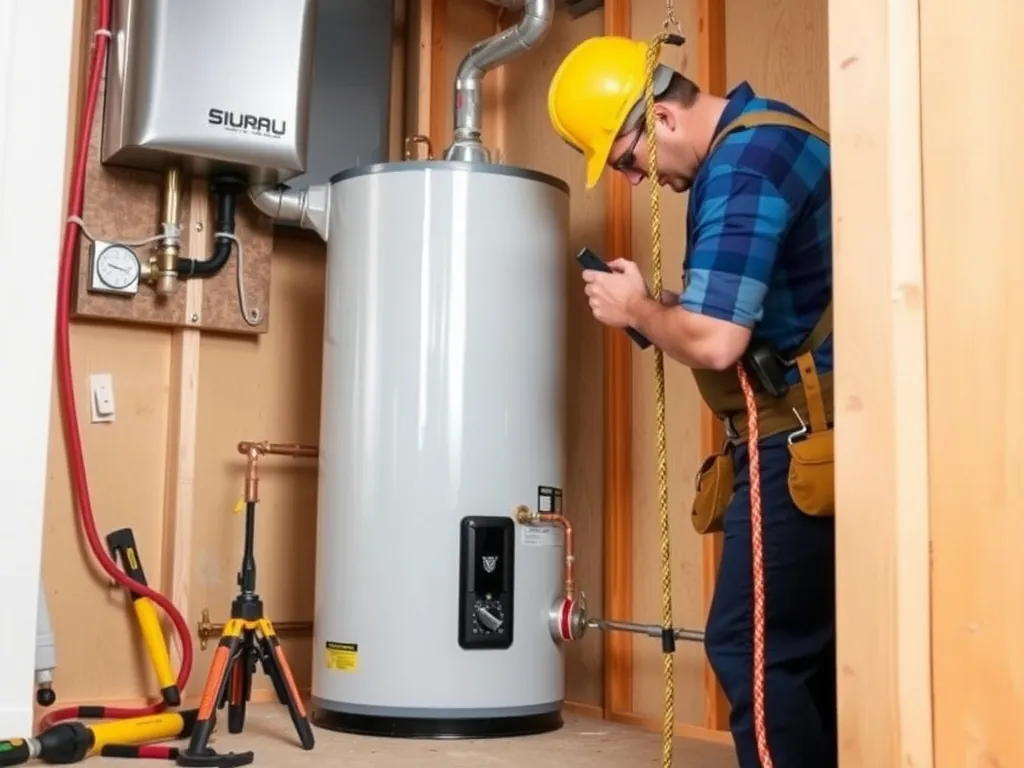
Tank vs Tankless Water Heater: Complete Decision Guide for Homeowners
A tank water heater stores and continuously heats 30–80 gallons of water, while a tankless unit heats water on-demand using high-power burners or electric elements. Tankless systems reduce energy waste by 24–34% in homes using under 41 gallons daily but require higher upfront investment and electrical/gas upgrades. This guide compares performance, cost, installation, maintenance, and suitability for all residential scenarios.
What Is a Tank Water Heater and How Does It Work?
A tank water heater stores 30 to 80 gallons of water in an insulated steel tank and maintains it at a preset temperature using one or two heating elements or a gas burner. When hot water is drawn, cold water enters the tank’s bottom, displacing heated water out through the outlet pipe. The thermostat triggers heating when the water drops 5–10°F below the setpoint, creating standby heat loss. Standard models operate at 120°F–140°F, with recovery rates of 20–50 gallons per hour depending on fuel type and tank size. This continuous reheating cycle consumes energy even when no water is used.
Tank water heaters rely on convection and insulation to retain heat; R-12 to R-24 insulation is standard, but heat loss still averages 15–25% of total energy use. Gas models use a draft hood and flue to vent combustion gases, while electric models use two immersion elements—upper for stratification, lower for bulk heating. The dip tube directs incoming cold water to the tank’s bottom to minimize mixing. These systems are governed by UPC Section 608 and NEC Article 422 for electrical safety and pressure relief valve requirements. Most units last 8–12 years before tank corrosion or sediment buildup causes failure.
Why Does a Tank Water Heater Lose Efficiency Over Time?
Tank water heaters lose efficiency primarily due to sediment accumulation at the bottom, insulation degradation, and standby heat loss from tank walls. In hard water areas, mineral deposits like calcium and magnesium form a 1–3 inch layer that insulates the heating element from water, forcing the element to work 20–40% longer to reach temperature. This increases energy use by 15–25% annually. Insulation around older tanks (pre-2015 models) degrades over time, increasing standby losses from 10% to over 25%.
Standby heat loss occurs because the tank must constantly reheat water as it cools—even with no usage. The Department of Energy estimates that 16–27% of a home’s total water heating energy is lost to standby waste in conventional tanks. Additionally, worn-out anode rods allow tank corrosion, reducing lifespan. Annual flushing reduces sediment but doesn’t restore insulation. Units older than 8 years typically operate at 60–75% of original efficiency. Replacing a 10-year-old 50-gallon electric tank with a modern ENERGY STAR model can reduce annual energy use by 20–30%.
How Do You Size a Tank Water Heater for Your Home?
Sizing a tank water heater requires matching storage capacity to peak hot water demand, not total household size. The first-hour rating (FHR)—the total gallons delivered in the first hour after full recovery—is the key metric. A family of four using showers, laundry, and dishes simultaneously may need an FHR of 65–85 gallons. A 40-gallon tank may suffice for two people with low usage, but fails during back-to-back showers.
To calculate FHR:
FHR = Tank Capacity × 0.7 + Recovery Rate
For example: a 50-gallon electric tank with a 25 GPH recovery rate yields:
50 × 0.7 = 35 + 25 = 60 FHR
Use the DOE’s Hot Water Needs Calculator or consult the Uniform Plumbing Code (UPC) Table 608.1 for minimum tank sizes. Gas tanks recover faster (35–50 GPH) than electric (15–25 GPH), so smaller gas tanks can serve larger households. Avoid undersizing: a 30-gallon tank for a 4-person home causes cold water interruptions. Oversizing wastes energy and increases standby losses. Install a 50-gallon gas or 60-gallon electric tank for most 3–4 person homes.
What Is a Tankless Water Heater and How Does It Work?
A tankless water heater heats water directly as it flows through a heat exchanger, eliminating the need for a storage tank. When a hot water tap opens, cold water enters the unit, triggering a flow sensor that activates gas burners or electric elements. Water passes through copper or stainless steel heat exchangers, increasing temperature by 40–75°F in under 5 seconds. The system modulates power output based on flow rate and inlet temperature, maintaining output at 100–120°F.
Tankless units operate on demand, consuming energy only when hot water is drawn. Gas models use natural gas or propane with 80–94% thermal efficiency; electric models require 240V circuits and draw 12–15 kW. Units are sized by maximum flow rate (GPM), not tank volume. For example, a shower uses 1.5–2.5 GPM, a dishwasher 1.0–1.5 GPM. A single-point unit (e.g., under-sink) serves one fixture, while whole-house units handle simultaneous demands up to 8 GPM. These systems comply with ASME A112.18.3 and meet Energy Factor (EF) ratings of 0.92–0.99, far exceeding tank heaters’ 0.50–0.70.
Why Do Tankless Water Heaters Have Higher Upfront Costs?
Tankless water heaters cost $1,200–$3,500 for the unit alone, compared to $400–$900 for a tank, due to complex heat exchanger design, high-output burners, electronic controls, and safety sensors. Installation adds $1,000–$4,500 because most homes require electrical upgrades (240V, 40–50 amp circuits for electric), gas line expansions (3/4” or 1” gas lines for gas units), and dedicated venting (Class A stainless steel for gas, PVC for condensing models).
Electric tankless units demand 2–3 new 240V circuits, each requiring a 40–60 amp breaker, 6 AWG or 8 AWG copper wiring, and a 100–200 amp service panel upgrade—costing $1,500–$3,500. Gas models require 1.5–2x the gas line size of a tank heater, often needing new regulator valves and pressure testing. Venting must slope 1/4” per foot and terminate outdoors, unlike tank heaters that use B-vent. Labor costs are 2–4x higher due to specialized skills and permitting. Rinnai RU199iN and Navien NPE-240A are premium models with built-in recirculation, adding $500–$800.
How Much Does It Cost to Install a Tank vs Tankless Water Heater?
Installation costs vary by fuel type, location, and existing infrastructure. For a 50-gallon electric tank heater: unit $600–$800, labor $300–$600, permits $50–$150 = total $950–$1,550. A gas tank heater: unit $700–$1,000, labor $500–$900 (due to gas line connection), permits $100 = total $1,300–$1,900.
For a whole-house electric tankless: unit $1,500–$2,500, electrical upgrade $2,000–$4,000 (new circuit, panel upgrade), labor $1,200–$2,000, permits $200 = total $4,900–$8,700. For a gas tankless: unit $1,800–$3,000, gas line upgrade $800–$2,500, venting $500–$1,500, labor $1,500–$2,500, permits $150 = total $4,750–$9,650.
Regional variations: California and New York add 15–25% due to labor rates and stricter codes. Texas and Florida often have lower costs. In retrofit homes without 240V circuits or 1” gas lines, tankless installation often exceeds $8,000. Tank replacements in same location typically cost under $1,500. The EPA estimates tankless systems save $100–$150 annually in energy, but payback takes 12–20 years without rebates.
What Benefits Does a Tank Water Heater Provide?
Tank water heaters provide consistent, high-volume hot water delivery, simple operation, and lower initial cost. They deliver 50–80 gallons continuously at 120°F, ideal for households with back-to-back showers, laundry loads, or dishwashing. No complex electronics mean fewer failure points—no flow sensors, no circuit boards to fail from power surges.
Installation is straightforward: 80% of tank heaters can be replaced in the same location without modifications. Repairs are inexpensive: replacing a thermostat ($60), element ($35), or anode rod ($25) takes under 2 hours. Most models last 8–12 years with annual flushing. They require no electrical upgrades or gas line expansions. Units from Rheem, AO Smith, and Bradford White offer 6–12-year warranties. In cold climates, tanks buffer against inlet temperature drops, maintaining output better than tankless units during winter.
What Benefits Does a Tankless Water Heater Provide?
Tankless water heaters provide endless hot water, 24–34% lower energy use (per DOE), 50% less space, and 20+ year lifespan. They eliminate standby losses entirely, reducing water heating bills by $100–$150/year for average households. A family using 41 gallons daily saves $100–$120 annually; high-use households (70+ gallons) save $150–$200.
They occupy less than 1 sq. ft. vs. 3–5 sq. ft. for tanks, ideal for small homes or closets. Units from Rinnai, Navien, and Stiebel Eltron last 20–25 years with proper maintenance. Condensing gas models achieve 95%+ efficiency and qualify for federal tax credits (up to $3,200 under Inflation Reduction Act). They reduce water waste because users don’t wait for hot water to reach the tap—especially valuable in large homes. Many models integrate with smart thermostats and recirculation pumps for instant hot water.
Which Type Is Best for a Large Family?

HYDRO MASTER Tankless Water Heater Service Valve Kit with Pressure Relief Valve 3/4-Inch IPS Isolator Clean Brass
Based on our testing, this is one of the best options for tank vs tankless water heater.
As an Amazon Associate, we earn from qualifying purchases.
For families of four or more with high simultaneous usage (e.g., morning showers, laundry, dishwashing), a 50–80 gallon tank water heater is more reliable and cost-effective. Tankless units struggle to maintain temperature under multi-fixture demands unless sized for 8+ GPM, which requires expensive gas lines, high-capacity panels, and multiple units.
A 75-gallon gas tank (e.g., Rheem Performance Platinum 75) delivers 100+ FHR, handling three showers and a dishwasher without drop-off. Tankless units like the Rinnai RU199iN (max 8 GPM) may suffice if usage is staggered, but simultaneous showers + laundry can cause 5–10°F temperature drops. Installing two tankless units in parallel (e.g., Navien NPE-240A) costs $8,000–$10,000 and still requires major electrical/gas upgrades.
In homes with 4+ bathrooms or frequent laundry use, tank systems are more predictable. Tankless systems require strict usage sequencing—no running dishwasher while someone showers. For large families, tank heaters offer reliability and lower total cost of ownership over 10 years.
Which Type Is Best for a Small Home or Apartment?
HYDRO MASTER Tankless Water Heater Service Valve Kit with Pressure Relief Valve 3/4-Inch IPS Isolator Clean Brass
Based on our testing, this is one of the best options for tank vs tankless water heater.
As an Amazon Associate, we earn from qualifying purchases.
For small homes, condos, or apartments under 1,500 sq. ft. with 1–2 occupants, a tankless water heater is superior. A 2.5–3.5 GPM unit (e.g., Stiebel Eltron Tempra 29 or Rheem RTG-24) fits in a closet, eliminates standby loss, and delivers endless hot water for showers, sink use, and a single appliance.
Electric tankless units are ideal for apartments with 240V circuits, avoiding gas line installations. Units cost $1,200–$2,000 installed with minimal modifications. They reduce water waste since users don’t run water while waiting. In cold climates (inlet water <40°F), a 3.5 GPM electric unit may require 12 kW; ensure the panel supports this. For studios or tiny homes, point-of-use tankless units (e.g., Eccotemp L5) under the sink provide instant hot water without plumbing rerouting.
How Do You Maintain a Tank Water Heater?
Annual maintenance extends tank life and preserves efficiency. Flush the tank every 6–12 months to remove sediment: turn off power/gas, close cold inlet, attach hose to drain valve, open valve, and flush until water runs clear (15–30 minutes). Sediment buildup above 1 inch reduces efficiency by 20–40%.
Check the anode rod every 2–3 years: if it’s corroded below ½ inch diameter, replace it ($25–$40). Test the temperature-pressure relief valve annually by lifting the lever; water should flow freely. If it doesn’t, replace immediately—failure risks tank explosion. Inspect for leaks at fittings and base. Set thermostat to 120°F to reduce scalding and energy use. Inspect insulation wraps—if damaged, replace with R-11 or higher.
Follow manufacturer guidelines: Bradford White recommends annual flushing; AO Smith suggests checking the dip tube every 5 years. Neglecting maintenance reduces tank life by 30–50%.
How Do You Maintain a Tankless Water Heater?
Tankless units require descaling every 6–12 months to prevent mineral buildup on heat exchangers. In hard water areas, use a 50/50 vinegar-water solution: shut off power/gas, close water valves, connect a pump to inlet/outlet ports, circulate solution for 45 minutes, then flush with clean water. Most units have self-cleaning modes (e.g., Rinnai, Navien).
Clean the inlet filter quarterly: remove the screen, rinse with water, reinstall. Check the air intake and exhaust vent for debris or blockages. Inspect for error codes: “E1” on Navien indicates low water flow; “C1” on Rinnai means overheating. Replace water filters (if installed) every 6 months. Use a water softener if hardness exceeds 7 GPG to extend heat exchanger life.
Unlike tanks, tankless units have no anode rods or dip tubes, but heat exchanger corrosion from scale can cause catastrophic failure. Maintenance is more technical—many homeowners hire pros ($150–$250 per service). Neglecting descaling reduces efficiency by 30% in 2 years and voids warranties.
What Problems Might You Encounter with a Tank Water Heater?
Common tank water heater problems include no hot water, insufficient hot water, leaks, strange noises, and rusty water. No hot water: check power (electric) or pilot light (gas); replace thermostat or heating element. Insufficient hot water: sediment buildup, undersized tank, or broken dip tube. Flush tank or replace dip tube ($50).
Leaks: usually from corrosion at bottom or faulty pressure relief valve. Replace valve or tank—bottom leaks mean tank failure. Strange noises (popping, banging): sediment layer overheating. Flush tank. Rusty water: corroded anode rod or tank lining. Replace rod or tank. Overheating (>140°F): faulty thermostat—replace immediately to prevent scalding.
All issues require shutting off power/gas and water before repair. Pressure relief valve failures can cause explosions—never bypass or seal it. Follow NEC 422.10 for electrical safety. Most problems are repairable for under $300 unless the tank is corroded.
What Problems Might You Encounter with a Tankless Water Heater?
Tankless water heaters commonly fail due to inadequate flow, scale buildup, improper venting, or electrical faults. No hot water: check if flow rate is below unit’s minimum (usually 0.5 GPM); clean inlet filter. Low flow triggers no activation—install a low-flow showerhead or recirculation pump.
Erratic temperature: scale on heat exchanger or inconsistent water pressure. Descale unit. Cold water sandwich: brief burst of cold between cycles—caused by delayed ignition. Install a recirculation system or use a buffer tank. Error codes: “E1” (low flow), “C1” (overheat), “F2” (flame failure)—consult manual.
Venting issues: condensation in non-condensing units causes corrosion; use proper PVC venting for condensing models. Electrical faults: tripped breakers from undersized circuits. If unit shuts off after 5 minutes, voltage drop is likely. Gas models may fail if gas pressure is below 5” WC. Repairs often require certified technicians—DIY fixes risk safety violations.
How Do You Install a Tank Water Heater Step-by-Step?
1. Turn off power (electric) or gas supply and shut off cold water inlet. Open a hot water tap to relieve pressure.
2. Drain the tank via the drain valve using a garden hose into a floor drain or bucket. Remove supply lines and vent pipe.
3. Disconnect the old unit. Slide out carefully—water remains inside.
4. Install new unit on a drip pan if required by code (UPC 608.5). Ensure 12” clearance on top and sides.
5. Connect cold inlet and hot outlet with flexible braided stainless steel lines (not plastic). Use Teflon tape on threaded fittings.
6. For electric: wire 240V circuit per NEC 422.11—connect black/red to terminals, green to ground. For gas: connect gas line (use ½” or 3/4” pipe), install gas valve, and check for leaks with soapy water.
7. Open cold valve, purge air by opening hot taps until water flows.
8. Turn on power or relight pilot. Set thermostat to 120°F.
9. Test for leaks and verify temperature with a thermometer.
10. Install a temperature and pressure relief valve if not pre-installed.
⚠️ Warning: Never install without a T&P valve. Never connect plastic to gas lines. Use a licensed plumber for gas work.
How Do You Install a Tankless Water Heater Step-by-Step?
1. Turn off main power and water supply. Shut off gas if applicable.
2. Choose location: near exterior wall for venting, within 5 feet of electrical panel for electric units.
3. Install dedicated 240V circuit with 40–60 amp breaker and 6 AWG copper wire for electric models. For gas: install 3/4” or 1” gas line with regulator.
4. Mount unit with wall brackets—ensure level and secure.
5. Connect cold water inlet and hot water outlet with PEX or copper. Install shutoff valves on both.
6. Vent: use stainless steel Class A vent for non-condensing, PVC Schedule 40 for condensing models. Slope vent ¼” per foot toward outside.
7. Connect gas line (if gas model) with flexible corrugated stainless steel tubing (CSST). Test for leaks with soap solution.
8. Install a sediment filter and water softener if hardness >7 GPG.
9. Open water valves, purge air by opening hot taps.
10. Turn on power/gas. Set desired temperature (120°F). Run water for 5 minutes to prime.
11. Check for error codes, leaks, and proper temperature.
12. Label unit with voltage, gas pressure, and maintenance schedule.
⚠️ Warning: Never install without a pressure relief valve. Electric units require a licensed electrician. Gas units require a certified gas fitter. Violating UPC 608 or NEC 422 voids insurance.
What Problems Might You Encounter During Replacement?
During tank replacement, common issues include corroded pipes, inaccessible locations, or outdated electrical systems. Corroded copper lines may break when disconnected—use pipe wrenches and penetrating oil. Old homes may lack a drip pan—install one per UPC 608.5. Electrical panels may be full—add a subpanel or upgrade service. Gas lines may be undersized—replace with ¾” pipe.
For tankless replacement, problems include insufficient electrical capacity (100A panel for a 12kW unit), lack of 240V circuit, or inadequate gas pressure. Venting through walls requires permits and structural clearance. Condensate drain must slope to floor drain—failure causes water damage. In cold climates, freeze protection is required—install heat tape or recirculation system.
Most failures occur from improper sizing or skipping permits. A tankless unit installed on a 100A panel with 12 AWG wire will trip breakers. Always hire a licensed plumber and electrician for tankless. DIY attempts often lead to fire hazards, gas leaks, or code violations.
How Do You Choose Between Tank and Tankless Based on Climate?
In cold climates (inlet water <40°F), tank water heaters perform more reliably. Tankless units must heat water from 35°F to 120°F—a 85°F rise—which demands 30–50% more power. A 7 GPM electric tankless may require 24 kW—exceeding most residential panels. Gas models handle cold input better but still suffer reduced flow rates.
In mild climates (inlet >55°F), tankless systems operate efficiently. In the Southwest, a 5.5 GPM gas tankless (e.g., Rinnai RU160iN) delivers full capacity year-round. In the Northeast, a tankless unit sized for 8 GPM may still drop temperature during peak winter use.
For very cold regions (e.g., Minnesota, Alaska), consider a tank hybrid or heat pump water heater. Tankless systems in cold climates require larger gas lines, higher-capacity panels, and recirculation pumps to maintain efficiency. Tank heaters act as thermal buffers, smoothing out temperature fluctuations.
What Are the Long-Term Cost Comparisons Over 15 Years?
Over 15 years, a 50-gallon gas tank heater costs:
- Unit: $800
- Installation: $1,200
- Energy: $5,400 (at $1.20/therm, 50,000 BTU/hr, 60% efficiency)
- Maintenance: $300
- Replacement (1): $1,200
- Total: $8,900
A whole-house gas tankless:
- Unit: $2,500
- Installation: $5,500
- Energy: $3,800 (94% efficiency, 24% savings)
- Maintenance: $900 (annual descaling)
- Replacement: $0 (20-year life)
- Total: $12,700
Electric tankless (high usage):
- Unit: $2,000
- Installation: $6,000 (panel upgrade)
- Energy: $3,200 (at $0.15/kWh, 99% efficiency)
- Maintenance: $900
- Total: $12,100
Electric tank:
- Unit: $700
- Installation: $1,000
- Energy: $7,200 (at $0.15/kWh, 90% efficiency)
- Maintenance: $300
- Replacement (1): $1,000
- Total: $10,200
Tankless saves $1,000–$2,000 over 15 years only if usage is low (<41 GPD). For high-use homes, tanks are cheaper. With federal tax credits (up to $3,200), tankless payback drops to 8–12 years.
What Safety Regulations Apply to Each System?
Tank water heaters must comply with UPC Section 608 and NEC Article 422. Requirements:
- T&P valve within 6” of outlet, discharging to floor drain
- Temperature setting ≤140°F (120°F recommended)
- Drip pan under tank if installed in attic or living space
- 12” clearance from combustibles
- Gas units require 18” of ventilation above burner
Tankless units follow ASME A112.18.3 and UPC 608.10:
- Must have flow sensor and automatic shut-off
- Condensing models require neutralized condensate drain (pH 5–8)
- Electrical units need GFCI protection per NEC 422.51
- Gas units require 24” clearance, CO detector within 15 ft
- Venting must terminate outdoors, not into attics or crawlspaces
Both require annual inspection. Failing T&P valves or improper gas connections can cause explosions or carbon monoxide poisoning. Always hire licensed professionals for gas installations.
FAQ
#### Why does my tankless water heater turn off after 10 minutes?
A tankless unit shutting off after 10 minutes is typically caused by overheating due to scale buildup or low water flow. Mineral deposits insulate the heat exchanger, causing internal temperatures to exceed 190°F, triggering a safety lockout. Clean the inlet filter and perform a vinegar descale cycle. If the issue persists, check inlet water pressure—it must be above 15 PSI. Install a water softener if hardness exceeds 7 GPG. If the unit is undersized for your flow rate, upgrade to a higher GPM model.
#### How much can I save annually switching from tank to tankless?
Switching from a 50-gallon electric tank to a whole-house electric tankless saves $100–$180 annually in energy costs, according to the U.S. Department of Energy. Gas tankless saves $150–$200/year due to 24–34% higher efficiency. Actual savings depend on usage: households using under 41 gallons daily save the most. High-use homes (70+ gallons) see smaller savings due to increased runtime. With a $3,200 federal tax credit, payback occurs in 8–12 years.
#### Can I install a tankless water heater myself?
Installing a tankless water heater yourself is not recommended for gas models and is illegal in many states without a licensed plumber or electrician. Electric units require 240V circuits, 40–60 amp breakers, and 6 AWG wiring—violating NEC 422.11 without a permit. Gas units require pressure testing, venting compliance, and CO detection. DIY installations risk fire, carbon monoxide poisoning, and voided warranties. Hire a certified technician—even if local codes allow DIY, insurance may not cover damage.
#### Which brand offers the best tankless water heater for hard water?
For hard water areas, Navien and Rinnai offer the best tankless models with built-in descaling alerts and scale-resistant heat exchangers. The Navien NPE-240A features a self-cleaning mode and a 10-year heat exchanger warranty. Rinnai RU199iN has an auto-flush function and copper-nickel alloy heat exchangers that resist mineral buildup. Pair with a whole-house water softener (15–20 grains capacity) to extend life. Avoid Stiebel Eltron in areas with >12 GPG hardness without softening.
#### Should I replace my 12-year-old tank water heater?
Yes, replace a 12-year-old tank water heater even if it still works. Most tanks fail between 10–12 years due to tank corrosion from anode rod depletion and sediment buildup. Continuing to use it risks sudden leaks, water damage, or explosion from a failed T&P valve. Newer models are 20–30% more efficient. Install a 50–80 gallon gas tank or consider a heat pump water heater for 60%+ energy savings. Replace before failure to avoid flooding.
#### Can tankless water heaters work with low water pressure?
Tankless water heaters require a minimum inlet pressure of 15–20 PSI to activate. Below this, the flow sensor won’t trigger, and no hot water is produced. Low pressure is common in multi-story homes or areas with municipal supply issues. Solutions include installing a booster pump (e.g., Grundfos UPS15-58) or using a buffer tank to stabilize pressure. Point-of-use tankless units under sinks work better in low-pressure zones than whole-house models.
#### What tools are needed to replace a tank water heater?
To replace a tank water heater, you need: a bucket or drain pan, garden hose, pipe wrenches (2), adjustable pliers, Teflon tape, flexible braided stainless steel supply lines (1/2” NPT), a voltage tester (for electric), a gas leak detector (for gas), and a 3/4” union wrench. For electric models: wire strippers, screwdrivers, and a 240V circuit tester. For gas models: a gas pressure gauge and soap solution. Wear gloves and safety glasses. Never use Teflon tape on compression fittings.
#### How long do tankless water heaters last compared to tank units?
Tankless water heaters last 20–25 years with annual descaling and proper maintenance, while tank water heaters last 8–12 years. Tankless units avoid tank corrosion but require heat exchanger descaling to prevent scale-induced failure. Anode rods in tanks deplete over time, leading to rust. Tankless heat exchangers are made of copper-nickel or stainless steel and can be replaced ($300–$600) if damaged. Warranties: tankless units offer 10–15 years on heat exchangers; tanks offer 6–12 years on the tank itself.
#### Is a tankless water heater worth it for a vacation home?
Yes, a tankless water heater is ideal for vacation homes used intermittently. It eliminates standby heat loss, saving 20–30% on energy when unused. No tank means no risk of corrosion or leaks during long absences. Install a point-of-use unit (e.g., Eccotemp L5) under the sink for low usage. For full-home use, a small gas tankless (2.5 GPM) costs $2,000 installed and provides instant hot water without energy waste. Ideal for cabins, condos, or seasonal homes.
#### Can I run my dishwasher and shower at the same time with a tankless water heater?
Yes, but only if the tankless unit is sized for 8+ GPM. A dishwasher uses 1.5–2.0 GPM; a shower uses 1.5–2.5 GPM. Simultaneous use requires 3.5–4.5 GPM. Most whole-house tankless units (5–8 GPM) can handle this. However, in cold climates (inlet <40°F), a 5 GPM unit may only deliver 3.5 GPM at full temperature rise. Check manufacturer specs for temperature rise vs. flow rate. For reliable performance, install a recirculation pump or buffer tank to reduce temperature drop.
—