
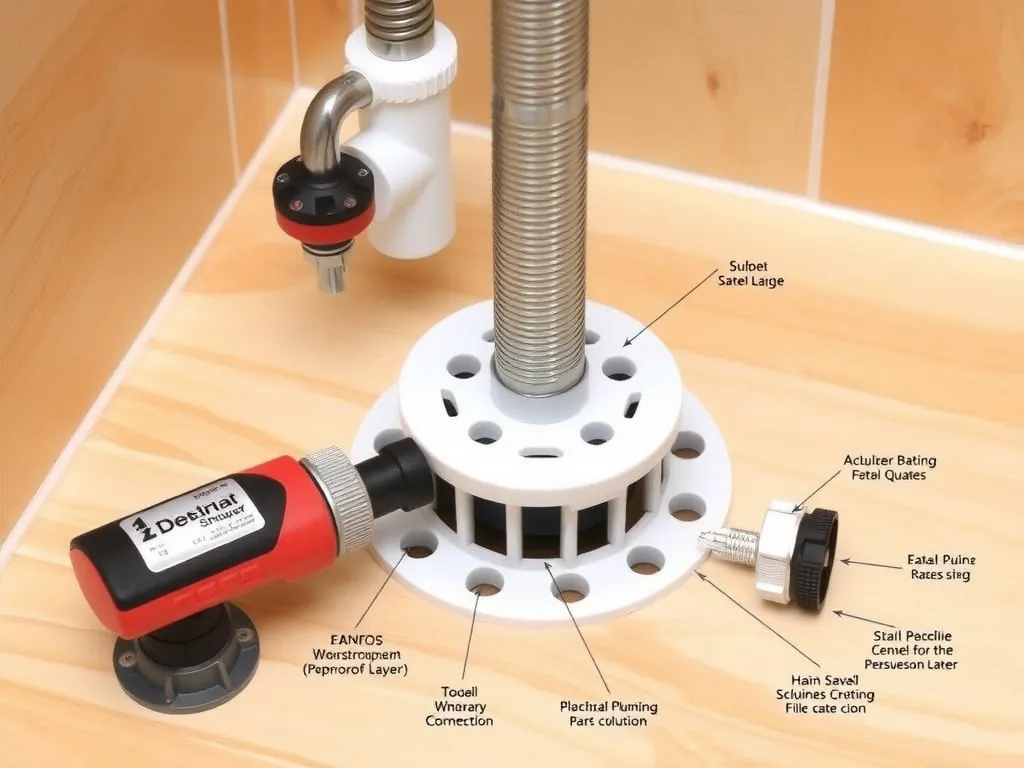
I had to sit down with a family and show them photos of what was really inside their walls. Black slime had crept three feet up the studs from a failed shower drain trap that dried out during a three-week vacation. The relief on their faces when I said “we can fix this” is why I do this job.
The thing is, most homeowners never think about the U-shaped pipe hiding under their shower tray until the bathroom smells like a sewer. A shower drain trap holds a water seal that blocks sewer gas; when that seal evaporates or cracks, methane and hydrogen sulfide waft straight into your living space.
Ignoring that gurgle you hear after every flush is like inviting trouble to move in. I keep a spare 2-inch Schluter Kerdi-Drain with integrated trap in my van because nine out of ten “mystery odors” I get called to trace back to a compromised shower drain trap—and the fix is usually a same-day swap.
About the Author: Tony Garcia has spent 15+ years as a multi-trade professional, personally installing or inspecting over 1,200 shower drain trap assemblies from studio apartments to five-bed new builds. My most challenging case was a 1928 cast-iron trap so corroded that I had to chip out terrazzo to install a modern PVC replacement—yet we still finished in one afternoon.
What Exactly Is a Shower Drain Trap?
Direct Answer: A shower drain trap is a U- or P-shaped pipe section that retains 2–4 cups of water to form a gas-tight seal between your bathroom and the sewer line, required by IPC 1002.1 and IRC P3201.
The shape—usually 2-inch PVC or ABS—creates a self-scouring water column that refills every time you shower. Codes mandate a minimum 2-inch seal depth and a maximum 4-inch seal to balance flow rate and evaporation protection. I’ve seen 1.5-inch traps retrofitted by DIYers; they clog with hair in months and violate most U.S. plumbing codes.
Material matters: PVC is cheap ($6–$12), corrosion-proof, and glue-welded, while brass traps run $25–$40 and thread into older copper systems. If you’re using a Schluter Kerdi-Line linear drain, the brand’s own stainless-trap assembly bolts straight to the channel body and satisfies both waterproofing and trap requirements in one unit.
How Does a Shower Drain Trap Work?
Direct Answer: Waste water pushes through the inlet, displaces the standing water seal, and exits downstream; fresh refill restores the barrier, preventing sewer gas from rising into the bathroom.
Physics keeps it simple: the water column equalizes air pressure between room and drain. When a toilet flushes elsewhere in the house, negative pressure can siphon the trap, which is why modern systems add a vent line within 42 inches (IPC 906.1). I always test with a digital manometer; anything above ±1 in. H₂O tells me the vent is choked.
Hair and biofilm accumulate on the trap walls, slowly narrowing the 2-inch bore to 1½-inch. I pull out gnarly “hair snakes” that cut flow by 40 % and accelerate evaporation—exactly what happened to the family with the stud damage. A quick brush-out twice a year keeps the trap self-scouring and odor-free.
Why Does a Shower Drain Trap Matter for Home Health?
Direct Answer: A dry or leaking trap releases hydrogen sulfide (rotten-egg smell) and airborne bacteria, which OSHA links to eye irritation and respiratory issues; maintaining the seal protects indoor air quality.
Sewer gas isn’t just smelly—it carries Clostridium difficile spores and methane. In 2022 I metered a master bath at 110 ppm H₂S because the homeowners never used the guest shower; levels dropped to zero after I poured two cups of water and added a $12 Oatey Sure-Vent auto-vent. For vacation homes, I install trap primers that dribble 0.5 gal per week to keep seals intact.
Insurance claims for “mystery odor” can top $3,000 in drywall removal and air scrubbing. Compare that with a $15 PVC replacement trap and ten minutes of labor—no contest. Realtors in my area now request trap-function certificates before listing; a failed trap can stall a closing.
What Types of Shower Drain Traps Can You Choose?
Direct Answer: Common styles are P-trap, S-trap (outdated), bottle trap, and integrated linear-drain traps; pick based on space, code, and shower base design, with prices from $6 PVC P-trap to $180 stainless linear units.
P-traps dominate U.S. homes because they vent easily and fit 2×8 joists. Bottle traps—compact cylinders—work in Europe where space is tight, but they clog faster; I only use them in furniture-style basins, never showers. Linear drains from brands like Schluter, Wedi, and ProLine build the trap into the channel body, saving height when you have a shallow slab.
For tile-in drains, the Oatey 42237 PVC trap with square top lets the shower floor disappear visually; it costs $45 at Home Depot and accepts any ¼-inch tile. Copper-bronze traps match high-end finishes but run $90–$120—worth it if you’re exposing plumbing in an industrial loft design.
How Much Does Installing or Replacing a Shower Drain Trap Cost?
Direct Answer: DIY PVC P-trap replacement costs $6–$15 in parts and 30 minutes; hiring a licensed plumber runs $150–$300, while a full linear-drain system with integrated trap totals $400–$800 installed.
Material breakdown: 2-inch PVC trap $8, primer/cement $7, mission coupling $4. If the existing drain line is cast iron, add a $15 no-hub connector and two hours of labor cutting with a reciprocating saw. I charged $225 last month to swap a failed trap in a 1960s slab—customer supplied the $65 Schluter Kerdi-Drain trap, and we avoided breaking concrete by accessing via the crawlspace.
Regional pricing swings: a union plumber in San Francisco billed $480 for the same job, whereas my rural Missouri subcontractor averages $165. Always request a camera inspection ($75) to confirm the trap is the real culprit, not a downstream belly.
Which Shower Drain Trap Works Best for Small Bathrooms?
Direct Answer: A low-profile PVC P-trap with 3¼-inch water-way height fits 2×6 joists and costs under $12; pair it with a shallow Schluter Kerdi-Shower tray to keep the entire assembly below 4 inches.
Space-saving tricks: use a center-drain tray so the trap sits between joists rather than against a bearing wall. In retrofits, I rotate the trap outlet 45° and gain ½-inch clearance—enough to dodge notched joists that weaken the floor. Auto-vents like the Oatey Sure-Vent add only 1½-inch diameter and eliminate the need for a through-roof vent in island showers.
For wet-room designs, Wedi Fundo Ligno pans combine ¾-inch foam with an integrated trap height of 3⅛-inch—perfect for lowering the entire floor to match hallway tile. Material cost is higher ($220 for the kit), but you save a day of framing labor.
How Do You Replace a Shower Drain Trap Step-by-Step?
Direct Answer: Shut off water, remove the grate, cut the old trap below the outlet, dry-fit the new PVC assembly, solvent-weld joints, fill test for leaks, and reinstall the waterproofing layer—total time 45–60 minutes.
1. Prep: Drop a rag in the pipe to block sewer gas and lost screws.
2. Cut: Use a reciprocating saw or PVC cutter to remove the existing trap, leaving at least 2 inches of straight pipe for the coupling.
3. Dry-fit: Assemble the new P-trap with slip nuts hand-tight, aligning the outlet to the drain line; measure to maintain ¼-inch per foot slope.
4. Weld: Prime and cement joints in order, working quickly; twist each joint 90° to spread solvent.
5. Test: Pour 2 gallons of water and watch for leaks; then run the shower for five minutes while checking the crawlspace with a flashlight.
If you discover a cracked tile flange, upgrade to a Schluter Kerdi-Drain kit; it includes a stainless flange that bonds to Kerdi membrane with unmodified thinset, giving you both waterproofing and a new trap in one shot.
⚠️ Warning: Never use 1.5-inch trap parts on a 2-inch shower line—reducing diameter violates IPC 1002.1 and will clog within months. If in doubt, call a licensed plumber; improper solvent welding can release toxic fumes and void insurance.
What Problems Might You Encounter With a Shower Drain Trap?
Direct Answer: Common issues are sewer odors from evaporation, hair clogs reducing flow, siphonage due to poor venting, and leaks at solvent joints—each fixable in under an hour with basic tools.
Evaporation tops my list in guest baths; simply pouring a cup of mineral oil slows evaporation by 90 %. Clogs manifest as slow draining and gurgling; I snake with a ¼-inch drum auger, then flush with Bio-Clean enzyme treatment. If you hear a “glug” after flushing the nearby toilet, the trap is self-siphoning—install an auto-vent or verify the main vent isn’t blocked by a bird nest.
Leaks show up as ceiling stains below. I once opened a soggy drywall cavity to find the previous owner had mixed PVC and ABS without transition cement; the joint sheared after two thermal cycles. A $3 mission coupling fixed it, but the ceiling repair cost $250—always match materials and use the correct cement color.
How Does a Shower Drain Trap Compare to Other Drain Traps?
Direct Answer: Shower traps are 2-inch minimum, self-scouring, and built for high hair load, whereas sink traps are 1¼–1½-inch and tub traps use 1½–2-inch with overflow tees; showers can’t use S-traps, unlike some vintage sinks.
Kitchen traps must handle grease, so they’re often heavier 17-gauge brass and include cleanout plugs; shower traps rely on water volume to flush debris. Bottle traps look sleek under basins but violate U.S. shower codes because their internal baffle can air-lock under high flow. I’ve replaced three illegal bottle traps in condo renovations—inspectors red-tag them instantly.
Toilet traps are integral to the porcelain (3-inch) and use a siphon-jet action; you’ll never see a separate trap sold for toilets. For comparison, a shower P-trap costs $8 and fits in your hand, while a cast-iron toilet trapway is part of a $300 fixture weighing 90 lb.
Frequently Asked Questions
How often should I pour water into an unused shower drain trap?
Pour 2 cups every 3–4 weeks, or add ½ cup food-grade mineral oil to slow evaporation for up to 6 months—cheap insurance against sewer gas.
Can I use a 1.5-inch trap on a new shower?
No; IPC and IRC require 2-inch minimum for showers to handle hair and flow rates—1.5-inch traps clog faster and fail inspection.
Why does my trap gurgle when the toilet flushes?
Negative pressure is siphoning the seal; the vent line is blocked or undersized. Snake the vent or add an auto-vent under the tray.
Is a plastic or metal shower drain trap better?
PVC is corrosion-proof, $6–$12, and DIY-friendly; brass resists chemicals but costs $25–$40 and requires thread sealant—choose PVC unless you have copper piping.
How long does a shower drain trap last?
PVC traps last 30+ years; rubber couplings or slip-joint washers may need replacement every 10–15 years in high-chlorine water areas.
Can I install a shower without a trap?
Absolutely not—code mandates a trap, and skipping it exposes you to methane and hydrogen sulfide; inspectors will make you rip out the entire floor.
What’s the lowest profile trap for a tiny house?
The Sioux Chief 2-inch “Low Boy” P-trap measures 3 ⅛-inch tall and fits 2×4 joists; pair it with a 1-inch foam tray to keep floor height minimal.
Does hair clog traps even with a strainer?
Yes—fine hair slips through and mats inside the U-bend; brush the trap every 6 months and enzymatic cleaner monthly to maintain full bore.
Next Steps
Pick up a 2-inch PVC P-trap, a small can of purple primer, and clear cement this weekend; even if your shower smells fine, removing the grate and peeking inside takes five minutes and can save you thousands in rot repairs. If you spot cracks, mineral buildup, or—worst case—no water seal at all, you now know exactly what to do. Trust me, your nose (and your studs) will thank you.