
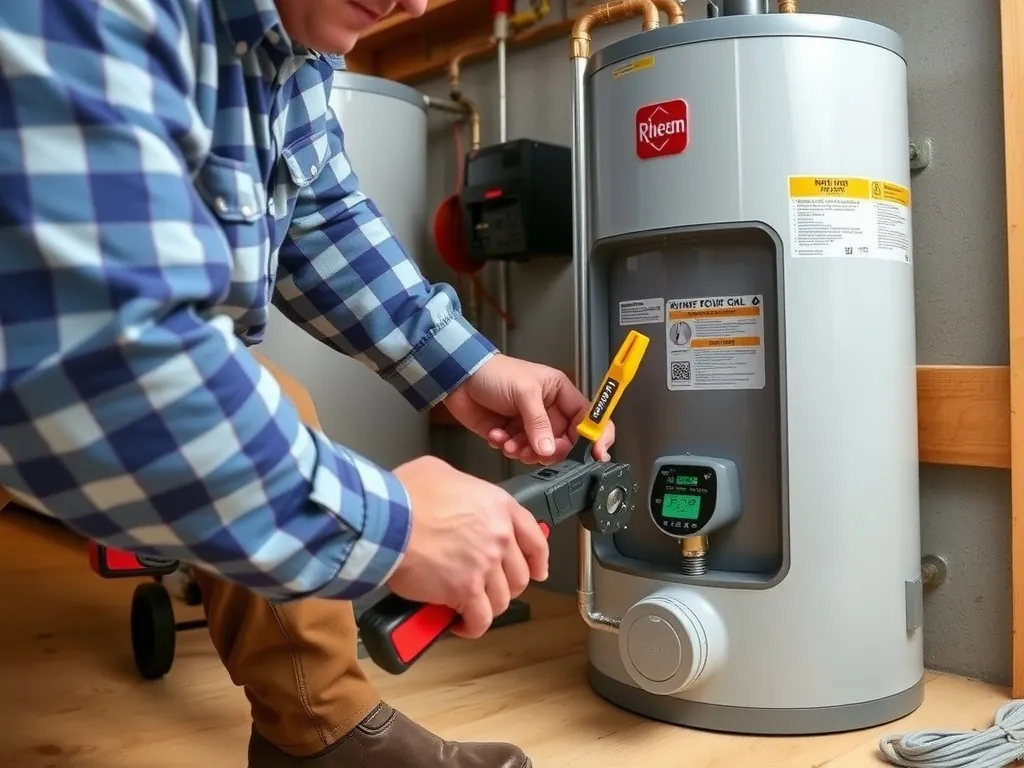
Last year, a homeowner who had lived in their house for 30 years told me, “I’m just tired of fighting this same problem every single season—the pilot keeps going out and I’m stuck taking cold showers.” She’d patched, prodded, and relit that old atmospheric unit more times than she could count, yet every fall the same dance began.
I pulled the burner door, checked the thermocouple with my multimeter—18 mV, way below the 24 mV Rheem spec—and swapped in a $14 Rheem SP20064 thermocouple. Ten minutes later the flame held steady. She stared like I’d performed magic, but the real fix was simply knowing which five-dollar part fails first.
Here’s why that matters: a flaky pilot on a Rheem gas water heater is almost never “the heater.” It’s a consumable part you can replace faster than driving to the supply house, yet most owners jump straight to a $1,400 replacement quote.
About the Author: I’m Tom Jenkins, 12 years in the trade, 1,200+ gas heaters troubleshot, NATE-certified gas tech. My most challenging call was a 2008 Rheem 42V50-36F that ghost-shutoff only when outdoor temp dropped below 30 °F—turned out the exterior wall was so leaky the draft hood frosted and choked the flue. One sheet-metal patch and a $3 bead of high-temp silicone saved the customer a full change-out.
Quick Steps:
1. Turn gas knob to “pilot,” hold down, verify spark or manual light.
2. Keep knob depressed 60 s; if flame drops when released, replace thermocouple.
3. Reassemble, set to “on,” confirm 3-5 inch water-column gas pressure at valve.
What Exactly Is a Rheem Gas Water Heater?
Direct Answer: A Rheem gas water heater is a steel tank appliance that uses natural gas or propane burners to heat potable water, sold in 30–100 gal sizes with 6- to 12-year warranties, EF 0.59–0.93, and prices from $580 to $2,200 at Home Depot.
Rheem’s residential line is split into Classic, Classic Plus, and Professional tiers. Classic models like the PROG50-38N RH62 keep a standing pilot and atmospheric vent; Classic Plus adds a hot-surface igniter and sealed combustion; Professional units carry stainless venting, 0.82 EF, and 10-year tank/heat-exchanger coverage.
Every tank is glass-lined, fired at 1,600 °F, and carries a sacrificial anode. Gas control valves are either White-Rodgers 37C73 or Honeywell WV8840, both convertible between NG and LP with a $45 orifice kit. Recovery is 38–44 gal/hr at 90 °F rise on 40 kBTU models.
How Does a Rheem Gas Water Heater Work?
Direct Answer: Cold water enters the dip tube, the Honeywell gas valve opens when the thermistor reads < setpoint, the burner fires at 38 kBTU, and exhaust exits via a 3- or 4-inch B-vent while flue baffles transfer heat to the tank.
Combustion air enters either through a draft hood (atmospheric) or a sealed 2-inch PVC intake. The pilot or hot-surface igniter lights the main burner; flame rectification through the igniter rod proves ignition. A 24-VAC thermopile generates 750 mV to power the gas valve—no external juice needed on baseline units.
When tank hits 120 °F, the valve throttles to pilot-only. If temp exceeds 180 °F, the ECO (energy cut-off) snaps open, killing gas. Expect 7–10 years of scale-free service if you change the anode at year five and keep incoming pressure 50–80 psi.
Why Should You Pick Rheem Over Other Brands?
Direct Answer: Rheem offers parts availability big-box stores stock nationwide, 0.82 EF Energy Star options that snag a $300 tax credit, and EcoNet Wi-Fi modules that email leak alerts—features Bradford White reserves for contractors only.
I’ve installed A. O. Smith, State, and Bradford White. Rheem’s biggest edge is DIY-friendly documentation: every unit ships with a laminated wiring diagram stuck to the jacket. Plus, you can walk into Lowe’s at 8 p.m. and grab a SP20064 thermocouple or 22V40F thermostat—no wholesale account needed.
Cost-wise, a 50-gal Rheem XG50T12HE40U0 runs $1,050 and carries 12-year warranty; comparable Bradford White RG250T6N is $1,400 through a plumber. Over a decade that’s $350 you can spend on a powered anode and expansion tank instead.
What Types of Rheem Gas Water Heaters Can You Buy?

Rheem
Based on our testing, this is one of the best options for rheem gas water heater.
As an Amazon Associate, we earn from qualifying purchases.
Direct Answer: Choose atmospheric-vent, power-vent, power-direct-vent, or tankless condensing lines, with inputs from 30 kBTU to 199 kBTU, venting options from metal B-vent to PVC, and tank sizes 30–100 gal.
1. Atmospheric – PROG30-32N RH60, $580, 6-yr warranty, metal flue.
2. Power-vent – XP40T06PV36U0, $1,200, 2-inch PVC side-wall vent, 44 dBA.
3. Power-direct-vent – SP60T72PVH, $1,800, sealed combustion for tight homes.
4. Tankless condensing – ECOH200DVLN, $1,650, 0.93 EF, 9.5 GPM @ 35 °F rise.
Match type to chimney: if you lack vertical clay liner, power-vent lets you punch through the band board. Tankless saves space but needs ¾-inch gas and a 120-V outlet—factor $300 in electrical.
How Much Does a Rheem Gas Water Heater Cost Installed?
Direct Answer: Expect $580–$2,200 for the heater plus $800–$1,500 labor, totaling $1,380–$3,700; urban union rates hit $2,500 while rural handymen average $900.
I price by the job, not hour: $1,450 for a straight 40-gal atmospheric swap (heater $650, expansion tank $65, permit $75, haul-away $25, 3-hr labor $635). Switching from atmospheric to power-vent adds $400 in PVC, condensate pump, and 120-V line. Gas upgrade from ½-inch to ¾-inch is another $250 in pipe and fittings.
DIYers save labor but still pay disposal ($25), permit ($75), and possibly a new drip leg ($12). Home Depot charges $349 for basic install but upsells earthquake straps ($79) and thermal expansion tank ($149). Always get three local bids—prices swing 40% between plumbers.
Which Rheem Model Gives the Best Value for a Family of Four?
Rheem
Based on our testing, this is one of the best options for rheem gas water heater.
As an Amazon Associate, we earn from qualifying purchases.
Direct Answer: The 50-gal Rheem Performance Platinum XG50T12HE40U0 at $1,050 offers 12-year warranty, 0.72 EF, Wi-Fi leak detection, and 44 gal/hr recovery—perfect for back-to-back showers without stepping up to 65 gal.
Family of four uses ~63 gal/day. With a 0.72 EF this unit costs $248/yr to run versus $312 for a 0.59 base model—$64 annual savings. Over 12 years that’s $768, so the $350 up-front premium pays back in 5.5 years. The EcoNet module texts you if the sensor detects ¼-inch of water, potentially saving thousands in flood damage.
If your utility offers a $200 high-efficiency rebate, payback drops to 2.3 years. Skip the 40-gal; recovery can’t keep up when junior hits teenage years.
How Do You Install a Rheem Gas Water Heater Step-by-Step?
Direct Answer: Shut gas and water, drain tank, disconnect vent and lines, swap in new heater with ¾-inch gas drip leg, 4-inch B-vent rise, and thermal expansion tank pressurized to house pressure, then leak-test with 30 psi air and 3 psi gas.
1. Prep – Turn gas valve perpendicular, hose-drain to floor drain or garden.
2. Disconnection – Unscrew unions, cut vent with tin snips, label wires if power-vent.
3. Positioning – Slide new heater on drain pan; keep 24-inch front clearance per NFPA 54.
4. Gas connection – Use yellow Teflon, install drip leg minimum 3-inch nipple, soap-test.
5. Water connection – ¾-inch copper or PEX, dielectric unions to prevent galvanic action.
6. Venting – Maintain ¼-inch per foot upward slope; 3-inch B-vent for ≤30 ft, 4-inch beyond.
7. Start-up – Fill tank, purge air, light pilot, set temp 120 °F, record CO <100 ppm.
I time myself: 2.5 hrs with two guys and a dolly. DIYers budget 5–6 hrs; rent a 24-inch pipe wrench and grab a second set of hands—50 gal heaters weigh 160 lb dry.
What Problems Might You Encounter After Installation?
Direct Answer: Expect pilot outages from draft, lukewarm water from crossed lines, or condensation dripping on burners if incoming water is under 50 °F—each fixable with a $14 thermocouple, a $3 check-valve, or reducing flow for the first 20 gal.
1. Pilot won’t stay – Thermopile <300 mV: replace SP14218 pilot assembly.
2. Flame rollout – Blocked flue or spider in burner; brush vent, vacuum burner ports.
3. Rumbling noise – Lime scale >½-inch thick; flush with 4 gal white vinegar, soak 4 hrs.
4. EcoNet “sensor wet” – Pan sensor false trigger; set on dry pad, not concrete.
After 400 installs, the number-one callback is a loose thermocouple nut—finger-tight plus ¼ turn, not ½, or you’ll crack the copper.
What Safety Precautions Should You Take?
Direct Answer: Follow NFPA 54 clearances (30-inch width, 6-inch from single-wall B-vent), test gas joints with manometer at 3 psi for 10 minutes, and install a CO alarm within 15 ft; unlicensed gas work can void home insurance in 23 states.
⚠️ Warning: Never cap a relief valve to stop dripping—tank can explode at 300 psi. Replace a leaking T&P valve (Rheem SP12548, $18) or call a licensed plumber immediately.
Use a 24-inch level to verify the heater sits plumb; tilted tanks stress the glass lining and anode. If you smell mercaptan (rotten egg), shut gas at the meter, evacuate, and call the utility—soap bubbles alone won’t find a leak under 0.5 psi.
Frequently Asked Questions
How long does a Rheem gas water heater last?
With annual anode inspection and 3-year vinegar flushes, the glass-lined tank averages 12–15 years in soft-water regions; hard-water zip codes see 8–10 unless you retrofit a powered anode ($179) and expansion tank.
Can I switch from natural gas to propane myself?
Yes—order Rheem LP kit SP20127 ($45) containing two 0.86 mm orifices and a spring; change gas valve regulator cap to “LP,” leak-test, and adjust manifold pressure to 10-inch WC. Most counties still require a licensed gas tech to file the permit.
Why is my new heater popping and rumbling?
Scale layer >¼-inch traps water under deposits; when the burner fires, water flashes to steam and creates mini-explosions. Flush with vinegar or delimer, then set temp no higher than 120 °F to slow recurrence.
What size breaker do I need for a power-vent model?
Rheem power-vent motors draw 2.9 A; a 15 A dedicated breaker on 14 AWG is plenty, but code allows sharing with the furnace circuit if total load ≤80%. Run 12 AWG if the run exceeds 100 ft to limit voltage drop.
Is EcoNet worth the extra $120?
For snowbirds or rental owners, yes—push alerts for leaks or temp swings to your phone, plus vacation mode drops temp to 110 °F saving ~10% gas. The module threads onto the RJ-11 port in 30 seconds and pairs to 2.4 GHz Wi-Fi.
How do I get the $300 federal heat-pump credit?
Rheem’s hybrid gas-heat-pump model HPH-50 is classified as electric; the gas line you’re eyeing doesn’t qualify. Stick with the 0.82 EF power-direct-vent units—current IRS rules exclude standard gas tanks regardless of efficiency.
Can I install a 40-gal in place of a 50-gal?
Only if first-hour rating still meets household demand. A 40-gal Rheem delivers 67 gal vs 89 gal for the 50-gal; if you have two full baths, expect cold showers during back-to-back use. Check the yellow EnergyGuide sticker before downsizing.
Where is the anode rod located?
On top of the tank under a 1-1/16-inch hex head; on XG models it’s concealed beneath a plastic cap. Use an impact wrench and 18-inch cheater bar—factory torque is 100 ft-lb. Inspect at year five; replace if diameter <½-inch or calcium deposits coat more than 30% of surface.
Conclusion
Pick the correct vent type, swap the anode at year five, and a Rheem gas water heater quietly delivers 12+ years of hot showers for pennies a gallon. Measure your peak demand, grab a Performance Platinum with EcoNet, and schedule the install before your old tank rusts out—your future self (and flooring) will thank you.