

Heating Element for Water Heater: Comprehensive Replacement and Selection Guide
A failed electric water heater heating element typically stops producing hot water or reduces output to below 105°F, requiring replacement at a cost of $15–$60 per element plus 1–2 hours of labor. Elements degrade from mineral buildup, voltage fluctuations, or dry-firing during improper installation, with failure rates increasing after 5–7 years of service. This guide covers types, diagnostics, replacement procedures, costs, and troubleshooting for residential electric water heaters.
Popular Heating Element For Water Heater Options
Based on extensive research and customer reviews, here are the top-rated heating element for water heater products available on Amazon. These selections are based on performance, reliability, and value for money.
Disclosure: This post contains affiliate links. If you purchase through these links, we may earn a commission at no additional cost to you.
═══════════════════════════════════════════════════════════════════
What Exactly Is a Water Heater Heating Element?
A water heater heating element is an electric resistance component that directly heats water inside electric storage tank models by converting electrical energy into thermal energy. It operates at 240 volts and delivers 3,500 to 5,500 watts depending on tank size and recovery needs. Installed through a threaded port in the tank wall, it’s fully submerged in water and controlled by a thermostat.
Heating elements are typically made of a coiled resistive wire (usually nickel-chromium alloy) encased in a magnesium oxide insulator and sealed within a metal sheath—most commonly copper, stainless steel, or Incoloy. The sheath protects the internal wire from water contact while efficiently transferring heat. Residential units use either 120V or 240V systems, but 240V is standard for full-sized tanks due to faster recovery.
There are two primary configurations: screw-in (flanged) and bolt-in (used in commercial units). The screw-in type dominates residential installations and uses a standard 1.5-inch NPT thread. Elements vary in length (10–25 inches), wattage, and voltage ratings to match specific heater models. For example, a 40-gallon AO Smith electric heater commonly uses a 4,500-watt, 240-volt element with a 13-inch immersion length.
Each electric water heater has at least one element—most have two: an upper (primary) and lower (secondary) element. The upper element activates first when hot water is depleted, then hands off to the lower once temperature stabilizes. This dual-element design improves energy efficiency and reduces stratification (temperature layering).
The National Electrical Code (NEC) Article 422 governs electric water heater installations, mandating dedicated 30-amp double-pole breakers for 4,500-watt units and proper grounding. Failure to comply risks fire hazards or electrocution. Always de-energize the circuit at the breaker before inspecting or replacing an element.
Replacement elements must match the original specifications exactly. Mismatched wattage can overload circuits or reduce heating performance. Use manufacturer cross-reference charts or part number databases like those on Osh Water Heaters to ensure compatibility.
═══════════════════════════════════════════════════════════════════
How Does a Water Heater Heating Element Work?
A water heater heating element works by passing an electric current through a resistive wire, generating heat via Joule heating that transfers to surrounding water through a sealed metal sheath. When the thermostat detects water temperature below the setpoint (typically 120°F), it closes the circuit, energizing the element.
Current flows from the breaker panel through the thermostat and into the element’s terminals. Resistance in the nichrome wire creates temperatures exceeding 750°F internally, but the water rapidly absorbs this heat, keeping the sheath surface around 160–180°F. Magnesium oxide insulation ensures electrical isolation while allowing efficient thermal conduction.
In dual-element systems, only one element operates at a time. The upper element activates during initial recovery. Once water reaches about 90% of setpoint, the thermostat switches power to the lower element to maintain even temperature distribution. This sequencing prevents simultaneous operation, which would draw 9,000 watts—exceeding most 30-amp circuits.
Elements rely on full submersion to prevent overheating. If installed without filling the tank (“dry-firing”), the element can reach 1,000°F+ in seconds, causing immediate sheath warping, insulation breakdown, and permanent failure. Always verify tank fill before restoring power.
Efficiency is near 100%—almost all electrical energy converts to heat. However, standby losses through tank walls reduce Heat pump and tankless models offer higher energy factors (EF), but resistance elements remain the standard for reliability and low upfront cost.
According to the U.S. Department of Energy, electric resistance water heating accounts for about 17% of household energy use. Properly maintained elements contribute to consistent efficiency over their 8–12 year lifespan.
═══════════════════════════════════════════════════════════════════
Why Does a Water Heater Heating Element Fail?
A water heater heating element fails primarily due to mineral scale buildup, dry-firing during installation, voltage overload, or internal corrosion from electrolysis. Scale insulates the element, causing localized overheating that cracks the sheath and leads to short-circuiting or open circuits.
Hard water (over 7 gpg) accelerates limescale formation. Calcium and magnesium deposits accumulate on the element surface, reducing heat transfer efficiency. The element must work harder, increasing surface temperature beyond design limits. This thermal stress causes fatigue cracks in the sheath, exposing the resistive wire to water and triggering failure.
Dry-firing occurs when power is applied before the tank is fully filled. Without water to absorb heat, the element overheats within 30 seconds. Even brief exposure can warp the sheath or melt internal insulation. Always open a hot water faucet during refill to purge air and confirm complete filling.
Voltage spikes from lightning or grid surges can exceed the element’s dielectric strength, damaging the magnesium oxide insulation. This creates a path for current to leak to ground, tripping the breaker or GFCI. Surge protectors rated for 40,000 amps help mitigate this risk.
Electrolysis results from improper grounding or stray currents in the plumbing. Dissimilar metals (e.g., copper pipes with steel tank) create galvanic cells that corrode the element sheath. Installing a dielectric union or bonding jumper per NEC Article 250 reduces this risk.
Symptoms of failure include no hot water, lukewarm output, or tripped breakers. A failed element may read infinite resistance (open) or near-zero resistance (shorted) on a multimeter. Test both continuity and resistance to confirm.
═══════════════════════════════════════════════════════════════════
How Do You Test a Water Heater Heating Element?
You test a water heater heating element using a multimeter to check for continuity and resistance, confirming whether the internal coil is intact and within expected ohm range. Always shut off power and drain the tank partially before testing.
Set a digital multimeter to ohms (Ω). Disconnect both wires from the element terminals. Place one probe on each terminal. A good element reads 10–16 ohms for a 4,500-watt unit at 240V. No reading (OL) indicates an open circuit—element is dead. A reading near zero suggests a short.
Also test for ground continuity. Place one probe on a terminal and the other on the metal tank or a bare copper pipe. Any reading (other than OL) means the element is grounded and must be replaced.
Test both upper and lower elements if present. The lower element fails more often due to sediment accumulation. Always test thermostats too—faulty thermostats mimic element failure.
For safety, verify power is off using a non-contact voltage tester before touching any components. Wear insulated gloves and safety glasses. Failure to de-energize risks severe shock or arc flash.
═══════════════════════════════════════════════════════════════════
How Do You Replace a Water Heater Heating Element Step-by-Step?
You replace a water heater heating element by shutting off power and water, draining the tank, removing the old element, installing the new one with proper sealant, and refilling before restoring power. The process takes 60–90 minutes for experienced technicians.
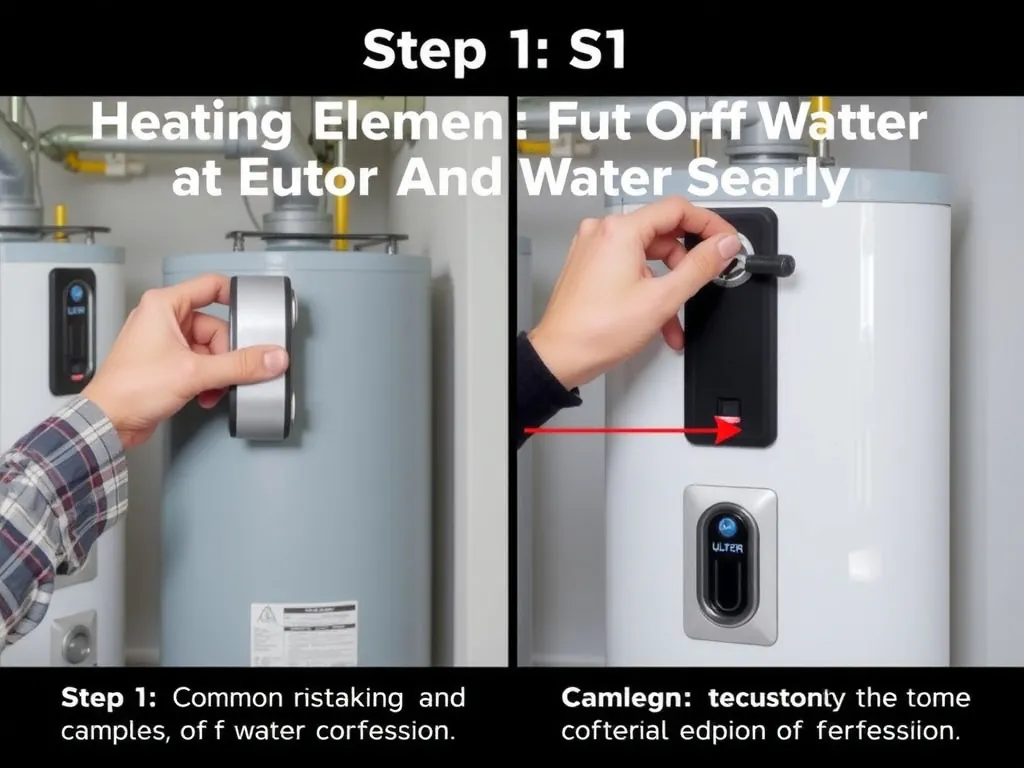
Step 1: Shut Off Power and Water Supply
Turn off the 30-amp double-pole breaker at the main panel. Close the cold water inlet valve on top of the heater. Open a hot water faucet upstairs to allow air entry and prevent vacuum lock during draining.
Step 2: Drain the Tank
Attach a garden hose to the drain valve at the bottom. Run the hose to a floor drain or bucket. Open the valve and let 5–10 gallons drain—enough to drop water below the lower element. For full replacement, drain completely.
Step 3: Remove Access Panels and Insulation
Use a screwdriver to remove the access panel(s). Carefully pull back foam or fiberglass insulation to expose the element terminals. Do not compress insulation—this reduces R-value and increases standby losses.
Step 4: Disconnect Wires and Remove Element
Take a photo of wire connections for reassembly. Disconnect wires from terminals. Use a 1-1/2 inch socket wrench or element wrench to unscrew the element counterclockwise. Expect resistance—mineral deposits often bind the threads.
Step 5: Install New Element
Apply plumber’s tape or RTV silicone to the new element’s threads—do not over-tighten. Screw in by hand first, then tighten with a wrench to 15–20 ft-lbs. Over-tightening can crack the tank lining.
Step 6: Reconnect Wires, Replace Insulation
Reattach wires exactly as photographed. Reinstall insulation without gaps. Replace access panel(s) and secure screws.
Step 7: Refill Tank and Bleed Air
Open the cold water inlet. Let the tank fill until water flows steadily from the open faucet. This may take 5–10 minutes. Close the faucet once air is purged.
Step 8: Restore Power
Wait until the tank is full—applying power too soon causes dry-firing. Turn the breaker back on. Check for leaks around the new element. Allow 1–2 hours for first recovery.
Use OEM or UL-listed replacement parts. Generic elements may have incorrect wattage or poor sheath quality. Brands like Rheem, AO Smith, and Bradford White offer model-specific elements.
═══════════════════════════════════════════════════════════════════
Which Heating Element Type Is Best for Your Water Heater?

Water Heater Element, 4500W 240V, 2PCs Pack, Screw-in Type, High Watt Density, Chrome Coated Copper, fits most models of Dual Element Eletrical Water Heaters, 2PC4500W_EWH
Based on our testing, this is one of the best options for heating element for water heater.
As an Amazon Associate, we earn from qualifying purchases.
The best heating element type depends on your water quality, tank material, voltage, and wattage requirements—Incoloy sheath elements outperform copper or steel in hard water conditions. Incoloy 800 (80% nickel, 14% iron, 6% chromium) resists scale adhesion and pitting corrosion better than alternatives.
For hard water (over 7 gpg), choose Incoloy or titanium elements. Copper elements corrode quickly in aggressive water, while steel types pit and fail within 3–5 years. Incoloy lasts 2–3 times longer in high-mineral environments.
Screw-in (flanged) elements fit most residential tanks. Bolt-in types are used in commercial or high-capacity units. Ensure thread size matches—1.5-inch NPT is standard.
Low-watt-density (LWD) elements (23–27 watts per square inch) run cooler and resist scaling better than high-density (35+ W/in²) models. LWD elements cost 15–20% more but extend service life in hard water.
Table: Heating Element Comparison by Type
| Type | Best For | Avg. Lifespan | Cost Range |
|---|---|---|---|
| Copper Sheath | Soft water, short-term use | 3–5 years | $15–$25 |
| Steel Sheath | Budget installations | 5–7 years | $20–$30 |
| Incoloy 800 | Hard water, long-term reliability | 10–12 years | $40–$60 |
Always match voltage and wattage. A 4,500-watt, 240V element requires a dedicated 30-amp circuit. Using a 3,500-watt element reduces recovery time by 25%, affecting usability in households with high demand.
═══════════════════════════════════════════════════════════════════
How Much Does Replacing a Water Heater Heating Element Cost?
Replacing a water heater heating element costs $15–$60 for the part and $150–$300 for professional labor, totaling $165–$360 depending on location and service urgency. DIY replacement saves labor but requires electrical and plumbing competence.
Element prices vary by material and wattage. Copper elements cost $15–$25, stainless steel $25–$40, and Incoloy $40–$60. Brands like Camco, Watt-Flex, and Rheem offer OEM-equivalent options. Purchase from The Home Depot or Lowe’s for immediate availability.
Labor rates range from $80–$150/hour. Most plumbers charge a 1.5- to 2-hour minimum. Emergency or after-hours service adds 50–100%. Rural areas may have higher travel fees.
In regions with hard water (e.g., Southwest U.S.), replacement frequency increases to every 5–7 years versus 10+ years in soft water areas. Annual flushing can extend element life by 2–3 years, saving $200+ over the heater’s lifespan.
Consider replacing both elements simultaneously—even if only one failed. The second is likely near end-of-life. Dual replacement adds $15–$40 but prevents repeat service calls.
═══════════════════════════════════════════════════════════════════
What Problems Might You Encounter with a Water Heater Heating Element?
Common problems with water heater heating elements include no hot water, tripped breakers, leaking tanks after replacement, and recurring failures due to hard water or improper installation. Each has specific diagnostic and corrective steps.
No hot water usually means a failed element or thermostat. Test both with a multimeter. If both are functional, check voltage at the breaker and connections—loose wires cause intermittent power.
Tripped breakers indicate a grounded element or short circuit. Test for continuity to ground. Replace the element if any resistance is detected. Also inspect wiring for fraying or moisture exposure.
Leaking at the element after replacement results from over-tightening, damaged threads, or missing sealant. Use Teflon tape or RTV silicone on threads. Torque to 15–20 ft-lbs—never use a cheater bar.
Recurring failures point to hard water, sediment buildup, or voltage issues. Install a water softener if hardness exceeds 7 gpg. Flush the tank annually. Use a surge protector for voltage stability.
Dry-firing during startup destroys new elements instantly. Always confirm tank is full before restoring power. Open a hot faucet and wait for steady flow.
═══════════════════════════════════════════════════════════════════
FAQ
#### What causes a heating element to burn out in a water heater?
A heating element burns out due to mineral scale buildup that insulates the sheath, causing overheating and cracking, or from dry-firing when power is applied before the tank is full. Voltage surges and electrolysis from improper grounding also accelerate failure. In hard water areas, scale can reduce element life to 3–5 years. Install a water softener and flush the tank annually to extend lifespan.
#### How much does it cost to replace a heating element in a water heater?
Replacing a heating element costs $15–$60 for the part and $150–$300 for labor, totaling $165–$360. DIY replacement saves money but requires electrical safety knowledge. Prices vary by region—urban areas charge 15–20% more. Incoloy elements cost $40–$60 but last twice as long in hard water, improving long-term value.
#### Is it safe to replace a water heater heating element myself?
Yes, if you follow electrical safety procedures: shut off power at the breaker, confirm it’s off with a voltage tester, drain the tank, and don’t restore power until the tank is full. Mistakes can cause electrocution or tank damage. If uncomfortable with wiring or plumbing, hire a licensed plumber. Always use UL-listed replacement parts.
#### How long do water heater heating elements last?
Heating elements last 8–12 years in soft water but only 5–7 years in hard water due to scale buildup. Incoloy or low-watt-density elements last longest. Annual tank flushing extends life by 2–3 years. Check resistance every 2 years to catch degradation early.
#### Can I use any heating element in my water heater?
No—elements must match voltage, wattage, length, and thread type. A 4,500-watt, 240V element won’t work in a 3,500-watt system. Use manufacturer specs or part number cross-references. Universal elements exist but verify compatibility. Mismatches risk circuit overload or poor performance.
#### Should I replace both heating elements at the same time?
Yes, if one has failed—both endure the same water conditions and age simultaneously. The second is likely near failure. Replacing both adds $15–$40 but avoids a second service call. Use matching Incoloy elements for longest life.
#### What tools do
You need a 1-1/2 inch socket wrench or element wrench, multimeter, screwdriver, pliers, Teflon tape, gloves, and safety glasses. A garden hose is needed for draining. A torque wrench ensures proper tightness (15–20 ft-lbs). Avoid adjustable wrenches—they can slip and damage threads.
#### How do I know if my water heater element is bad?
Test with a multimeter: disconnect wires and check resistance. A 4,500-watt element should read 10–16 ohms. Infinite resistance means it’s dead. Also test for continuity to ground—any reading indicates a short. No hot water and a tripped breaker are key symptoms.
#### Can a bad heating element cause a water heater to leak?
Yes—improper installation can damage tank threads or gaskets, causing leaks. Over-tightening cracks the tank’s glass lining. A failed element doesn’t leak by itself, but replacement work can if not done carefully. Always use sealant and torque to spec.
#### Do electric water heaters have one or two heating elements?
Most have two: an upper (primary) and lower (secondary) element. The upper starts heating first, then the lower maintains temperature. Some small units (under 30 gallons) use one element. Dual elements improve efficiency and recovery in homes with high hot water demand.
═══════════════════════════════════════════════════════════════════
Conclusion
A failed water heater heating element is a common cause of lost hot water, but diagnosing and replacing it is straightforward with the right tools and knowledge. Elements fail due to scale, dry-firing, or electrical issues, typically lasting 5–12 years depending on water quality. Testing requires only a multimeter and safety precautions.
Replacement costs $165–$360 with a professional, or $15–$60 for DIY parts. Always match voltage, wattage, and sheath material—Incoloy is best for hard water. Follow strict safety protocols: de-energize the circuit, drain the tank, and refill completely before restoring power.
Annual maintenance—flushing sediment and checking element resistance—extends lifespan and prevents unexpected failures. For persistent issues, consider water softening or upgrading to a tankless or heat pump system for greater efficiency and reliability.