
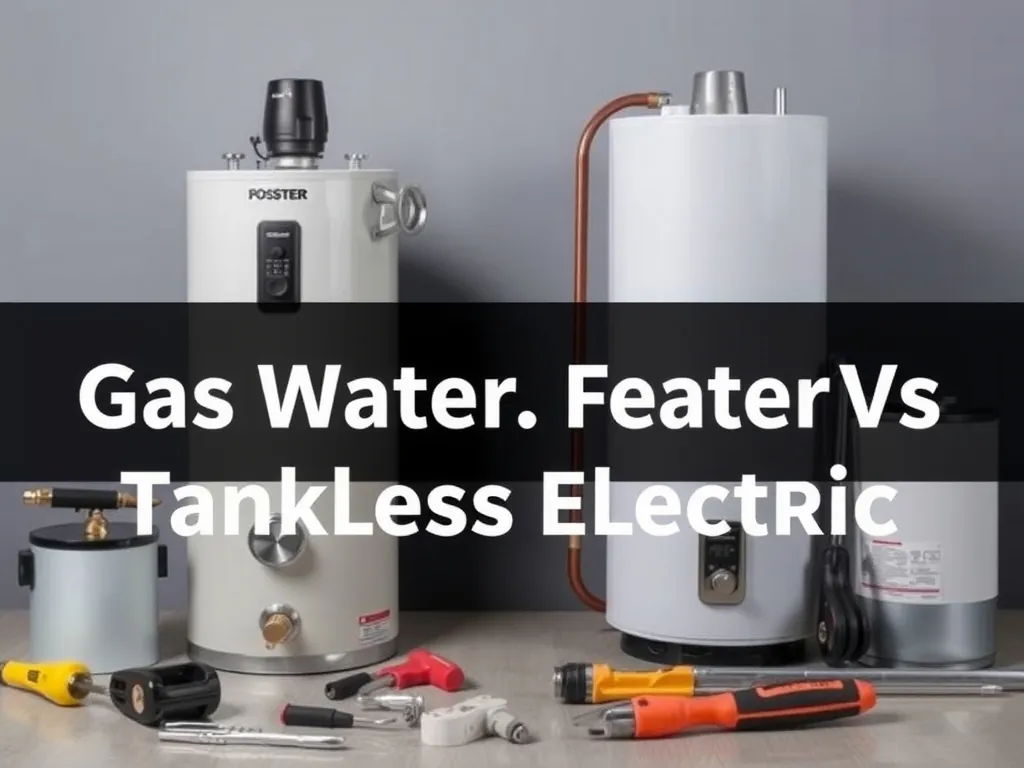
Gas Water Heater vs Tankless Electric: Complete Performance, Cost, and Installation Comparison
Gas water heaters deliver 30-50 gallons of stored hot water at 40,000-75,000 BTU/hr while tankless electric units provide 2-5 GPM endless hot water using 18-36 kW heating elements. Gas units cost $300-600 upfront but consume $200-400 annually in fuel, while tankless electric models cost $500-1,200 initially but use $300-600 yearly in electricity. This guide compares efficiency, installation requirements, operating costs, and performance differences to determine the best option for your home.
What Exactly Is a Gas Water Heater and How Does It Work?
A gas water heater stores 30-80 gallons of water in an insulated tank and heats it continuously using a gas burner located beneath the tank. The unit maintains water temperature between 120-140°F by cycling the burner on/off via a thermostat, consuming energy even when no hot water is used. Cold water enters through a dip tube at the tank bottom, gets heated by the burner, and rises to the top where it’s drawn through the hot water outlet when taps open.
The combustion process requires proper venting through a flue pipe that extends through the roof, drawing air from the surrounding area or through dedicated combustion air ducts. Modern gas water heaters include safety features like a thermocouple that shuts off gas if the pilot light extinguishes, a temperature and pressure relief valve preventing tank rupture, and sealed combustion chambers on power-vent models. The standing pilot light or electronic ignition system provides consistent heating capability regardless of electrical power availability.
What Is a Tankless Electric Water Heater and How Does It Operate?
A tankless electric water heater contains powerful heating elements ranging from 18-36 kW that activate only when hot water flows through the unit. The system detects water flow via a sensor, instantly energizing heating elements that raise water temperature as it passes through copper or stainless steel heat exchangers. This on-demand approach eliminates standby heat losses since no water is stored, but requires substantial electrical capacity to achieve temperature rise rates of 45-65°F at flow rates of 2-5 gallons per minute.
The unit’s control board modulates power to heating elements based on incoming water temperature and desired output temperature, typically adjustable between 100-140°F. Installation requires dedicated 240V electrical circuits with 60-150 amp breakers, often necessitating electrical service upgrades for older homes. Advanced models feature self-modulating technology that adjusts power consumption based on demand, digital temperature displays, and diagnostic systems that alert users to maintenance needs or component failures.
How Do Installation Requirements Compare Between Gas and Tankless Electric?
Gas water heater installation requires gas line connections sized at 1/2″ to 3/4″ depending on BTU rating, proper venting through 3-4″ diameter metal flue pipes extending above roofline, and combustion air supply meeting code requirements. The installation area needs 6-18 inches clearance from combustible materials, level floor capable of supporting 400-600 pounds when full, and access for maintenance. Professional installation typically takes 2-4 hours and costs $500-1,500 including permits and inspection.
Tankless electric installation demands 240V electrical service with dedicated circuits, often requiring electrical panel upgrades from 100-amp to 200-amp service for whole-house units. Electricians must run 6-2 AWG copper wire through conduit, install double-pole breakers sized for unit amperage, and ensure proper grounding. The compact wall-mount design saves space but requires 12-18 inches clearance for service access and must be protected from freezing temperatures. Installation complexity makes professional installation essential, costing $800-2,000 including electrical upgrades.
What Are the Energy Efficiency Differences Between These Systems?
Gas water heaters achieve 60-70% efficiency for standard models and 80-90% for Energy Star condensing units, with standby losses accounting for 15-25% of total energy consumption. The constant heating cycle maintains tank temperature regardless of usage, resulting in 200-400 therms annual consumption for typical households. Recovery efficiency varies by model but generally delivers 30-40 gallons per hour at 90°F rise, making them suitable for simultaneous multiple fixture use.
Tankless electric units reach 99% heating efficiency since energy converts directly to heat without combustion losses or standby heating. However, electrical generation and transmission losses at power plants reduce These units consume 0 kWh when idle but require 18-36 kW during operation, potentially creating demand charges from utilities. Actual efficiency depends on usage patterns, with savings most significant in households using less than 41 gallons daily.
How Much Do Gas Water Heaters Cost to Purchase and Operate?

Ranein Natural Gas Tankless Water Heater, Indoor Max 4.3 GPM, 100,000 BTU Instant Hot Water Heater
Based on our testing, this is one of the best options for gas water heater vs tankless electric.
As an Amazon Associate, we earn from qualifying purchases.
Standard gas water heaters cost $300-600 for 40-50 gallon units, while high-efficiency condensing models range $800-1,500. Installation adds $500-1,500 depending on complexity, venting requirements, and local labor rates. Annual operating costs vary by region: $200-300 in areas with $0.90-1.20 per therm gas rates, up to $400-500 where gas costs $1.50+ per therm. Maintenance expenses include $150-300 annual flue cleaning and $50-100 for anode rod replacement every 3-5 years.
Total 13-year ownership costs reach $4,000-8,000 including purchase, installation, operation, and maintenance. Regional variations significantly impact costs: southern states with mild groundwater temperatures see lower operating costs, while northern regions require more heating energy. Gas price volatility affects long-term expenses, with historical increases averaging 2-4% annually. Energy Star models qualify for utility rebates up to $300 in many markets, reducing initial investment.
What Are the Purchase and Operating Costs for Tankless Electric?
Ranein Natural Gas Tankless Water Heater, Indoor Max 4.3 GPM, 100,000 BTU Instant Hot Water Heater
Based on our testing, this is one of the best options for gas water heater vs tankless electric.
As an Amazon Associate, we earn from qualifying purchases.
Tankless electric units cost $500-1,200 for whole-house models capable of 4-5 GPM flow rates, with premium models featuring advanced controls reaching $1,500-2,000. Installation costs range $800-2,000 including potential electrical panel upgrades, dedicated circuits, and permits. Annual electricity consumption runs 3,000-5,000 kWh for typical households, translating to $300-600 yearly operating costs at $0.10-0.15 per kWh rates. High-demand homes may see $600-900 annual electricity costs.
Professional maintenance costs $100-200 annually, primarily involving filter cleaning, heating element inspection, and scale removal in hard water areas. Total 20-year ownership costs range $5,000-12,000, with electrical rates and usage patterns being primary variables. Time-of-use electricity rates can reduce costs by 15-25% for households that shift hot water usage to off-peak hours. Many utilities offer $200-500 rebates for Energy Star certified models, improving return on investment.
How Does Hot Water Performance Compare Between Gas Storage and Tankless Electric?
Gas water heaters deliver 30-80 gallons of stored hot water before experiencing temperature drop, with recovery rates of 30-40 gallons per hour at 90°F temperature rise. This provides consistent temperature and flow for multiple simultaneous uses like showers and laundry. First-hour ratings of 60-90 gallons accommodate peak demand periods, though consecutive long showers can deplete the tank causing 20-30 minute recovery delays.
Tankless electric units provide endless hot water but are limited by flow rate capacity: 2-3 GPM for point-of-use models, 4-5 GPM for whole-house units. Temperature rise capability decreases as flow increases, with 65°F rise at 2 GPM dropping to 45°F rise at 4 GPM. Cold water sandwich effects can occur with intermittent usage, creating brief temperature fluctuations. Multiple simultaneous fixtures may exceed capacity, resulting in temperature drop or reduced flow rates requiring usage management.
What Problems Might You Encounter with Gas Water Heaters?
Gas water heaters face several common failure modes including pilot light extinguishment due to drafts or thermocouple failure, requiring relighting or $150-300 service calls. Tank corrosion and leakage typically occur after 8-12 years, resulting in complete unit replacement needs. Sediment buildup in hard water areas reduces efficiency and creates popping sounds, requiring annual flushing and possible element replacement. Gas control valve failures cost $200-400 to replace and leave units completely inoperable.
Venting problems pose serious safety risks: blocked flues cause carbon monoxide backdrafting, while improper vent slope creates condensation damage. Thermal expansion in closed plumbing systems requires expansion tanks to prevent premature tank failure. Anode rod depletion accelerates tank corrosion, shortening lifespan without regular inspection. Gas leaks present explosion hazards requiring immediate professional attention and potential gas line replacement costing $500-1,500.
What Issues Are Common with Tankless Electric Water Heaters?
Tankless electric units experience mineral scale buildup in hard water areas, reducing heating efficiency and potentially causing element failure within 2-3 years without water softening. The high electrical demand can overload residential electrical systems, causing breaker trips or voltage fluctuations affecting other appliances. Inadequate flow rates fail to activate heating, resulting in cold water delivery during low-demand situations like hand washing or dishwasher filling.
Electrical component failures including control boards, relays, and heating elements cost $200-600 each to replace, with multiple components often failing simultaneously. Cold weather installations face freeze damage risks requiring additional insulation and freeze protection systems adding $200-500 to installation costs. Power outages completely eliminate hot water availability, unlike gas units that can operate without electricity. Error codes indicating various faults require professional diagnosis, with service calls averaging $150-250 plus parts.
Which System Works Better for Different Household Sizes and Usage Patterns?
Small households of 1-2 people using under 30 gallons daily achieve optimal savings with tankless electric units, reducing standby losses by 25-35% compared to gas storage. The compact wall-mount design suits apartments and condos with limited space, while lower installation costs benefit rental properties and budget-conscious owners. Point-of-use installations near fixtures minimize wait times and water waste in small homes.
Medium households of 3-4 people with moderate simultaneous usage find gas storage more reliable, providing consistent temperature for multiple showers and appliances. The 40-50 gallon capacity handles peak morning demand without capacity concerns, while lower operating costs benefit from economies of scale. Large families of 5+ people or homes with high hot water demand exceeding 60 gallons daily require gas storage or multiple tankless units, with gas providing better cost-effectiveness for high-volume usage.
How Long Do Gas Water Heaters Last Compared to Tankless Electric?
Gas water heaters typically last 8-12 years depending on water quality, maintenance frequency, and anode rod replacement schedules. Hard water areas see 6-10 year lifespans due to accelerated sediment buildup and corrosion, while soft water and regular maintenance extend service to 12-15 years. Tank failure becomes inevitable as glass lining deteriorates and steel walls corrode, requiring complete unit replacement rather than repair.
Tankless electric units average 15-20 year lifespans with proper maintenance, though heating elements may require replacement every 10-15 years in hard water conditions. The modular design allows component replacement extending Water quality significantly impacts longevity: soft water areas see 20+ year lifespans, while hard water without treatment reduces element life to 5-8 years requiring $300-600 replacement costs.
What Maintenance Requirements Differ Between Gas Storage and Tankless Electric?
Gas water heater maintenance involves annual tasks including flushing 2-3 gallons from the tank bottom to remove sediment, testing temperature-pressure relief valve operation, and checking anode rod condition every 2-3 years. Professional service should include flue inspection for proper drafting, burner cleaning for efficient combustion, and gas connection leak testing. Homeowners can perform basic tasks while professional service costs $150-250 annually.
Tankless electric maintenance requires monthly filter cleaning to prevent flow restriction and annual descaling using vinegar or commercial solutions to remove mineral deposits. Heating element inspection every 2-3 years identifies scaling issues before failure, while flow sensor cleaning ensures proper activation. Professional service includes electrical connection inspection, control board diagnostics, and heat exchanger cleaning costing $100-200 annually. Hard water areas need descaling every 6-12 months compared to 2-3 years in soft water regions.
Which System Provides Better Return on Investment?
Gas water heaters achieve payback periods of 6-8 years compared to basic electric storage units through lower operating costs, with total 13-year ownership costs of $4,000-8,000 providing 8-12% annual return on investment. Energy Star models qualify for utility rebates and tax credits up to $500, improving initial returns. The shorter lifespan requires replacement every 8-12 years, resetting ROI calculations and requiring additional capital investment.
Tankless electric units show 8-12 year payback periods versus standard electric storage through energy savings, with 20-year ownership costs of $5,000-12,000 yielding 6-10% annual returns. Higher upfront costs including electrical upgrades extend payback periods, while longer lifespans spread initial investment over 15-20 years. ROI improves significantly in high-electric-rate areas with time-of-use pricing, achieving 4-6 year payback when shifting usage to off-peak hours with 30-40% rate reductions.
FAQ
#### Can I install a gas water heater in a home without existing gas service?
Installing gas water heaters in homes without gas service requires utility line installation costing $1,000-3,000 plus monthly meter fees of $15-30. Propane conversion adds $500-1,500 for tank installation and gas line routing. The total investment of $1,500-4,500 makes electric alternatives more economical unless multiple gas appliances justify infrastructure costs. Municipal permits and inspections add $200-500 to installation expenses.
#### What size electrical service do I need for whole-house tankless electric?
Whole-house tankless electric units require 240V service with 150-200 amp main panels, often necessitating service upgrades from standard 100-amp residential panels. The electrical demand of 18-36 kW equals 75-150 amps during operation, requiring dedicated 6-gauge copper wire and double-pole breakers. Homes with electric heating, dryers, or ranges may need 300-400 amp services to accommodate simultaneous loads without breaker trips.
#### How do I determine if my home has hard water requiring treatment?
Hard water testing reveals mineral content above 7 grains per gallon (120 ppm) requires treatment for tankless units. Simple test strips cost $10-20, while professional testing provides detailed analysis for $50-100. Visual indicators include white scale on fixtures, soap scum buildup, and reduced appliance lifespan. Water softening systems cost $400-1,500 installed, protecting tankless units and extending element life by 50-100%.
#### Which system works better during power outages?
Gas water heaters with standing pilot lights continue operating during power outages, providing hot water for 3-5 days using stored tank capacity. Electronic ignition models require minimal 120V power for controls, operable with small generators or battery backup systems. Tankless electric units become completely inoperable without grid power, lacking any hot water capability until electrical service restoration occurs.
#### What permits and inspections are required for each system?
Gas water heater installations require plumbing and gas permits costing $50-150, with mandatory pressure testing and flue inspection by local authorities. Some jurisdictions require licensed professionals for gas connections. Tankless electric needs electrical permits at $50-100, often requiring professional installation and inspection of dedicated circuits. Both systems must meet local building codes and utility interconnection requirements.
#### How do regional climate differences affect performance and costs?
Northern climates with 35-45°F groundwater temperatures reduce tankless electric efficiency, requiring 80-90°F temperature rise versus 45-55°F rise in southern states. Gas units maintain consistent performance regardless of climate but see 20-30% higher operating costs in cold regions. Installation costs increase 15-25% in areas requiring freeze protection or enhanced insulation for tankless units mounted in unconditioned spaces.
#### What are the most reliable brands for each system type?
Top gas water heater manufacturers include Bradford White with 8-12 year warranties and proven track records, Rheem offering 6-10 year coverage with widespread service networks, and AO Smith providing commercial-grade residential units with 10-12 year warranties. Leading tankless electric brands feature Stiebel Eltron with 7-year leak and 3-year parts warranties, EcoSmart offering lifetime warranty on heating chambers, and Rheem providing 5-year parts and 1-year labor coverage.
#### Can these systems be combined with solar water heating?
Gas water heaters integrate easily with solar thermal systems using storage tanks as backup heating, reducing gas consumption by 50-70% in sunny climates. Solar preheating reduces tankless electric runtime but electrical demand remains unchanged during operation. Combination systems cost $3,000-8,000 installed, achieving 6-10 year payback periods in areas with 4+ peak sun hours daily and favorable net metering policies.
Conclusion
Gas water heaters and tankless electric systems serve different household needs effectively. Gas storage excels for medium-large families needing consistent simultaneous hot water, offering lower operating costs and power-outage reliability despite shorter lifespans and venting requirements. Tankless electric suits small households prioritizing space savings and energy efficiency, providing endless hot water with higher electrical demands and installation complexity.
Your choice depends on household size, usage patterns, utility availability, and infrastructure costs. Calculate total 10-year ownership costs including purchase, installation, operation, and maintenance for your specific situation. Consider consulting local plumbers and electricians for site-specific assessments, obtaining multiple quotes, and checking utility rebate programs before deciding. Professional installation ensures safety compliance and optimal performance regardless of system selection.
—