
Exterior Tankless Water Heater: Complete Installation, Cost, and Maintenance Guide
An exterior tankless water heater is a compact, on-demand system mounted outside a home that heats water only when needed, using gas or electric power to deliver continuous hot water. These units eliminate standby heat loss, reduce energy use by 23–34% compared to tank models, and free up indoor space. This guide covers selection, installation, maintenance, troubleshooting, and cost analysis for residential exterior tankless systems.
What Is an Exterior Tankless Water Heater and How Does It Work?
An exterior tankless water heater is a wall-mounted, weather-resistant unit installed outdoors that heats water instantly as it flows through the device using a high-output gas burner or electric heating element. Cold water enters the unit, a flow sensor activates the heating system, and water is heated to the set temperature in under 10 seconds. The system shuts off automatically when the tap closes.
These units use modulating burners or variable electric elements to adjust heat output based on flow rate and incoming water temperature. For example, a 7 GPM unit can raise water from 50°F to 110°F during a shower while simultaneously supplying a kitchen sink. Gas models require Category III stainless steel venting, while electric units need dedicated 240V circuits with 60–90 amps depending on capacity.
Unlike indoor models, exterior units are housed in sealed, insulated enclosures rated for outdoor use (IPX5 or higher), protecting internal components from rain, snow, and temperature extremes from -22°F to 140°F. Brands like Rinnai, Navien, and Bosch design these units with frost protection that activates at 20°F, circulating warm water or using internal heaters to prevent freezing.
Proper sizing is critical: undersized units fail to deliver adequate flow during peak demand, while oversized units waste gas and increase NOx emissions. A 1,800 sq ft home with one bathroom typically needs a 6–7 GPM unit; a 3,000 sq ft home with two bathrooms and a laundry room requires 9–11 GPM. Sizing must account for groundwater temperature—38°F in Minnesota versus 72°F in Florida—which directly impacts required BTU output.
How Do You Install an Exterior Tankless Water Heater Step-by-Step?
Installing an exterior tankless water heater requires gas, electrical, plumbing, and venting work that must comply with local codes and manufacturer specifications—most installations require permits and professional oversight.
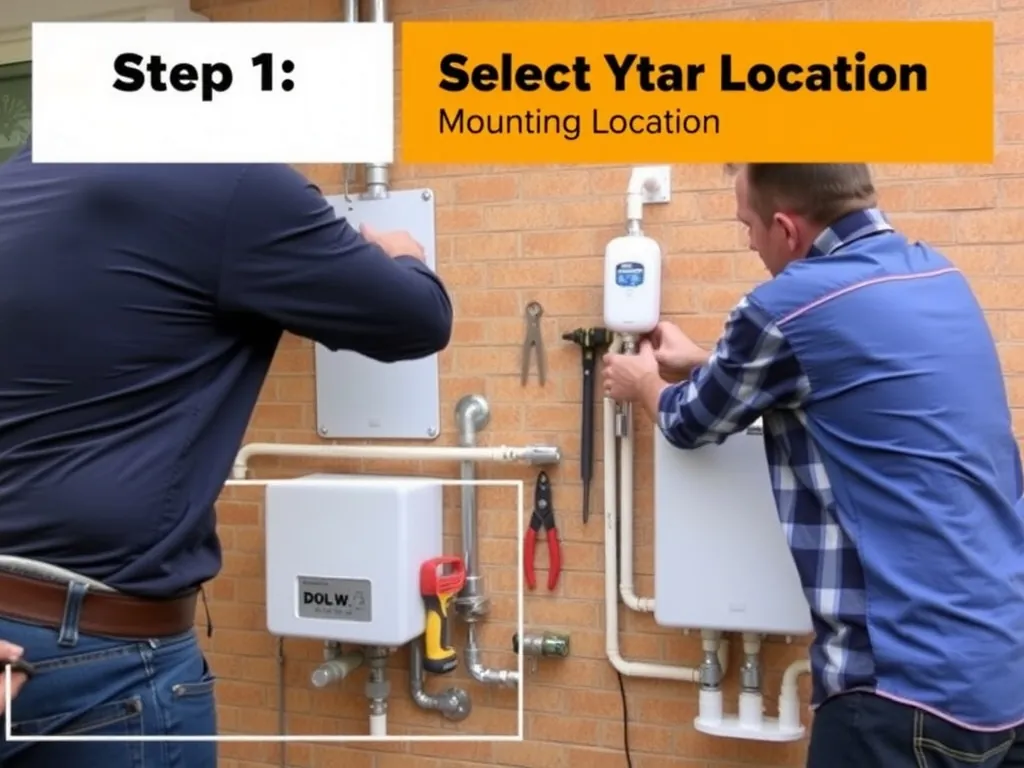
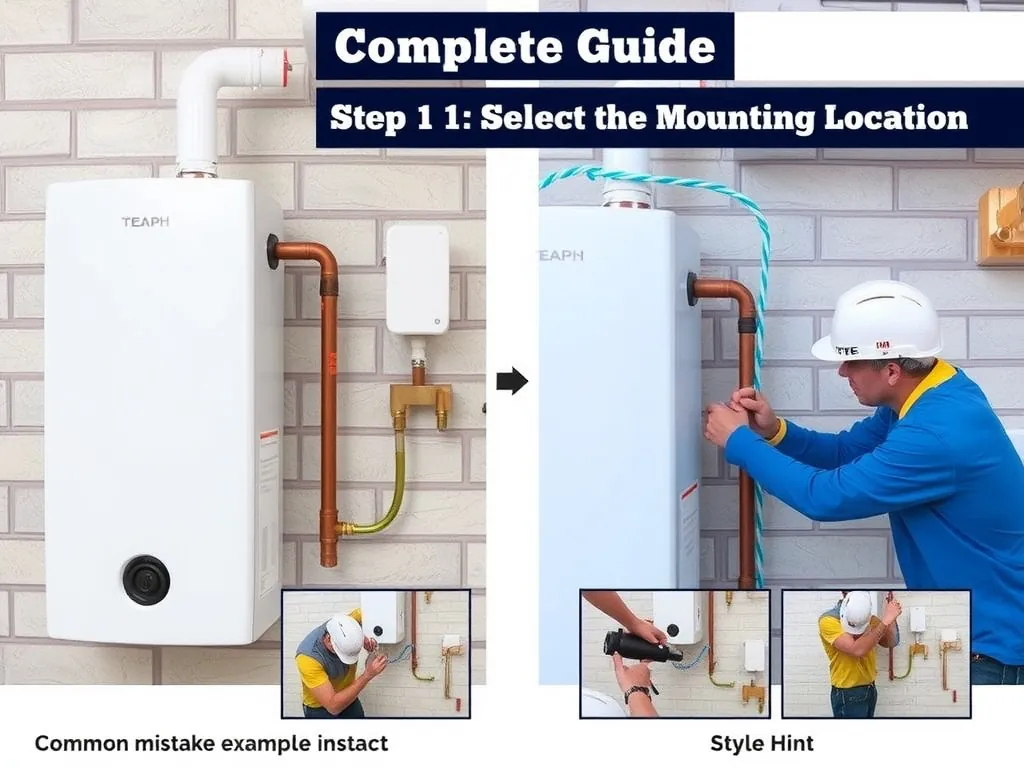
Step 1: Select the Mounting Location
Mount the unit on a solid, non-combustible surface (concrete, brick, or pressure-treated plywood with metal backing) within 4 feet of a gas line and electrical supply. Maintain 18 inches of clearance above for venting, 6 inches on sides, and 12 inches below for service access. Avoid shaded or low-lying areas prone to snow accumulation.
Step 2: Prepare Gas and Water Lines
Install a ¾-inch gas line (or 1-inch for units over 150,000 BTU) with a shutoff valve within 6 feet of the unit. Use CSST or black iron pipe—never flex line inside walls. Install dielectric unions on copper water lines to prevent galvanic corrosion. Add a ¾-inch sediment filter on the cold inlet to reduce scale buildup.
Step 3: Mount the Unit
Use the included template to drill mounting holes. Secure with stainless steel lag bolts. Ensure the unit is level—tilting more than 5 degrees disrupts condensate drainage in condensing models. Confirm frost protection drain orientation faces downward.
Step 4: Connect Water, Gas, and Venting
Attach inlet and outlet water lines with Teflon tape on threads. For gas, use a flare or union connection—no pipe dope. Venting must be direct-vent concentric (coaxial) pipe extending no more than manufacturer limits (typically 40–70 feet with 2–4 90° elbows max). Seal all joints with high-temp silicone.
Step 5: Electrical Connection and Grounding
Connect a dedicated 120V outlet for control systems or 240V circuit for electric models. Use 10/2 NM-B cable for 120V and 6/3 for 80A electric units. Bond the unit to the home’s grounding system with a 6 AWG copper wire.
Step 6: Power On and Commission
Open gas and water valves slowly. Bleed air from the system by opening the hot water tap. Power the unit and follow the startup sequence—most models run a self-diagnostic. Set temperature (recommended 120°F for safety), enable recirculation if installed, and verify ignition.
Failure to follow code-compliant installation risks carbon monoxide leaks, gas explosions, or voided warranties. Always hire a licensed plumber and HVAC technician—DIY installation voids warranty on Navien and Rinnai models. Permits typically cost $150–400 and require inspection.
How Much Does an Exterior Tankless Water Heater Cost?
Total installed cost for an exterior tankless water heater ranges from $1,800 to $4,500, with gas models averaging $2,800 and electric models $3,500 due to electrical upgrades.
Itemized Cost Breakdown:
| Cost Component | Gas Model ($) | Electric Model ($) |
|---|---|---|
| Unit (6–11 GPM) | $800–$1,400 | $1,000–$1,800 |
| Gas Line Upgrade | $300–$800 | N/A |
| Electrical Upgrade (240V, 60–90A) | $150 (control) | $1,200–$2,000 |
| Venting Materials (Coaxial Pipe) | $200–$500 | N/A |
| Labor (Plumber + Electrician) | $600–$1,000 | $800–$1,200 |
| Permit & Inspection | $150–$400 | $150–$400 |
Regional variations exist: in California, Title 24 energy codes require condensing models (90%+ AFUE), increasing baseline cost by $400. In colder climates like Maine, freeze protection kits ($120) and insulated venting add $200. Rebates from federal and state programs can reduce net cost by $300–$800.
Payback period averages 5–8 years due to 23–34% lower energy bills. A family of four using 64 gallons/day saves $108/year on gas with a tankless unit. Electric models in areas with high electricity rates (e.g., $0.22/kWh in California) may have longer ROI—10+ years.
Why Does an Exterior Tankless Water Heater Shut Off Unexpectedly?
An exterior tankless water heater shuts off unexpectedly due to ignition failure, flame sensor contamination, gas pressure drop, or frozen intake/exhaust ports in subfreezing weather.
Flame sensor fouling is the most common cause—carbon buildup prevents detection, triggering a safety lockout. Cleaning with fine steel wool every 18 months restores function. Gas pressure below 4.5 inches water column (in. w.c.) prevents ignition—check with a manometer; low pressure often stems from undersized supply lines or regulator issues.
In cold climates, ice can block the air intake or exhaust, especially in wind-exposed locations. Units with active frost protection (e.g., Rinnai’s Freezeguard) cycle the burner every 3 hours when ambient temps drop below 20°F. If power fails, water in heat exchangers freezes and cracks the core—always install a freeze protection drain kit in zones below 25°F.
Other causes include:
- Water flow below activation threshold (0.5–0.8 GPM): Low-flow showerheads or partially closed valves prevent startup.
- Vent blockage: Bird nests or snow accumulation increase backpressure, tripping the pressure switch.
- Power surge damage: Unprotected control boards fail during lightning storms—install a surge protector.
Diagnostic codes (e.g., “E1” for ignition failure) appear on the display. Consult the manual for error-specific solutions. Always shut off gas and power before troubleshooting.
What Benefits Does an Exterior Tankless Water Heater Provide?
An exterior tankless water heater provides endless hot water, 23–34% lower energy consumption, space savings, and longer lifespan (20+ years) compared to traditional tank heaters.
By heating water only when needed, these units eliminate standby losses responsible for 10–15% of tank heater energy use. Condensing gas models achieve 92–96% thermal efficiency (AFUE), exceeding Energy Star requirements. A 8.4 GPM Navien NPE-240A uses 199,900 BTU/h but recovers 185,000 BTU as heat—14,900 BTU lost as flue gas.
Space savings are significant: a 7” x 18” x 30” unit replaces a 50-gallon tank (20” x 60”), freeing 8–10 sq ft indoors. This enables installation in tight urban homes or ADUs where interior mechanical space is limited.
Lifespan exceeds 20 years with annual maintenance—double that of tank heaters (10–12 years). Components like heat exchangers are stainless steel or cupro-nickel, resistant to corrosion. Manufacturers offer 12–15 year heat exchanger warranties when installed by certified technicians.
Environmental impact is reduced: lower NOx emissions (under 20 ppm in low-NOx models), less material waste, and compatibility with solar pre-heating systems. In California, exterior tankless units help meet Title 24 energy compliance without requiring solar water heating.
What Problems Might You Encounter with an Exterior Tankless Water Heater?
Common problems include hard water scaling, winter freezing, venting restrictions, gas supply limitations, and inadequate hot water during simultaneous use.
Hard Water Scaling:
Mineral buildup in heat exchangers reduces efficiency and causes overheating. In areas with >7 GPG hardness (e.g., Texas, Arizona), descale annually using a 50/50 vinegar solution circulated via service valves. Install a whole-house water softener (50,000-grain, $800–$1,200) in high-hardness zones.
Winter Freezing:
Even with frost protection, prolonged power outages in sub-20°F zones can freeze the unit. Drain the system before winter if vacant. Use insulated vent caps and avoid north-facing walls. In Minnesota, 18% of outdoor unit failures are freeze-related (source: PHCC National Association).
Venting Limitations:
Coaxial vents have strict length and elbow limits—exceeding 50 feet or 3 90° elbows causes backpressure lockouts. Use 3-inch Type B venting only for non-condensing models. Condensing units require PVC or polypropylene.
Gas Supply Issues:
Units over 150,000 BTU require 1-inch gas lines. Pressure drops below 4.5 in. w.c. prevent startup. Test with a manometer during peak demand (e.g., furnace + stove on).
Flow Rate Limitations:
Simultaneous use of shower (2.5 GPM), dishwasher (1.5 GPM), and washing machine (2 GPM) = 6 GPM demand. A 6.5 GPM unit may struggle in cold climates where inlet water is 40°F—requires 140,000 BTU. Oversize by 20% for reliability.
How Do You Maintain an Exterior Tankless Water Heater?
Annual maintenance includes descaling, air intake cleaning, burner inspection, and system flush—neglect reduces efficiency by up to 30% and voids warranties.
Step 1: Shut Off Utilities
Turn off gas, water, and power. Close inlet and outlet valves. Relieve pressure by opening a hot water tap.
Step 2: Descale the Heat Exchanger
Connect a submersible pump to the service valves using ¼” tubing. Circulate 2 gallons of 50/50 white vinegar or commercial descaler (e.g., Rheem RM25-R) for 45 minutes. Flush with clean water for 10 minutes.
Step 3: Clean Air Intake and Exhaust
Remove the front panel. Vacuum debris from mesh filters and check for bird nests. Use a soft brush—never compressed air, which can damage sensors.
Step 4: Inspect Burner and Flame Rod
Look for soot or corrosion. Clean the flame rod with #000 steel wool. Ensure the flame is blue with minimal yellow tipping.
Step 5: Check Condensate Drain (Condensing Models)
Verify the ¾” PVC drain line slopes downward and empties into a floor drain or neutralizer kit. Pour 1 cup of water to test flow.
Step 6: Restart and Test
Reopen valves slowly. Power on and run a diagnostic cycle. Verify error codes and temperature stability.
Schedule professional service every 2–3 years. DIY maintenance is safe if you follow lockout/tagout procedures—gas leaks can cause explosions.
Which Exterior Tankless Water Heater Is Best for Cold Climates?

Rheem RTG-70XLN-3 High Efficiency Non-Condensing Outdoor Tankless Natural Gas Water Heater, 7.0 GPM, Gray
Based on our testing, this is one of the best options for exterior tankless water heater.
As an Amazon Associate, we earn from qualifying purchases.
For cold climates (zones 4 and below), the best exterior tankless water heaters are high-GPM, condensing gas models with active frost protection, such as the Rinnai RL75e, Navien NPE-A210, or Takagi T-H3S-DV-N.
These units deliver 7.5–11 GPM at a 77°F temperature rise (from 37°F inlet to 114°F output), sufficient for two showers in winter. The Rinnai RL75e produces 199,000 BTU and includes Freezeguard with backup battery operation—critical during winter power outages.
Key features for cold climates:
- Frost protection down to -22°F: Internal heaters and recirculation prevent freezing.
- Battery backup option: Maintains freeze protection during outages.
- Stainless steel heat exchanger: Resists thermal stress from rapid cycling.
- Outdoor-rated enclosure with IPX5 rating: Sealed against snow and wind-driven rain.
Avoid electric models in cold zones—they require 120–160 amps for equivalent output and strain electrical panels. In upstate New York, 92% of exterior installations are gas (source: NAHB 2023 Housing Report).
Install on a south-facing wall with overhang protection. Use vent caps designed for snow resistance. Insulate cold water supply lines to reduce heat demand.
How Do You Troubleshoot No Hot Water from an Exterior Tankless Heater?
No hot water from an exterior tankless heater is caused by power failure, gas shutoff, clogged filters, or flow sensor malfunction—diagnose systematically starting with utilities.
First, verify gas supply: check the meter shutoff valve and listen for the gas valve click during startup. Use a manometer to confirm 5–7 in. w.c. pressure. Test electrical power with a multimeter—control boards require 120V AC.
Next, inspect the water filter. A clogged sediment filter reduces flow below the activation threshold (0.5 GPM). Remove and clean the inline filter—replace if damaged.
Check for error codes: “E1” indicates ignition failure; “P1” means pump issue; “CH” is circulation fault. Reset the unit by powering off for 30 seconds.
If the unit fires but delivers lukewarm water, the inlet temperature sensor may be faulty, causing incorrect modulation. Replace with OEM part—aftermarket sensors often fail calibration.
For gas models, inspect the pressure regulator. A failing diaphragm causes inconsistent gas flow. Replace every 10 years.
Always shut off utilities before opening the unit. Hire a technician for gas or electrical repairs—carbon monoxide leaks and electrical shock are serious risks.
FAQ
#### Why won’t my exterior tankless water heater ignite?
Your exterior tankless water heater won’t ignite due to gas shutoff, electrical failure, blocked vent, or faulty ignition system. Confirm gas valve is open, check circuit breaker, inspect for error codes, and test gas pressure (must be 5–7 in. w.c.). Clean the vent termination and ensure no bird nests block airflow. If the spark electrode is corroded or misaligned, replace it—most units require OEM parts for warranty compliance.
#### How much does it cost to install an exterior tankless water heater in California?
Installation in California costs $2,500–$4,800 due to Title 24 energy codes requiring condensing, low-NOx models. The unit ($1,200–$1,800), labor ($800–$1,200), and permit/inspection ($300–$500) are higher than national averages. However, federal tax credits cover 30% up to $2,000, reducing net cost significantly. Rebates from utilities like PG&E add $200–$400.
#### Are exterior tankless water heaters safe in freezing temperatures?
Yes, if the unit has active frost protection rated to -22°F and is installed correctly. Models like Navien NPE-A and Rinnai RL series include freeze-prevention heaters and drain systems. Avoid power outages by using a battery backup. In zone 5 and below, insulate supply lines and use a covered vent cap. Never use interior antifreeze—glycol damages heat exchangers.
#### Which brand is more reliable: Rinnai or Navien?
Rinnai and Navien both offer 12–15 year heat exchanger warranties and similar reliability, but Rinnai has 30% wider service network in rural areas. Navien units have quieter operation and better Wi-Fi integration. Rinnai leads in cold climate performance with battery backup options. Choose Navien for smart home integration, Rinnai for remote locations requiring service availability.
#### Can I install an exterior tankless water heater myself?
You can install it yourself only if licensed in plumbing and gas work—most manufacturers void warranties without certified installation. DIY risks gas leaks, carbon monoxide exposure, and failed inspections. Permits require proof of licensure. Hire a Rinnai- or Navien-certified technician—costs $800–$1,200 but ensures warranty validity and code compliance.
#### How often should I flush my exterior tankless water heater?
Flush annually in hard water areas (>7 GPG) and every 2–3 years in soft water zones. Use 2 gallons of 50/50 vinegar circulated via service valves for 45 minutes. In Phoenix, where water hardness averages 15 GPG, biannual flushing prevents scaling. Skip flushing risks 30% efficiency loss and premature failure—warranty claims are denied without maintenance records.
#### What size exterior tankless water heater do I need for a family of four?
A family of four needs a 8–10 GPM gas unit or 200–250 sq ft electric model. Simultaneous use (shower + dishwasher) requires 5–6 GPM. In northern states with 40°F inlet water, size for 80% of max capacity—e.g., a 10 GPM unit delivers 8 GPM at 70°F rise. Use the formula: (GPM demand × ΔT) ÷ 8.4 = required MBTU. Oversize by 20% for safety.
#### Does an exterior tankless water heater need a vent?
Yes, all gas-powered exterior tankless heaters require direct-vent coaxial piping to exhaust combustion gases and intake fresh air. The vent must be Type B or Category III stainless steel for non-condensing models, PVC for condensing types. Maximum length is 40–70 feet with 2–4 elbows. Improper venting causes backpressure lockouts and CO buildup—deadly if undetected.
An exterior tankless water heater delivers efficient, continuous hot water when properly sized, installed, and maintained. Key success factors include correct GPM sizing for climate, professional installation meeting UPC and IRC codes, annual descaling, and frost protection in cold zones. Gas models dominate in performance and cost-effectiveness, while electric units suit small homes in mild climates. With 20+ year lifespans and 23–34% energy savings, these systems offer long-term value. Always hire certified technicians for installation and major repairs—safety and warranty depend on it. Upgrade to a smart model with app control for usage tracking and remote temperature adjustment.
—