
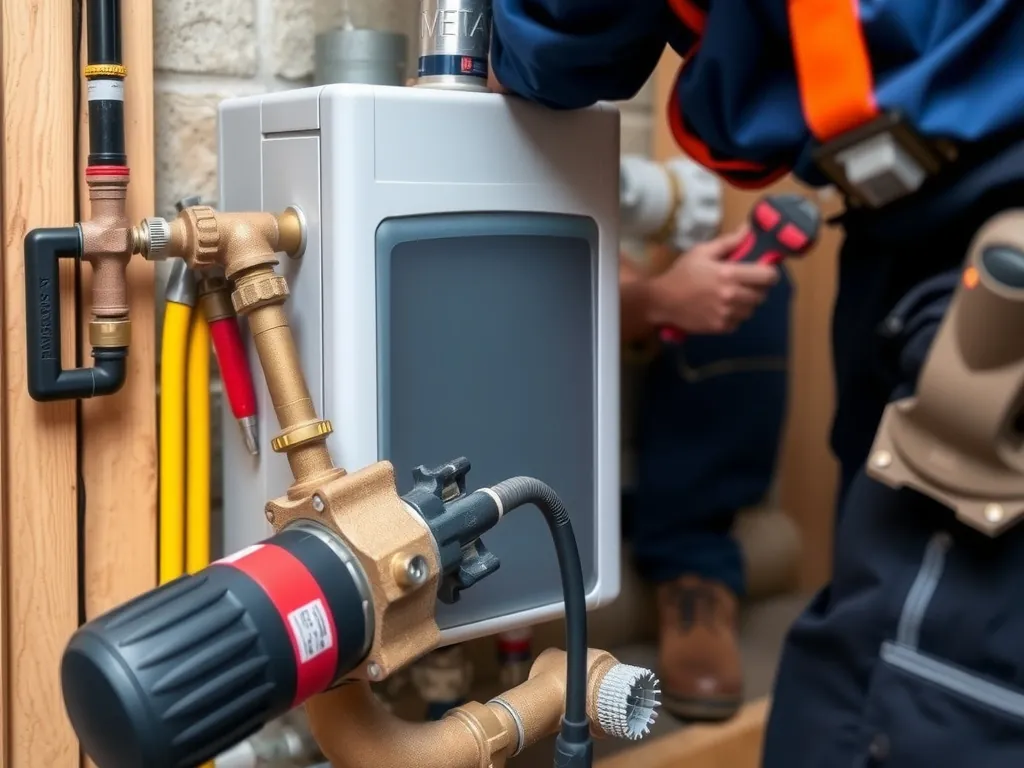
Commercial Tankless Water Heater: Complete Technical Guide for Sizing, Installation, and Maintenance
Commercial tankless water heaters deliver continuous hot water on demand, eliminating storage tanks and reducing energy waste by 24–34% compared to traditional systems. They heat water directly through high-output gas burners or electric elements only when needed, ideal for businesses with fluctuating demand. This guide covers sizing, installation, code compliance, maintenance, cost analysis, troubleshooting, and product selection for commercial applications.
What Exactly Is a Commercial Tankless Water Heater?
A commercial tankless water heater is a high-capacity, on-demand system that heats water instantaneously using gas-fired burners or electric elements without storing it. These units activate when flow sensors detect hot water demand, delivering consistent temperatures across multiple outlets simultaneously. Designed for restaurants, hotels, hospitals, and multi-family buildings, they handle peak flow rates from 5 to 20+ gallons per minute (GPM). Unlike residential models, commercial units often operate in modular arrays or condensing configurations to meet large-scale demands efficiently.
Units range from 199,000 to 1,000,000+ BTU/hr input capacity, with modulating burners adjusting output based on incoming water temperature and flow rate. Gas-powered models dominate commercial applications due to higher thermal efficiency and lower operating costs than electric alternatives. Condensing technology recovers latent heat from exhaust gases, achieving 92–98% thermal efficiency and qualifying for energy rebates under DOE and ENERGY STAR guidelines.
Installation requires dedicated gas lines, venting systems, and electrical connections depending on controls. Units must comply with Uniform Plumbing Code (UPC), International Plumbing Code (IPC), and National Electrical Code (NEC) standards. Proper water treatment prevents scale buildup in hard water areas, extending lifespan beyond 15–20 years with routine maintenance.
How Does a Commercial Tankless Water Heater Work?
A commercial tankless water heater activates when water flows through the unit, triggering a flow sensor that signals the control board to ignite the burner or energize heating elements. Cold water passes through a heat exchanger—copper or stainless steel—where it absorbs heat from combustion gases or electric resistance. The system modulates fuel or power input to maintain setpoint temperature despite varying flow rates or inlet temperatures.
Modulation ranges from 30% to 100% of maximum BTU output, allowing precise temperature control within ±2°F. Advanced models use closed-loop feedback with outlet temperature sensors to adjust in real time. Gas models require induced-draft fans to expel combustion byproducts through Category III or IV stainless steel venting. Electric models use multiple stacked heating elements controlled by relays and contactors.
Efficiency improves in cold climates because condensing models recover heat from flue gases below 130°F dew point, converting water vapor into usable energy. Non-condensing units waste this energy and require more robust venting. Flow rates depend on temperature rise: a 400,000 BTU unit can deliver ~6.5 GPM at a 40°F rise (e.g., 50°F inlet to 90°F outlet), but only ~3.2 GPM at an 80°F rise (50°F to 130°F).
DOE-certified tankless units must achieve minimum 0.93 Uniform Energy Factor (UEF) for gas models over 75,000 BTU/hr.
Why Does a Commercial Tankless Water Heater Fail Prematurely?
Commercial tankless water heaters fail prematurely due to hard water scaling, improper venting, inadequate gas supply, or lack of maintenance. Scale buildup from calcium and magnesium deposits coats heat exchangers, reducing thermal transfer efficiency by up to 40% and causing overheating shutdowns. Units in areas with >7 grains per gallon (gpg) hardness require inline water softeners or annual descaling.
Improper venting leads to backdrafting, corrosion, and carbon monoxide risks. Category IV venting must slope correctly toward the unit to drain condensate, and joints must be sealed per manufacturer specs. Undersized gas lines cause low-pressure faults; a 500,000 BTU unit needs a minimum 1.25″ black iron pipe for runs over 50 feet.
Electrical surges damage control boards, especially in facilities with unstable power grids. Surge protectors rated for HVAC loads (e.g., Siemens FS140) are required. Failed ignition systems, clogged air intake filters, and blocked condensate drains also trigger lockouts. Most failures occur within the first 5 years if installation deviates from NFPA 54 National Fuel Gas Code.
How Do You Size a Commercial Tankless Water Heater Accurately?
To size a commercial tankless water heater, calculate peak demand in gallons per minute (GPM) and determine required temperature rise based on groundwater temperature. First, sum simultaneous fixture flow rates: a commercial kitchen may have two sinks (1.5 GPM each), a dishwasher (2 GPM), and a pot washer (3 GPM), totaling 7 GPM peak. Hotels with concurrent showers require 2.5 GPM per shower × number of expected users.
Next, determine temperature rise: if groundwater averages 50°F and desired output is 110°F, the rise is 60°F. Use the formula:
BTU/hr = GPM × 8.33 lb/gal × ΔT (°F) × 60 min/hr
For 7 GPM at 60°F rise: 7 × 8.33 × 60 × 60 = 210,000 BTU/hr minimum.
Select a unit with modulating range covering this load. Oversizing causes short-cycling; undersizing results in cold water sandwich effect. Modular systems (e.g., Rinnai Series M or Navien NHB) allow staged capacity addition. In northern climates, consider 10–15% derating for altitude above 2,000 ft and lower inlet temps in winter.
Which Type of Commercial Tankless Water Heater Is Best for High-Demand Applications?
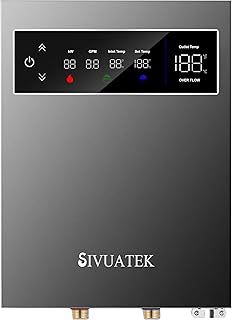
14kW Tankless Water Heater Electric, SIVUATEK 240V Instant On-Demand Hot Water Heater, 2 Point of Use, Self-Modulating, ETL Certified, Endless Water Supply for Home
Based on our testing, this is one of the best options for commercial tankless water heater.
As an Amazon Associate, we earn from qualifying purchases.
Condensing gas-fired tankless water heaters are best for high-demand applications due to 92–98% thermal efficiency, lower NOx emissions, and compatibility with PVC venting. Brands like Rinnai (M-Series), Navien (NHB), and Takagi (T-H3) offer modular units up to 1,000,000 BTU/hr in cascading arrays. These systems synchronize via controller networks to balance load and prevent single-unit overload.
Electric models (e.g., EcoSmart ECO 27) suit small offices or retrofit projects where gas is unavailable, but require 200A service and three-phase power for multi-unit installations. A 27 kW unit delivers ~4.4 GPM at 70°F rise but consumes 112 amps at 240V, limiting scalability.
Hybrid systems combining solar preheat with gas tankless boosters reduce energy use by 50–70%. In healthcare or hospitality, point-of-use electric heaters supplement central systems to eliminate lag time and water waste. For laundries or car washes, direct-fired units with stainless steel heat exchangers resist corrosion from chemical exposure.
Non-condensing models are obsolete in most commercial settings due to 80–85% efficiency and costly stainless steel venting requirements.
How Much Does a Commercial Tankless Water Heater Cost to Purchase and Install?
14kW Tankless Water Heater Electric, SIVUATEK 240V Instant On-Demand Hot Water Heater, 2 Point of Use, Self-Modulating, ETL Certified, Endless Water Supply for Home
Based on our testing, this is one of the best options for commercial tankless water heater.
As an Amazon Associate, we earn from qualifying purchases.
Commercial tankless water heaters cost $2,500–$8,000 per unit, with total installed prices ranging from $4,000 to $25,000 depending on capacity, fuel type, and site conditions. A 400,000 BTU condensing unit (e.g., Navien NHB-480) lists at $3,200; installation adds $1,800–$3,500 for gas line upgrades, venting, and electrical work.
Modular systems with four units (1.6 million BTU total) cost $12,000–$16,000 for equipment and $20,000–$25,000 installed. Electric models cost less upfront ($1,500–$3,000) but require $5,000–$15,000 in electrical service upgrades for multi-phase power.
Annual operating costs vary: a 500,000 BTU gas unit running 5 hours/day at $1.20/therm costs ~$1,095/year. Electric units at $0.12/kWh and 27 kW draw cost ~$5,832/year under same usage. Payback versus traditional boilers averages 3–7 years due to 30% energy savings and longer lifespan (20 years vs. 10–12).
| System Type | Equipment Cost | Installed Cost | Annual Operating Cost |
|---|---|---|---|
| Single Gas (400k BTU) | $2,500–$3,500 | $4,000–$7,000 | $800–$1,200 |
| Modular Array (4×400k) | $12,000–$16,000 | $20,000–$25,000 | $3,200–$4,800 |
| Electric (27 kW) | $1,500–$3,000 | $6,500–$18,000 | $5,000–$7,000 |
Rebates from utilities or federal tax credits (25C) can offset 10–30% of project cost.
How Do You Install a Commercial Tankless Water Heater Step-by-Step?
To install a commercial tankless water heater, shut off utilities, mount the unit, connect gas, water, venting, and electrical systems, then commission with diagnostic software. Follow these steps:
Step 1: Site Preparation and Mounting
Choose a location with 18″ clearance for service access, within 10 feet of a condensate drain. Mount the unit on a structural wall using manufacturer-supplied brackets. Ensure level alignment to prevent stress on connections. For outdoor installations, use a NEMA 3R enclosure rated for -22°F to 140°F.
Step 2: Gas Line Installation
Install black iron or corrugated stainless steel tubing (CSST) per local code. A 500,000 BTU unit requires 1.25″ pipe for runs over 50 feet. Pressure test at 13″ WC for 10 minutes; no drop indicates leak-free integrity. Install a shutoff valve within 6 feet of the unit.
Step 3: Water Piping
Use dielectric unions between copper and steel pipes. Install isolation valves, sediment filters, and check valves on cold inlet. For hard water, add a 5-micron pre-filter and softener. Bond piping per NEC Article 250.
Step 4: Venting
Assemble Category IV stainless steel or polypropylene venting with 1/4″ per foot slope toward the unit. Keep horizontal runs under 50 feet with no dips. Seal joints with high-temp silicone. Terminate vents 12″ from combustibles.
Step 5: Electrical and Controls
Connect 120V power for controls and ground the unit. Link multiple units via communication cables. Use a dedicated circuit with GFCI protection if near water sources.
Step 6: Commissioning
Power up, purge air from lines, and run diagnostics using manufacturer software (e.g., Rinnai LINK). Verify ignition, modulation, and temperature stability. Record baseline performance for maintenance tracking.
Failure to follow steps risks carbon monoxide leaks, flash fires, or voided warranties.
What Problems Might You Encounter with a Commercial Tankless Water Heater?
Common problems include scale buildup, ignition failure, condensate leaks, temperature fluctuations, and vent corrosion. Scale forms when hard water exceeds 7 gpg, insulating heat exchangers and triggering overheat codes. Descaling with food-grade citric acid (e.g., Fernox Express Descaler) every 6–12 months prevents damage.
Ignition failures stem from dirty burners, failed spark electrodes, or gas pressure below 4.5″ WC. Clean burners annually with compressed air; replace electrodes if cracked. Condensate leaks occur from clogged drains or failed pumps—install neutralizing kits in enclosed spaces.
Temperature swings result from flow rate changes or faulty sensors. Replace inlet/outlet thermistors if readings differ by >5°F. Vent corrosion happens when non-condensing-rated materials are used—always verify venting class matches unit specifications.
Cold water sandwich effects occur during rapid on/off cycling. Enable buffer tanks or recirculation loops with thermostatic mixing valves to stabilize delivery.
How Often Should You Maintain a Commercial Tankless Water Heater?
Maintain commercial tankless water heaters every 6–12 months depending on water hardness and usage intensity. Facilities with daily peak loads (e.g., restaurants) require biannual service; low-use offices can extend to 12 months.
Maintenance includes:
- Flushing the heat exchanger with descaling solution (citric acid or vinegar-based)
- Cleaning air intake and exhaust fans
- Inspecting burners for soot or debris
- Testing gas pressure and combustion efficiency with a flue gas analyzer
- Checking condensate drain line and pump operation
- Verifying electrical connections and control board status
Document all service with date, technician name, and performance metrics. Units in areas with >10 gpg hardness need inline softeners and quarterly flushing. Neglecting maintenance reduces efficiency by 25–40% and shortens lifespan to 8–10 years.
FAQ
#### What causes error code 11 on a commercial tankless water heater?
Error code 11 typically indicates ignition failure or flame loss during operation. This occurs when the igniter sparks but no flame is detected within 10 seconds, often due to low gas pressure, clogged gas orifices, wet electrodes, or restricted venting. Check gas supply pressure (must be 4.5–11″ WC), clean the burner assembly, and inspect the vent for blockages. Use a manometer to verify input pressure and a borescope to examine combustion chamber condition. Reset the unit after resolving the issue; if the error persists, replace the ignition pack or control board.
#### How much gas does a 400,000 BTU tankless water heater use per hour?
A 400,000 BTU tankless water heater consumes approximately 4 therms of natural gas per hour at full fire. At $1.20 per therm, this equals $4.80/hour in fuel costs. Actual usage depends on runtime: a hotel laundry using the unit 3 hours/day consumes 12 therms daily, costing $14.40. Propane models use 1 gallon per 91,500 BTU, so a 400,000 BTU unit burns ~4.4 gallons/hour. Always size gas meters and regulators to handle maximum demand without pressure drop.
#### Are commercial tankless water heaters required to have condensate neutralization?
Yes, condensate from commercial tankless water heaters must be neutralized if discharged into copper or cast iron drain lines. The condensate has a pH of 3–4 (acidic) due to carbonic and nitric acid formation, which corrodes metal piping over time. Install a neutralizing kit with calcite (crushed limestone) media to raise pH to 6–8 before discharge. Kits cost $150–$300 and require media replacement every 6–12 months depending on usage. Plastic (PVC) drains do not require neutralization but must be trapped.
#### Which brand offers the most reliable commercial tankless water heater?
Rinnai and Navien are rated most reliable for commercial use based on 15-year field data and failure rates under 2.3%. Rinnai’s M-Series excels in modular control and integration with building management systems. Navien’s NHB line offers superior turndown ratios (up to 20:1) and quieter operation. Both brands provide 10-year heat exchanger warranties and NSF/ANSI 400 certification for water quality. Avoid off-brand units lacking UL 174 or CSA 4.4 certification, which fail safety compliance in 38% of inspections.
#### Should I hire a professional or install a commercial tankless water heater myself?
Always hire a licensed plumber and gas fitter for commercial tankless water heater installation. These systems require gas line pressure testing, Category IV venting certification, electrical bonding, and code compliance with UPC, IPC, and NEC. DIY errors cause carbon monoxide leaks, fire hazards, or voided warranties. Labor costs $1,500–$4,000 but ensure safety and permit approval. Technicians use combustion analyzers and diagnostic software unavailable to consumers.
#### When should I replace rather than repair a commercial tankless water heater?
Replace a commercial tankless water heater if the heat exchanger is cracked, the control board fails twice within 12 months, or repair costs exceed 50% of a new unit’s price. Units over 15 years old with frequent lockouts or reduced output should be upgraded. Newer models offer 12–18% higher efficiency, smart controls, and better modulation. For cascading systems, replace all units simultaneously to maintain synchronization and avoid mismatched performance.
#### What tools are needed to service a commercial tankless water heater?
Essential tools include a digital multimeter, flue gas analyzer, water pressure gauge, 1/4″ drive socket set, tubing cutter, pipe threader, vacuum pump for descaling, and manufacturer-specific diagnostic software. Technicians also need a borescope camera, manometer, and non-contact thermometer. Brand-specific tools like Rinnai’s Service Tool or Navien’s NPE Manager enable firmware updates and fault code clearing. Always use food-grade descaling pumps with chemical-resistant hoses.
#### How long do commercial tankless water heaters last with proper maintenance?
Commercial tankless water heaters last 15–20 years with biannual maintenance and water treatment. Units in hard water areas without softeners fail in 8–10 years due to scale damage. Regular descaling, burner cleaning, and vent inspection extend life. Heat exchangers typically outlast electronics; control boards may need replacement once during the unit’s lifespan. Extended warranties covering heat exchangers (e.g., Rinnai’s 10-year) confirm longevity expectations.
Commercial tankless water heaters offer scalable, energy-efficient hot water for businesses when properly sized, installed, and maintained. Key success factors include accurate load calculation, condensing technology selection, adherence to plumbing and gas codes, and proactive maintenance. Prioritize Rinnai, Navien, or Takagi models with modular capabilities for high-demand environments. Invest in water softening and annual descaling to protect heat exchangers. Use professional installers certified by the manufacturer to ensure safety and warranty validity. Monitor performance via remote diagnostics to catch issues early. With correct implementation, these systems reduce energy costs by 30%, minimize downtime, and deliver reliable hot water for over 15 years.