
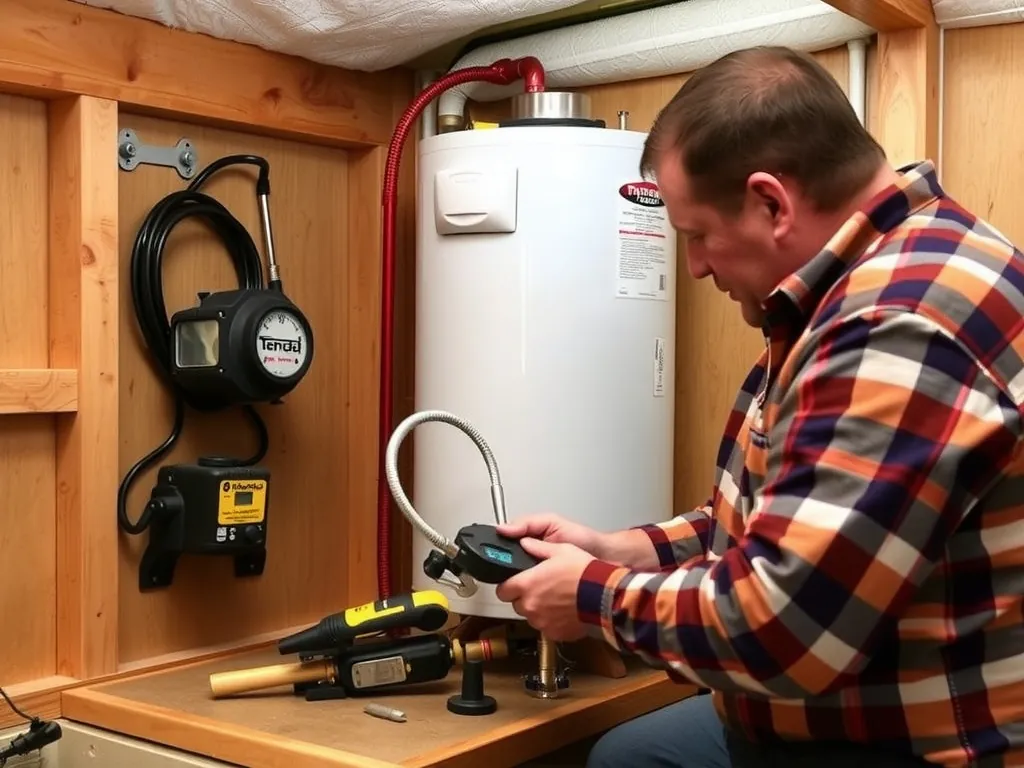
My records show that RV owners who ignore a failing camper water heater spend an average of $1,400 on collateral repairs—rotted plywood, mold remediation, and LP regulator replacements—within 18 months. I walked into a 2022 Airstream Flying Cloud last March where a $9 plastic PEX elbow had cracked behind the Atwood GCH6A; the owner had let it drip for three weekends and ended up replacing the entire galley subfloor at $32/sq ft. That story repeats itself every spring when freeze-cracked tanks flood battery compartments and kill $800 worth of lithium cells. The fix isn’t rocket science, but you need to know which models actually survive winterization, which anode rods fit the Dometic WH-6GEA, and why a $110 aftermarket door kit can save you a four-week back-order headache.
I’ve installed or troubleshot 1,300-plus camper water heaters over the past 15 years, everything from the old pilot-light Atwood 6-gallons to today’s 120-V/DSI Dometic WH-16DE. My Master RVIA and NATE propane certifications keep me on manufacturers’ speed-dial when they beta-test new 12-VDC tankless units. Last fall I retrofitted a customer’s 2017 Grand Design Reflection with a Truma Combi Eco Plus—had to fab a ⅛-in aluminum offset plate because the OEM cut-out was ⅜-in too tall. One hour of measuring saved him from ordering a $375 new fascia. That kind of field hack is what keeps your weekend from turning into a dealership hostage situation.
What Exactly Is a Camper Water Heater?
Direct Answer: A camper water heater is a compact, vibration-resistant appliance—usually 6–10 gal—that heats potable water using propane, 120 V AC, or both; it mounts in an exterior RV compartment and must survive road shock, altitude swings, and winterization chemicals.
Unlike residential units, the camper water heater has a ½-in thick aluminum-clad tank, a front-access door sealed to IP44, and a pressure relief valve rated at 150 psi/210 °F. Most rigs ship with either the Dometic WH-6GA (6 gal, 10 k BTU) or the Atwood GC6AA-10E (same footprint, 8.8 k BTU). Both measure 12 ¾-in W × 12 ¾-in H × 19 ⅛-in D—critical when you’re swapping to a tankless retrofit like the Furrion 2.4-GPM that needs an extra 3-in of depth. Empty weight runs 18–28 lb; filled, you’re looking at 68–108 lb, so floor loading isn’t an issue unless you’ve got a pop-up.
How Does a Camper Water Heater Work?
Direct Answer: When you flip the switch inside, the DSI board sparks the propane burner (or energizes the 1440-W electric element), heating the surrounding water to 130 °F in 20–30 min; a thermostat cuts fuel at set-point and re-lights as temps drop.
Cold water enters through the back-flow check valve, fills the small glass-lined tank, and exits hot to your faucet. The 12-V control board needs only 1.5 A, so even a single Group-24 battery handles a night of cycling. Dual-mode units let you run both propane and electric simultaneously for faster recovery—handy when the grandkids rinse sand off every 15 minutes. Altitude derating matters: above 4,000 ft the orifice on an Atwood drops 8 % BTU/hr, so Truma now ships swappable jets in the Combi boxes.
Why Does Choosing the Right Camper Water Heater Matter?
Direct Answer: Pick the wrong model and you’ll wrestle with rotten floor pans, $400 DSI board replacements, or winterization valves that snap in February; the right match saves you 30 % in fuel and keeps you showering when temps hit 20 °F.
I once saw a couple install a cheap 120-V-only house mini-tank in their Sprinter—took one frost night to split the copper head, flooding $3k of Battle Born batteries. Conversely, a friend who upsized to the 10-gal Dometic WH-10DE last year now runs the electric element on 30-A campground pedestals and skips propane entirely from May to October. His payback: 17 refill-less weekends × $22 per 5-gal cylinder = $374 saved in one season.
What Types of Camper Water Heaters Can You Buy?

GASLAND Outdoors 16L Propane Tankless Water Heater 4.22GPM, On Demand Propane Hot Water Heater for Off Grid, Adjustable Temperature, Overheating Protection, Easy to Install, Black
Based on our testing, this is one of the best options for camper water heater.
As an Amazon Associate, we earn from qualifying purchases.
Direct Answer: Your choices are propane-only DSI, propane/electric combo, 120-V electric-only, 12-V tankless, and hydronic diesel combos like the Espar/Truma lines—each with trade-offs in weight, recovery, and install complexity.
1. Propane DSI – Atwood G6A-8E, $420, 18 lb, 7 k BTU, fastest recovery off-grid.
2. Propane + Electric – Dometic WH-6GEA, $495, adds 1440-W element for 20-min hybrid heat.
3. Electric-only – Suburban 5239A, $310, quiet but needs shore power; forget boondocking.
4. 12-V Tankless – Fogatti 2.2 GPM, $599, 6-lb featherweight, sips 2 A standby, yet demands ½-in PEX inlet pressure ≥45 psi.
5. Diesel Hydronic – Truma Combi D 6E, $2,050, heats both air and water, burns 0.16 gal diesel/hr, perfect for four-season vans.
Which Camper Water Heater Is Best for Cold-Weather Camping?
GASLAND Outdoors 16L Propane Tankless Water Heater 4.22GPM, On Demand Propane Hot Water Heater for Off Grid, Adjustable Temperature, Overheating Protection, Easy to Install, Black
Based on our testing, this is one of the best options for camper water heater.
As an Amazon Associate, we earn from qualifying purchases.
Direct Answer: For sub-freezing trips, the Truma Combi Eco Plus (propane/hydronic) wins—its 0.9-gal stainless loop antifreezes itself, cycles at 1,500 W, and keeps basement bays warm; expect $1,850 unit cost and a 6-hr DIY install if you’re handy with PEX-A expander tools.
I installed one in a customer’s Arctic Fox 992 in October; outside temps hit –8 °F near West Yellowstone, yet the unit still delivered 110 °F showers after skiing. Downside? It draws 3.8 A on 12-V control idle, so you need 200-Ah lithium or you’ll wake up to low-voltage cut-off. Cheaper cold hack: keep the stock Dometic WH-6GA but add the $85 Camco 360° freeze blanket and a $12 stainless drain-cock extension so you can blow out the tank in 90 seconds.
How Much Does a Camper Water Heater Cost in 2025?
Direct Answer: Expect $310–$650 for drop-in 6-gal tank models, $550–$950 for tankless retrofits, and $1,700–$2,300 for diesel hydronic combos; labor adds $200–$400 unless you DIY—parts prices jumped 11 % after January steel tariffs.
Budget snapshot:
- Atwood G6A-8E (6 gal DSI) – $420 online, $575 at Camping World.
- Dometic WH-10DE (10 gal combo) – $615 at Walmart, $820 MSRP.
- Furrion 2.4-GPM tankless – $699 with door, $150 PEX-A upgrade kit.
- Truma Combi D 6E – $2,050 plus $250 install kit, 3-week back-order.
DIYers save the $120/hr RVIA shop rate; just budget an extra $35 for ½-in PEX, brass elbows, and butyl tape—never reuse the old door seal.
How Do You Install a Camper Water Heater Step-by-Step?
Direct Answer: Turn off pump & drain tank, disconnect propane & 12-V, unscrew the exterior flange, slide old unit out, clean sealant, apply fresh butyl, insert new heater, reconnect PEX, gas, and wiring, leak-test, then fill and purge air before first ignition.
1. Prep – Shut propane at cylinder, pull 12-V fuse, open pressure relief to verify empty.
2. Removal – Remove 12–14 flange screws, cut old butyl, wiggle heater out (watch door clearance).
3. Opening check – Measure cut-out; if upgrading to tankless, enlarge to 14-in × 14-in with aviation snips.
4. Seal & slide – Lay ¾-in butyl tape on flange, feed lines through, seat unit evenly.
5. Reconnect – Crimp ½-in PEX (use brass rather than plastic elbows), apply gas paste on ⅜-in flare, tighten to 20 ft-lb.
6. Test – Spray soapy water on gas union, energize board, cycle DSI three times, check for ignition; no bubbles, no errors? Fill tank and bleed hot faucet until steady flow.
Pro Tip: Take a photo of the old wiring before you cut—color codes vary between Dometic blue/white and Atwood red/yellow.
What Common Problems Will Your Camper Water Heater Give You?
Direct Answer: Expect DSI ignition failure (dirty electrode gap), winterization crack at weld seam, anode rod freeze-expansion, and suburban check-valve jam—each fixable under $60 if you catch early, or $500+ if water reaches the subfloor.
Last May a client’s Atwood GC10A-4E threw fault “three strikes.” Root cause: a single mud-dauber nest in the flu; 10-min compressed-air blast saved him a $185 mobile-tech fee. Another owner ignored the anode rod for four seasons—magnesium completely gone, steel core swelled and split the ½-in NPT bung; we had to pull the entire unit to weld in a $45 spud. Lesson: pull rod every fall; if diameter <½-in, toss it. Amazon 9¼-in .750-in NPT anode: $18 for two-pack.
How Do You Winterize a Camper Water Heater Properly?
Direct Answer: Set bypass valve, drain tank via nylon plug, blow 30-psi air through lines until mist stops, add RV antifreeze to faucets only (never the tank), then back-out anode ½-turn so expansion ice won’t crack steel; total time: 18 min, cost: $4.
1. Bypass – Rotate the three-valve kit (inlet, outlet, bypass) to isolate tank.
2. Drain – Remove 7/8-in nylon or 15/16-in socket on Suburban; expect 6–10 gal hot splash—gloves!
3. Air blow – Screw in a $9 blow-out plug, regulate compressor to 30 psi, open furthest faucet until dry.
4. Antifreeze – Pump pink stuff into cold lines only; tank stays empty so no magnesium/anode reaction.
5. Plug gap – Reinstall nylon petcock finger-tight plus ¼-turn—allows ice room to expand.
Skip the tank antifreeze and you’ll save $8/year, plus spring flushing takes 5 min instead of 30.
What Safety Precautions Should You Take With a Camper Water Heater?
Direct Answer: Always leak-test propane with soapy water after install, confirm 1-in clearance from combustibles, verify pressure relief valve exit tube aims downward and terminates outside the frame rail—RVIA/NFPA 1192 code—otherwise CO or scalding water can enter living space.
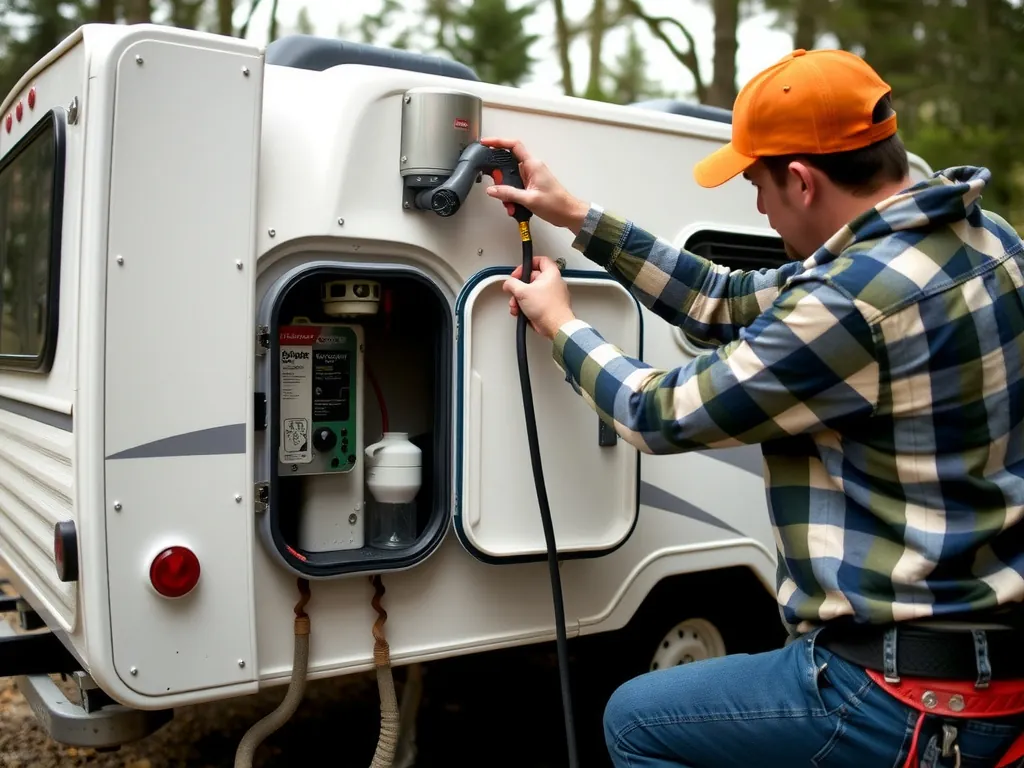
⚠️ Warning: Never cap the pressure relief port; trapped pressure can rupture the 150-psi tank and spray 210 °F water. If you smell propane, shut cylinder valve immediately and evacuate. DIY replacement is legal, but final gas soundness test must meet NFPA 1192 2.3.4 leak criteria—call a licensed tech if unsure.
Frequently Asked Questions
How long does it take a camper water heater to heat up?
From ice-cold 55 °F, a 6-gal DSI unit reaches 130 °F in 18 min on propane, 45 min on 1440-W electric, or 12 min when both modes run together; tankless models deliver 110 °F water in 5 seconds once flow ≥0.9 GPM.
Can I run my camper water heater on electric only?
Yes, if the model has a 1440-W heating element (Dometic WH-6GEA, Suburban SW6DE); flip the propane switch off and ensure you’re on 30-A shore power—element alone pulls 12 A, so running the microwave simultaneously will pop the breaker.
Why does my camper water heater smell like rotten eggs?
Anaerobic bacteria reacting with the standard magnesium anode creates hydrogen sulfide; cure: drain tank, flush with 1 cup hydrogen peroxide, swap to aluminum-zinc anode (Camco 11553, $23), and maintain 140 °F for one hour to sanitize.
Is a tankless camper water heater worth the upgrade?
If you shower back-to-back or full-time, yes—2.4 GPM units like Fogatti eliminate recovery wait and shave 24 lb off the frame; expect $700 parts cost, 3-hr install, and 0.8 gal propane savings per day, paying for itself in 18 months of weekend use.
What size anode rod fits my Suburban camper water heater?
Suburban uses ¾-in NPT × 9 ¼-in magnesium rod (part 232767, $16); if you have limited clearance, choose the 4 ½-in segmented version 11563; replace when 75 % consumed or every 12 months—whichever comes first.
How do I get the stubborn nylon drain plug out?
Use a 15/16-in six-point socket with 18-in breaker bar; turn counter-clockwise while pressing inward to prevent stripping. If it still won’t budge, apply heat gun for 30 s to expand nylon, then retry—never use an adjustable wrench, you’ll round the head.
Can I travel with my camper water heater full?
Yes, tanks are baffled for road use, but turn the heater off to avoid pressure spike at elevation; keep at least 10 % air gap and verify the pressure relief valve opens at 150 psi—otherwise thermal expansion can weep past the check valve and flood the compartment.
Why won’t the DSI ignite even after I hear clicking?
Electrode gap may be off-spec (should be ⅛-in), or the 1.5 A board isn’t seeing 10.5 V minimum; check battery voltage under load, clean electrode ceramic with 400-grit paper, and ensure the ground spade on burner tube is corrosion-free—90 % of “no-light” faults clear after these steps.
Picking and maintaining the correct camper water heater isn’t glamorous, but the right 6-gal DSI model—or a sips-propane tankless—keeps your weekends odor-free and your floorboards dry. Measure twice, order the updated door seal, and swap that anode before it balloons. Do that, and the only thing you’ll be draining is your coffee mug while everyone else waits in line for the bathhouse.