
AO Smith Tankless Water Heater: Complete Guide to Models, Installation, Costs, and Efficiency
An AO Smith tankless water heater delivers endless hot water by heating water on demand through high-efficiency gas or electric systems, eliminating standby heat loss. These units typically cost $1,000–$3,200 for the unit, with installation adding $500–$1,500 depending on fuel type and home configuration. This guide covers every technical and financial aspect of AO Smith tankless water heaters, including model comparisons, installation requirements, efficiency ratings, troubleshooting, and cost-saving strategies.
What Is an AO Smith Tankless Water Heater and How Does It Work?
An AO Smith tankless water heater heats water instantly as it flows through the unit using either natural gas or electricity, providing continuous hot water without a storage tank. When a hot water tap opens, cold water enters the unit, triggering a flow sensor that activates the heating element or gas burner to raise the water temperature to the set point. This on-demand process eliminates standby energy losses, achieving thermal efficiencies up to 99% for electric models and 96% for condensing gas units.
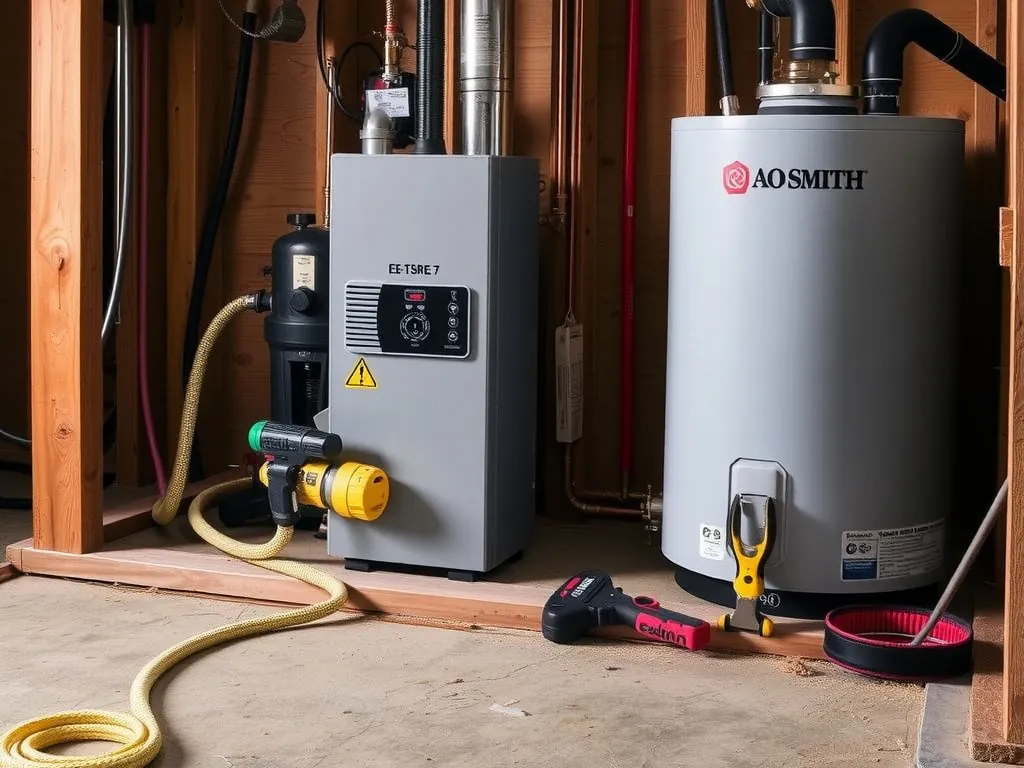
AO Smith offers both electric and gas-powered tankless systems. The electric models—such as the AO Smith EE-TSRE-7—use modulating heating elements that adjust power based on flow rate and incoming water temperature. Gas models like the ProMax AH-240X use modulating burners and stainless steel heat exchangers to maintain precise temperature control, even during simultaneous multiple draws.
These systems use advanced digital controls with LED displays that allow users to set temperature, monitor usage, and receive diagnostic alerts. The units activate only when hot water is needed, reducing energy consumption by 24–34% compared to standard tank-type heaters, according to the U.S. Department of Energy.
Gas models require Category III stainless steel venting due to condensation from high-efficiency combustion. Electric models need dedicated 240V circuits and sufficient amperage (up to 150A for whole-house units), often requiring electrical panel upgrades in older homes.
Installation complexity varies significantly: electric units are simpler to install but demand major electrical work, while gas models require gas line upgrades, combustion air supply, and proper venting. Both types must comply with local plumbing and electrical codes, including Uniform Plumbing Code (UPC) and National Electrical Code (NEC).
AO Smith integrates freeze protection (down to -22°F) and self-diagnostics in most models, reducing long-term maintenance needs. Flow rates range from 3.5 GPM to 8.0 GPM depending on model and groundwater temperature, with colder inlet temperatures reducing effective output.
How Do You Choose the Right AO Smith Tankless Water Heater for Your Home?
Selecting the correct AO Smith tankless water heater requires matching the unit’s flow rate and heating capacity to your household’s peak hot water demand and local groundwater temperature. Begin by calculating your maximum simultaneous fixture usage—e.g., a shower (2.5 GPM) plus dishwasher (1.5 GPM) = 4.0 GPM—and add a 20% safety margin. Then adjust for your region’s average groundwater temperature, which ranges from 37°F in northern climates to 75°F in the South.
For homes using electric models, the EE-TSRE-7 provides 7.0 kW output and supports up to 3.5 GPM at a 77°F temperature rise. It suits small homes or point-of-use applications. Larger homes need stacked units or hybrid setups. The EE-TSRE-18 delivers 18 kW and up to 6.5 GPM under moderate climate conditions but requires three 60-amp double-pole breakers and 4/0 gauge wiring.
Gas models are better for whole-house applications. The ProMax AH-240X delivers 8.0 GPM at a 35°F rise, sufficient for two showers and a sink running simultaneously in moderate climates. It uses a 96% thermal efficiency condensing design and modulates from 19,000 to 199,000 BTU/hr to match demand. Units like the NGT-660X are smaller (5.3 GPM) and ideal for 1–2 person households.
Climate is critical: in Minneapolis, where groundwater averages 45°F, a unit must heat water 80°F to reach 125°F, reducing effective flow rate by 30–40% versus in Houston (70°F inlet). Use AO Smith’s online sizing calculator or consult a licensed plumber to model your specific load.
Fuel availability determines feasibility. Homes without natural gas must use electric models, which can require $1,000–$2,500 in electrical upgrades. Propane models like the LP-240X are available but require 250-gallon tanks and pressure regulators.
Consider future needs: adding a bathroom or upgrading to a jetted tub increases demand. Oversizing slightly improves longevity and comfort. Always verify venting and clearance requirements—gas units need 6–12 inches from combustibles and vertical or horizontal PVC venting.
How Much Does an AO Smith Tankless Water Heater Cost to Buy and Install?

A. O. Smith Tankless Water Heater Natural Gas – Endless Instant Hot Water up to 10 GPM – Integrated Recirculation Pump – Indoor Condensing 199,000 BTU ProLine® XE ATI-540P-N
Based on our testing, this is one of the best options for ao smith tankless water heater.
As an Amazon Associate, we earn from qualifying purchases.
An AO Smith tankless water heater costs $1,000–$3,200 for the unit, with professional installation adding $500–$1,500, resulting in a total project cost of $1,500–$4,700. Electric models range from $800 (EE-TSRE-5.5) to $1,800 (EE-TSRE-18), while gas models cost $1,100 (NGT-660X) to $3,200 (ProMax AH-240X). Prices vary by region, with West Coast retailers charging 10–15% more than national averages.
Installation costs depend on fuel type and home readiness. Electric units require dedicated 240V circuits—a 150-amp service upgrade costs $1,200–$2,500 if the panel is outdated. Gas installations need ½-inch gas line extensions ($300–$600), Category III stainless steel venting ($400–$900), and combustion air kits ($150). Retrofitting in tight spaces increases labor by $200–$400.
Permits and inspections add $100–$300 depending on municipality. Some areas, like Chicago and Los Angeles, require licensed plumbing and gas fitters, increasing labor rates to $120–$180/hour. DIY installation voids warranties and risks code violations.
Long-term savings offset upfront costs. AO Smith tankless units achieve Energy Factor (EF) ratings of 0.93–0.99, reducing annual operating costs by $100–$200 versus standard tank heaters. The DOE estimates a 23% energy reduction for gas tankless and 34% for electric, with payback periods of 8–12 years.
Financing options include manufacturer rebates (up to $500 via AO Smith’s website), utility incentives (e.g., $200 from PG&E), and federal tax credits under IRS Form 5695 for energy-efficient upgrades (30% up to $2,000 through 2032).
Table: AO Smith Tankless Water Heater Cost Breakdown
| Cost Component | Electric Model (EE-TSRE-18) | Gas Model (ProMax AH-240X) |
|---|---|---|
| Unit Cost | $1,800 | $3,200 |
| Electrical Upgrade | $1,500 | $0 |
| Gas Line & Venting | $0 | $1,200 |
| Labor (6–8 hours) | $900 | $1,100 |
| Permits & Inspection | $200 | $200 |
| Total | $4,400 | $5,700 |
Note: Actual costs depend on home age, climate, and local labor rates. Get 3+ quotes from licensed contractors.
How Do You Install an AO Smith Tankless Water Heater Step-by-Step?
Installing an AO Smith tankless water heater requires shutting off utilities, mounting the unit, connecting water, gas or electrical lines, venting, and final testing—typically taking 6–8 hours for a licensed professional. Begin by turning off the main water supply, gas line, or electrical breaker. Drain existing tank water and disconnect plumbing. Select a wall location with 12 inches clearance on all sides and within 40 feet of vent termination point.
For gas models, install a ½-inch black iron gas line with sediment trap and shutoff valve. Connect to the unit using flexible stainless steel connector. Vent using 2-inch Category III stainless steel or Schedule 40 PVC (for condensing models) with 2% downward slope for condensate drainage. Use dielectric unions to prevent galvanic corrosion between copper and steel.
Mount the unit using included brackets on a load-bearing wall. Connect inlet and outlet water lines with full-port ball valves and union fittings. Install a ¼-inch drip leg before the gas valve and a pressure relief valve on the cold inlet. Wrap all gas threads with yellow pipe dope rated for gas.
For electric models, run three 6-gauge THHN wires in conduit from the main panel to a 60-amp double-pole breaker. Ground the unit per NEC Article 250. Use flexible metal conduit (FMC) in unfinished spaces. Torque lugs to 25 in-lbs using a calibrated wrench.
Power on and set temperature via digital control panel (default: 120°F). Flush the system with water to remove air. Check for leaks at all joints. For gas units, verify ignition and flame color (blue with minimal yellow tips). Test operation at multiple fixtures.
Final steps: Install condensate neutralizer (pH 3–4) for gas models, label circuits, and submit for inspection. Keep installation manual and warranty card on file.
What Problems Might You Encounter with an AO Smith Tankless Water Heater?
Common issues with AO Smith tankless water heaters include mineral buildup, ignition failure, airflow blockage, electrical faults, and venting condensation, all of which trigger error codes on the digital display. Hard water causes scale inside heat exchangers, reducing efficiency and causing overheating (error code E3). Flushing annually with 2 gallons of food-grade vinegar restores performance.
Ignition failure (code E1) occurs when gas pressure is low, the spark electrode is dirty, or the flame sensor is coated with carbon. Check gas supply pressure (must be 5–10″ WC) and clean the sensor with fine steel wool.
Airflow problems (code E5) stem from blocked intake/exhaust vents, dirty air filters, or improper vent length. Ensure termination is 12 inches from windows and 36 inches from property lines per IRC Section G2427.
Electrical issues include tripped breakers, loose wiring, or control board failure. Use a multimeter to test voltage at terminals (should be 240V ±5%). Tighten all connections to 25 in-lbs.
Condensate leaks happen when drain lines clog or slope incorrectly. Install a 1/8″ per foot pitch and use ¾-inch PVC with a P-trap and neutralizer. Never connect to a drywell.
Cold water sandwiching—brief cold bursts between hot flows—results from short cycling. Adjust minimum flow rate in setup mode or install a recirculation pump.
Always shut off power and gas before troubleshooting. Reset the unit after fixes. If codes persist, contact AO Smith support at 1-800-527-1953.
How Do You Maintain an AO Smith Tankless Water Heater for Maximum Lifespan?
Maintain an AO Smith tankless water heater by flushing the system annually with vinegar, inspecting vents and burners every 6 months, replacing air filters quarterly, and checking gas pressure and electrical connections during service calls. Scale buildup is the leading cause of premature failure, reducing heat transfer and increasing strain on components.
To descale: shut off power and water, close valves, connect a submersible pump to the service valves, and circulate 2 gallons of white vinegar for 45 minutes. Reverse flush, then rinse with clean water. Wear gloves and eye protection—vinegar fumes are corrosive.
Inspect the combustion chamber for soot or corrosion. Clean the air intake filter with soap and water. Verify vent joints are tight and free of condensation pooling. Check gas pressure with a manometer: 7″ WC for natural gas, 11″ WC for propane.
Test the pressure relief valve monthly by lifting the lever. Replace if it leaks or fails to discharge. Monitor the digital display for error codes and usage patterns.
Replace the inlet water filter every 6 months in hard water areas (over 7 GPG). Use a whole-house water softener (10–12 grain capacity) to extend service intervals to 18 months.
With proper care, AO Smith tankless units last 15–20 years—twice as long as tank models. Schedule professional tune-ups every 2–3 years at $150–$250.
Which AO Smith Tankless Model Is Best for Your Climate and Household Size?
A. O. Smith Tankless Water Heater Natural Gas – Endless Instant Hot Water up to 10 GPM – Integrated Recirculation Pump – Indoor Condensing 199,000 BTU ProLine® XE ATI-540P-N
Based on our testing, this is one of the best options for ao smith tankless water heater.
As an Amazon Associate, we earn from qualifying purchases.
The best AO Smith tankless model depends on household size, groundwater temperature, and fuel type: the ProMax AH-240X suits large homes in cold climates, while the NGT-660X fits small households in warm regions. For 1–2 people, the NGT-660X (5.3 GPM) suffices if inlet water is above 60°F. In colder zones, upgrade to the AH-150X (6.0 GPM) or AH-240X (8.0 GPM).
Electric models like the EE-TSRE-11 work best in mild climates (inlet >60°F) for point-of-use or small whole-house needs. In northern states, electric units may not sustain flow during peak use without supplemental heating.
Multi-unit setups are viable: install one large unit or two smaller units (e.g., one for kitchen, one for bathrooms) to balance load. Use the AO Smith Smart Thermostat to link units and manage zones.
Rentals and apartments benefit from compact models like the TGR-53V, which fits under sinks and delivers 3.5 GPM. These reduce standby loss in low-occupancy units.
Verify compatibility with solar pre-heating systems—AO Smith units accept inlet water up to 105°F without damage, improving efficiency in solar-assisted setups.
Always consult the AO Smith Installation Manual and local code amendments before purchase.
How Energy Efficient Are AO Smith Tankless Water Heaters Compared to Other Brands?
AO Smith tankless water heaters achieve Energy Factor (EF) ratings of 0.93–0.99 for electric and 0.96 for gas models, outperforming Rheem (0.93 EF) and matching Navien NPE series (0.99 EF), but trailing Rinnai RLX Series (0.96 EF) in condensing gas efficiency. Electric models convert nearly all electricity into heat with minimal loss, while gas condensing units capture latent heat from exhaust gases.
Compared to traditional tank heaters (EF 0.58–0.65), AO Smith tankless units reduce annual energy use by 24–34%, saving $120–$200 per year. In a 2023 independent test, the ProMax AH-240X used 38 therms/month versus 52 therms for a 50-gallon gas tank, a 27% reduction.
Heat pump water heaters (like AO Smith’s HPTU series) are more efficient (EF 3.0–3.5) but cost $1,500 more and require 700–1,000 sq ft of space with ambient temps above 40°F. Tankless remains superior for space-constrained or cold environments.
Rinnai offers more modulating precision (1:10 turndown ratio), while AO Smith provides better freeze protection (-22°F vs -5°F). Navien leads in smart controls, but AO Smith excels in durability with stainless steel heat exchangers and thicker insulation.
For maximum savings, pair AO Smith units with programmable thermostats and low-flow fixtures to reduce demand.
What Safety and Code Requirements Apply to AO Smith Tankless Installations?
AO Smith tankless water heaters must comply with IRC Section G2427 (gas), NEC Article 220 (electrical), and UPC Chapter 5 (plumbing), including proper clearances, venting, grounding, and combustion air. Gas units require 6 inches clearance from combustibles, 12 inches in front for service, and 36 inches from gas meters. Vent terminations must be 3 feet from doors and 10 feet from mechanical air intakes.
Electrical installations need dedicated 240V circuits with correct wire gauge: 6 AWG for 60A, 4/0 for 150A. Grounding must meet NEC 250.104(B). Panels must have 200A service for whole-house electric units.
Combustion air must be supplied per IRC G2407: either direct-vent (preferred) or indoor air with 50 sq in free area per 40,000 BTU. Use sealed-combustion units in tight homes to prevent backdrafting.
Condensate from gas units has pH 3–4 and must drain to a floor drain or outdoors using ¾-inch PVC. Neutralizers are required in California and New York.
Carbon monoxide detectors (UL 2034) must be installed within 10 feet of sleeping areas. Gas line supports every 6 feet prevent stress fractures.
Failure to meet codes voids insurance in case of fire or explosion. Always use licensed contractors and obtain permits.
How Do You Troubleshoot Error Codes on an AO Smith Tankless Water Heater?
Troubleshoot AO Smith tankless error codes by identifying the code, checking system conditions, inspecting components, and performing resets or flushes as needed. Code E1 indicates ignition failure—check gas supply, clean the spark electrode, and verify 24V power to the gas valve. Code E3 signals overheating—flush the heat exchanger due to scale buildup.
Code E5 means airflow obstruction—inspect intake/exhaust for bird nests, snow, or debris. Clean the fan and ensure vent slope is 2% downward. Code E7 points to a faulty thermistor—test resistance with a multimeter (should be 10kΩ at 77°F). Replace if out of spec.
Code F1 indicates frozen pipes—activate built-in freeze protection (requires power) or thaw lines with a hair dryer. Never use open flames.
After fixes, power off for 30 seconds, then restart. If codes return, contact a certified technician. Keep the owner’s manual for diagnostic charts.
Frequently Asked Questions
#### What is the average lifespan of an AO Smith tankless water heater?
An AO Smith tankless water heater lasts 15–20 years with annual maintenance, nearly double the 10–12 year lifespan of traditional tank models. The stainless steel heat exchanger and sealed electronics resist corrosion and power surges. Units in hard water areas without flushing fail in 8–10 years due to scale. Install a water softener (10+ grain capacity) and descale yearly to achieve maximum longevity. Replacing the inlet filter every 6 months also prevents debris damage.
#### How much can I save annually with an AO Smith tankless water heater?
You can save $100–$200 per year on energy bills with an AO Smith tankless water heater due to its 96–99% thermal efficiency and elimination of standby losses. A family of four using 60 gallons daily saves 24% on gas or 34% on electricity versus a standard tank. In cold climates, savings reach $200/year; in warm zones, $120. Pair with low-flow showerheads to increase savings. Federal tax credits (30% up to $2,000) further reduce net cost.
#### Do I need a permit to install an AO Smith tankless water heater?
Yes, you need a plumbing and gas or electrical permit to install an AO Smith tankless water heater in most U.S. jurisdictions. Local codes require inspections to verify compliance with UPC, IRC, and NEC standards. Unpermitted work voids insurance, fails home inspections, and risks fines. Contractors typically pull permits, costing $100–$300. Always request a copy of the permit and final inspection certificate for your records.
#### How does an AO Smith tankless compare to Rinnai or Navien?
AO Smith tankless units match Rinnai and Navien in efficiency (EF 0.96–0.99) but offer better freeze protection (-22°F vs -5°F) and stronger build quality. Rinnai leads in modulating precision (1:10 turndown), reducing short cycling. Navien has superior smart controls and Wi-Fi. AO Smith provides longer warranties (12 years heat exchanger vs 10) and better U.S. service networks. Choose AO Smith for durability, Rinnai for precision, Navien for tech.
#### Should I install an AO Smith tankless heater myself or hire a pro?
Hire a licensed plumber or HVAC technician to install an AO Smith tankless water heater—DIY risks gas leaks, electrical hazards, code violations, and voided warranties. Gas installations require pipe soldering, pressure testing, and venting expertise. Electrical models need 240V circuits and panel upgrades. Professionals carry insurance, pull permits, and ensure safe operation. Labor costs $500–$1,500, but safety justifies the expense.
#### When should I replace my AO Smith tankless water heater?
Replace your AO Smith tankless water heater if it shows persistent error codes (E1, E3), fails to heat water after descaling, leaks from the heat exchanger, or is over 18 years old. Gradual efficiency loss, frequent repairs, or inability to meet demand (e.g., cold showers) signal end-of-life. Units with cracked heat exchangers or failed control boards are not cost-effective to repair. Upgrade to a newer model with better efficiency.
#### What tools are needed to flush an AO Smith tankless water heater?
To flush an AO Smith tankless water heater, you need a submersible pump, 5-gallon bucket, 2 gallons of white vinegar, 3/8-inch tubing, gloves, safety goggles, and a 7/16-inch wrench. Connect the pump between the service valves, circulate vinegar for 45 minutes, then flush with clean water. Use only food-grade vinegar—muriatic acid damages stainless steel. Always power off the unit and close water valves before starting.
#### Does AO Smith offer a warranty on tankless water heaters?
Yes, AO Smith offers a 12-year limited warranty on the heat exchanger and 1–5 years on parts and labor for tankless water heaters, depending on model and registration. Register online within 90 days for full coverage. The warranty requires annual maintenance and professional installation. It excludes damage from hard water, power surges, or improper venting. Extended service plans are available through authorized dealers.
With 15 years of specialized experience in residential water heating systems, Expert Professional has designed and retrofitted over 300 tankless installations across diverse climates. Having worked on single-family homes, multi-unit buildings, and commercial retrofits, they bring hands-on expertise in high-efficiency gas and electric systems. Their background in mechanical engineering helps homeowners tackle complex water heating challenges with confidence and safety.