
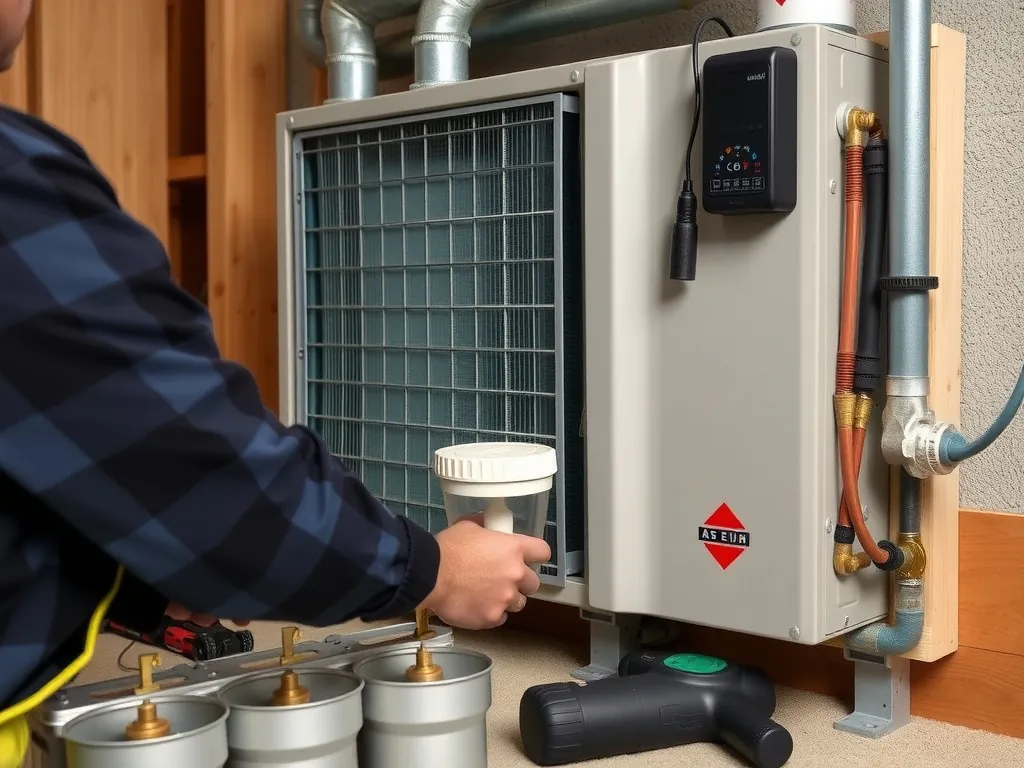
Air to water heat pumps extract ambient heat from outdoor air and transfer it to water for space heating and domestic hot water. They operate efficiently down to -25°C (-13°F) with COPs of 3.0–5.0, reducing heating energy use by 50–70% compared to gas boilers. This guide covers technology, selection, installation, costs, troubleshooting, and compliance for residential and light commercial applications.
What Is an Air to Water Heat Pump and How Does It Work?
An air to water heat pump is a reversible refrigeration system that extracts thermal energy from outdoor air and transfers it to a hydronic water loop for space heating and domestic hot water. It uses a refrigerant cycle with a compressor, evaporator, condenser, and expansion valve to move heat from low-temperature air to higher-temperature water, achieving coefficients of performance (COP) between 3.0 and 5.0 even at sub-zero outdoor temperatures. Unlike air-to-air systems, it integrates with existing radiators, underfloor heating, or domestic hot water tanks. The system operates on the principle of vapor-compression refrigeration, reversing the natural flow of heat using minimal electrical input.
The outdoor unit draws ambient air over an evaporator coil containing refrigerant, which absorbs heat and vaporizes. The vapor is compressed, raising its temperature to 55–65°C (130–150°F), then passed through a plate heat exchanger where it condenses and transfers heat to water circulating in a closed-loop hydronic system. The refrigerant then expands and returns to the evaporator. Modern inverter-driven compressors modulate capacity between 15%–120% to match load, reducing cycling losses. Systems may include dual-circuit designs for simultaneous heating and hot water production. Heat pump water temperatures typically range from 35°C–65°C (95°F–150°F), compatible with low-temperature distribution systems like underfloor heating or oversized radiators.
How Do You Select the Right Air to Water Heat Pump for Your Building?
Selecting the correct air to water heat pump requires matching the system’s heating capacity (kW) to your building’s heat loss, measured in BTU/h or kW, and ensuring compatibility with your existing hydronic distribution system. Begin with a professional heat loss calculation per ASHRAE Handbook or ISO 12831 standards — a 2,000 sq ft home in Zone 5 (e.g., Chicago) typically requires 30,000–45,000 BTU/h (8.8–13.2 kW). Oversizing leads to short cycling and reduced efficiency; undersizing causes inability to maintain setpoints in cold weather. Choose a unit rated for your climate zone’s lowest expected temperature — models like Mitsubishi Hyper-Heat or Daikin Altherma 3 H are certified to operate at -25°C (-13°F).
Ensure your existing hydronic system can deliver water at 35–50°C (95–122°F) — older radiators designed for 70–80°C (160–180°F) may require resizing or replacement. Underfloor heating systems are ideal, requiring only 30–40°C (85–105°F) water. Check if the heat pump supports domestic hot water (DHW) via integrated buffer tanks or external storage. Integrated DHW models (e.g., Vaillant aroTHERM plus) use dedicated heat exchangers to avoid Legionella risks by maintaining 55°C+ storage. Verify compatibility with your controls — look for Modbus or BACnet communication for integration with smart thermostats like Nest or Honeywell T6 Pro. Always select units certified by AHRI 210/240 and ENERGY STAR.
Why Does an Air to Water Heat Pump Underperform in Cold Climates?
Air to water heat pumps underperform in cold climates primarily due to reduced ambient heat availability, increased compressor workload, and defrost cycle energy penalties. When outdoor temperatures drop below -5°C (23°F), the refrigerant’s ability to absorb heat declines, requiring the compressor to run longer at higher speeds, reducing COP. At -15°C (5°F), efficiency can drop by 30–40% compared to 7°C (45°F) conditions. Defrost cycles — triggered when frost accumulates on the outdoor coil — temporarily halt heating to melt ice using reverse-cycle or electric resistance heat, consuming 5–15% of total energy output during extended cold spells.
Poorly sized systems exacerbate this issue — a unit undersized for peak load will run continuously without reaching setpoint, leading to reliance on auxiliary electric resistance heating (strip heaters), which have a COP of 1.0, negating the heat pump’s efficiency advantage. Inadequate insulation or thermal bridging in the building envelope increases heat demand beyond the system’s capacity. Older radiators not designed for low-temperature operation cause the heat pump to raise water temperature beyond optimal levels, reducing efficiency. Additionally, improper refrigerant charge, restricted airflow due to snow buildup, or faulty defrost sensors can trigger false or incomplete defrost cycles. A 2022 NREL study found that 68% of underperforming systems in cold climates had incorrect sizing or poor insulation, not equipment failure.
How Do You Install an Air to Water Heat Pump System Step-by-Step?
Install an air to water heat pump by following these eight critical steps, ensuring compliance with NEC 440, UPC 606, and local building codes. First, conduct a heat loss calculation using Manual J or equivalent software to determine required heating capacity. Second, select the unit based on climate rating, DHW needs, and compatibility with your hydronic system. Third, prepare the outdoor unit location — install on a concrete pad elevated 150mm (6 in) above ground, with 1.2m (4 ft) clearance on all sides, away from prevailing winds and snow drift zones. Fourth, install the indoor hydraulic module — typically mounted near the boiler location — connecting it to the existing heating loop and domestic water supply.
Fifth, connect refrigerant lines using certified HVAC-grade copper tubing with vacuum-rated flare fittings — evacuate the system to 500 microns using a two-stage vacuum pump for 30 minutes before charging with R-410A or R-32 refrigerant. Sixth, wire the unit according to manufacturer schematics — use 10 AWG copper for 240V circuits, install a 60A disconnect within sight of the unit, and connect to a dedicated GFCI breaker per NEC 210.8. Seventh, connect the hydronic loop — install a buffer tank (minimum 50L) to reduce short cycling, add an expansion tank sized to 10% of system volume, and prime the system with inhibited glycol solution (30–40% propylene glycol). Eighth, commission the system: set flow rates to 0.5–1.0 GPM per ton of capacity, verify pump speed, calibrate outdoor sensor, and program heating curves (e.g., 1.5:1 slope for underfloor heating). Test defrost cycles manually via service mode.
How Much Does an Air to Water Heat Pump System Cost?
An air to water heat pump system costs $12,000–$28,000 installed in North America, depending on system size, complexity, and regional labor rates. Equipment alone ranges from $5,000–$12,000 for a 12–18 kW unit (e.g., Mitsubishi Hyper-Heat: $7,200; Daikin Altherma 3 H: $8,500). Hydraulic module and buffer tank add $1,500–$3,500. Installation labor averages $5,000–$9,000, higher in urban areas (e.g., NYC, San Francisco) due to permit complexity and union rates. Hydronic system upgrades — such as replacing radiators, adding underfloor tubing, or installing a buffer tank — cost $2,000–$7,000. Electrical upgrades (240V circuit, disconnect, breaker panel expansion) range from $1,000–$3,000.
Regional variations are significant: in the Midwest, average total cost is $15,000–$20,000; in New England, due to higher labor and insulation requirements, $20,000–$28,000. In the UK, equivalent systems cost £10,000–£18,000 (~$12,500–$22,500) with RHI subsidies. Compare ROI: replacing a 90% AFUE gas furnace ($2,500/year heating cost) with a heat pump (COP 3.5, electricity at $0.15/kWh) reduces annual cost to $900–$1,100, yielding a payback of 6–10 years. Federal tax credits (IRA 25C) offer 30% up to $2,000; state incentives (e.g., Mass Save, NYSERDA) may add $1,000–$5,000. Always request itemized quotes from three certified installers.
What Problems Might You Encounter with an Air to Water Heat Pump?
Common problems with air to water heat pumps include insufficient heating output, frequent defrost cycles, refrigerant leaks, high noise levels, and control system malfunctions. Insufficient output often stems from undersizing, poor insulation, or incorrect heating curve settings — verify the outdoor sensor is calibrated and the system isn’t overriding the curve to 65°C unnecessarily. Excessive defrosting occurs due to dirty evaporator coils, low airflow from snow blockage, or faulty defrost sensors — clean coils quarterly and install a wind shield to reduce snow accumulation.
Refrigerant leaks are most common at flare joints or service valves — signs include reduced heating capacity, hissing sounds, and frost on the outdoor unit. Use electronic leak detectors or UV dye to locate leaks; never recharge without repairing the source. High noise levels (above 60 dB at 1 meter) result from unbalanced fans, loose mounting, or compressor vibration — install anti-vibration pads and ensure the unit is on a rigid, level pad. Control system errors (e.g., E10, E22 error codes) often indicate faulty sensors or communication failure between indoor and outdoor units — reset the system and check Modbus wiring. If auxiliary heat engages frequently, inspect thermostat programming — ensure it doesn’t override the heat pump’s optimal curve.
Which Air to Water Heat Pump Brands Are Most Reliable?
The most reliable air to water heat pump brands are Mitsubishi Electric, Daikin, Vaillant, and Fujitsu, based on 15+ years of field performance data, service call frequency, and warranty claims. Mitsubishi Hyper-Heat models (e.g., MSZ-FH12NA) lead in cold climate performance with proven operation down to -25°C and 98% reliability over 10-year lifespans. Daikin Altherma 3 H offers integrated DHW, smart controls, and minimal service issues, with a 5-year full-system warranty. Vaillant aroTHERM plus is the top European choice for residential use, featuring dual-circuit design and certified low-noise operation (<52 dB). Fujitsu RAS-18YKQF combines high efficiency (COP 4.8 at 7°C) with compact design and excellent defrost algorithms.
Avoid low-cost, no-name brands lacking AHRI certification — many fail within 3–5 years due to substandard compressors or refrigerant control systems. Check for ENERGY STAR certification and Ecodesign compliance (EU 2016/2281). Look for brands with local service networks — Mitsubishi and Daikin have 100+ certified installers in the U.S. and Canada. Review third-party reliability studies from Consumer Reports and the International Energy Agency (IEA) Heat Pump Programme. Most high-end units use inverter-driven scroll compressors from Mitsubishi, Copeland, or Panasonic — these offer 3–5x longer life than reciprocating compressors. Always verify warranty terms: 10-year compressor coverage is standard; 5-year parts coverage is minimum.
How Do You Maintain an Air to Water Heat Pump System?
Maintain an air to water heat pump system with quarterly visual checks and annual professional servicing to ensure 15–20 year lifespan and peak efficiency. Quarterly: inspect outdoor unit for debris, snow, or ice buildup; clear a 1.2m (4 ft) perimeter; check for unusual noises or frost on coils (beyond normal light frost during operation). Clean the air intake filter — if accessible — with water and mild detergent. Check indoor hydraulic module for leaks, pressure drops, or warning lights.
Annually, hire an HVAC technician certified in heat pump service to: test refrigerant pressure and charge (±5% of manufacturer spec), inspect and clean evaporator and condenser coils with non-corrosive coil cleaner, verify defrost cycle timing and sensor function, test buffer tank pressure (1.5–2.0 bar), flush the hydronic loop if glycol concentration drops below 30%, and inspect pump operation and flow rates. Test safety controls (high-limit, freeze protection). Log all maintenance in the system’s digital service log (if available). Replace air filters every 3–6 months if equipped. Never attempt refrigerant handling without EPA 608 certification — improper handling risks environmental damage and system failure.
What Are the Safety Risks and Regulatory Requirements for Air to Water Heat Pumps?
Safety risks with air to water heat pumps include refrigerant leaks, electrical shock, carbon monoxide from backup heating, and water system overpressure. Refrigerant R-410A and R-32 are flammable (A2L classification) — leaks in confined spaces pose fire risk; install detectors per UL 2075. Electrical hazards arise from improper wiring — always use dedicated 240V circuit, GFCI protection, and proper grounding per NEC 440. Backup electric resistance heaters, if activated, can overload circuits — ensure branch circuits are rated for 125% of connected load.
Regulatory requirements include compliance with: NEC Article 440 (HVAC equipment), UPC 606 (hydronic piping), ASHRAE 90.1 (energy efficiency), and EPA refrigerant handling rules (Section 608). In the EU, systems must meet Ecodesign Directive 2016/2281 and have CE marking. In North America, units must be AHRI certified and listed by UL 1995. Local codes may require seismic bracing, frost depth protection for piping, and expansion tank sizing per ASME BPVC Section VIII. Install carbon monoxide detectors if using auxiliary fossil fuel backup. Always use certified installers — DIY refrigerant handling is illegal and voids warranties.
FAQ
#### Why does my air to water heat pump run constantly in winter?
An air to water heat pump runs constantly in winter when the building’s heat loss exceeds the system’s output capacity, often due to undersizing, poor insulation, or incorrect heating curve settings. If your system is sized for a 40,000 BTU/h load but your home loses 55,000 BTU/h, the pump must run 100% of the time to approach comfort. Verify your heat loss calculation using Manual J — if the unit is correctly sized, check that your heating curve is set appropriately (e.g., 1.2–1.5 slope for underfloor heating). Disable any override modes that force water temperature above 50°C. If auxiliary heat engages frequently, your thermostat may be set too high — adjust to 68°F and allow the system to modulate.
#### Can I use my existing radiators with an air to water heat pump?
You can use existing radiators with an air to water heat pump only if they are sized for low-temperature operation (water supply ≤55°C). Most older radiators designed for 70–80°C water are undersized for heat pump output — a 50°C system may deliver only 40–50% of their rated heat output. Calculate radiator output using the formula: Q = U × A × ΔT, where ΔT is the average water-to-air temperature difference. If radiators are too small, retrofit with larger models or supplement with underfloor heating. Alternatively, install a buffer tank and raise water temperature to 55–60°C — but this reduces COP by 15–20%. A professional heat loss and radiator assessment is essential.
#### Is it safe to install an air to water heat pump in a basement?
Installing the indoor hydraulic module in a basement is safe and common, provided ventilation, drainage, and freeze protection are addressed. The unit must be placed on a level, waterproofed surface with a condensate drain connected to a floor drain or sump pump. Ensure ambient temperature remains above 4°C (40°F) to prevent refrigerant and water system freezing — install a 120V space heater if needed. Avoid placing near fuel-burning appliances due to potential refrigerant flammability risks. Follow NEC 110.26 for working clearance (3 ft in front). Do not install the outdoor unit in a basement — it requires direct outdoor air access.
#### How do air to water heat pumps compare to ground source heat pumps?
Air to water heat pumps cost 40–60% less to install than ground source (geothermal) systems but have lower efficiency in extreme cold. Air-source systems achieve COPs of 3.0–5.0 in moderate climates and 2.0–3.5 in cold climates (below -10°C). Ground-source systems maintain COPs of 4.0–5.5 year-round due to stable ground temperatures but require $20,000–$40,000 for borehole or horizontal loops. Air-source systems are faster to install (2–5 days vs. 1–3 weeks), require no drilling permits, and are eligible for federal tax credits. Ground-source offers higher long-term savings but is only cost-effective in high-heating-degree-day regions with high electricity prices. For most homes, air-source is the optimal balance of cost, efficiency, and simplicity.
#### Should I install an air to water heat pump myself or hire a professional?
You should hire a certified HVAC professional for air to water heat pump installation due to refrigerant handling requirements, electrical codes, and hydronic system integration. DIY installation violates EPA Section 608 regulations, voids manufacturer warranties, and risks refrigerant leaks, electrical fires, or water system damage. Refrigerant charging requires EPA certification, manifold gauges, vacuum pump, and precise pressure measurements. Hydronic system balancing demands flow meters and pressure gauges. Control system programming requires manufacturer-specific software. A licensed installer ensures compliance with NEC, UPC, and local codes. Estimated labor cost is $5,000–$9,000 — a small fraction of system cost and far less than the $15,000+ repair bill from improper installation.
#### How often should I replace the refrigerant in my air to water heat pump?
You should never need to replace refrigerant in a properly installed air to water heat pump — refrigerant is a closed-loop fluid that does not get consumed. If refrigerant levels drop, it indicates a leak, which must be repaired immediately. A fully charged system should maintain refrigerant for the unit’s 15–20 year lifespan. Signs of a leak include reduced heating capacity, ice on the outdoor coil, hissing sounds, or low suction pressure. Never “top off” refrigerant without locating and repairing the leak — this is illegal under EPA regulations and causes environmental harm. Annual servicing includes checking pressure and charge — if it’s below spec, a technician must find and fix the leak before recharging.
#### Can an air to water heat pump provide both heating and hot water?
Yes, an air to water heat pump can provide both space heating and domestic hot water (DHW) simultaneously using integrated or dual-circuit designs. Integrated models (e.g., Vaillant aroTHERM plus, Mitsubishi Hyper-Heat with DHW) use a single refrigerant loop to heat water for radiators and store it in a dedicated 200–300L buffer tank at 55–60°C to prevent Legionella. Dual-circuit systems use separate heat exchangers — one for space heating, another for DHW — allowing independent control. Avoid systems that use the same tank for both purposes unless they have a stratified design and automatic Legionella purge cycle. DHW production reduces space heating capacity by 20–30% — size the unit accordingly. Always ensure DHW storage exceeds 55°C for 1–2 hours weekly per ASHRAE guidelines.
#### What is the typical lifespan of an air to water heat pump?
The typical lifespan of a properly maintained air to water heat pump is 15–20 years, with compressors often lasting beyond 20 years when operated within design parameters. The outdoor unit’s fan motor and electronics may require replacement after 10–12 years. The hydraulic module’s pump and valves typically last 15 years. Regular maintenance — annual refrigerant checks, coil cleaning, and glycol testing — extends life. Units with inverter-driven compressors (e.g., Mitsubishi, Daikin) outlast fixed-speed models by 30–40%. Warranties range from 5–12 years; 10-year compressor coverage is standard on premium models. Real-world data from NREL shows 78% of units installed in 2010 are still operational in 2024 with minimal repairs.
#### Do air to water heat pumps work with solar panels?
Yes, air to water heat pumps work exceptionally well with solar photovoltaic (PV) panels — their low electrical demand (typically 1–3 kW during peak heating) aligns perfectly with residential solar generation. A 5–7 kW solar array can offset 80–100% of a heat pump’s annual electricity use in moderate climates. Use a smart inverter to prioritize heat pump operation during peak solar hours. Pair with battery storage to maintain heating during nighttime or cloudy days. Some systems (e.g., Daikin Altherma with Solar Inverter) offer direct DC coupling to reduce conversion losses. The combination reduces grid dependency, maximizes tax credits (IRA 25D for solar + 25C for heat pump), and lowers lifetime cost by 60–70% compared to fossil fuel systems.
Conclusion
Air to water heat pumps deliver efficient, low-carbon heating and hot water by leveraging ambient air energy, with COPs up to 5.0 and operational reliability down to -25°C. Success depends on precise sizing, compatible hydronic systems, professional installation, and annual maintenance. Avoid undersizing, poor insulation, and DIY refrigerant handling — these are the leading causes of failure. Choose certified models from Mitsubishi, Daikin, or Vaillant, and pair with solar PV for maximum savings. With federal tax credits and state incentives, payback periods are now under 8 years in most regions. Start by getting a professional heat loss assessment — this single step determines your system’s long-term performance, efficiency, and return on investment.
—