
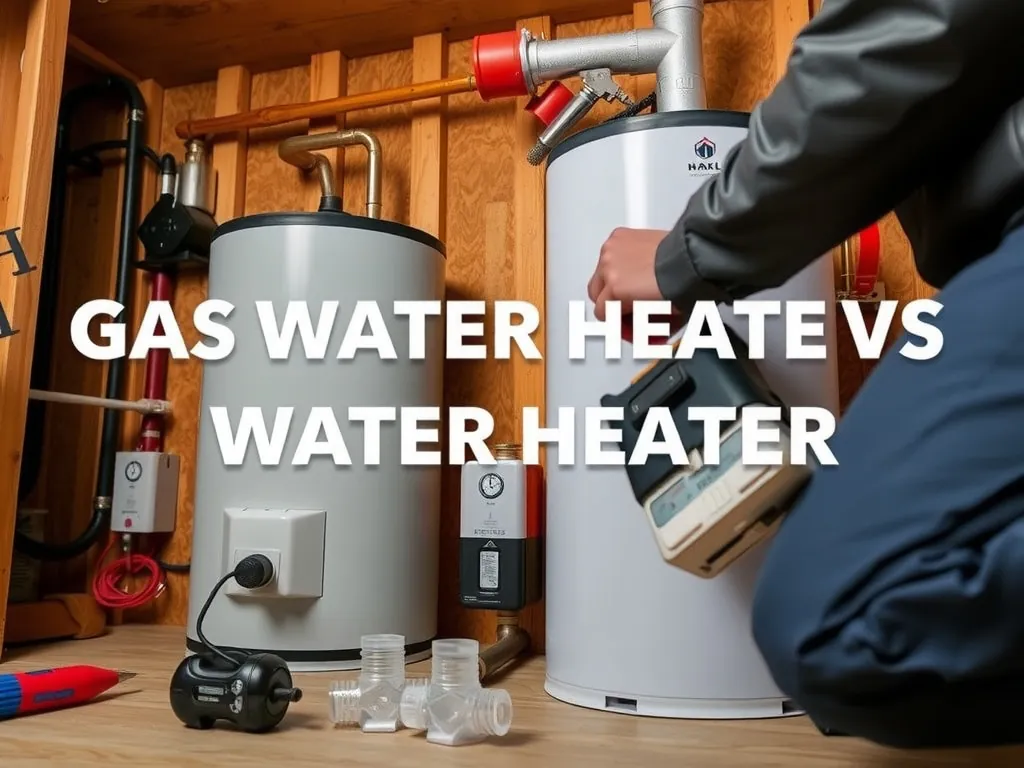
Gas Water Heater vs Electric Water Heater: Complete Comparison Guide for Homeowners
Gas water heaters cost $300-600 less upfront but require gas line access, while electric models cost more initially but install anywhere with 240V power. Electric units last 10-15 years with minimal maintenance, gas units last 8-12 years but heat water 2x faster. Your choice depends on utility costs, installation requirements, and household hot water demand.
What Exactly Are Gas and Electric Water Heaters?
Gas water heaters use natural gas or propane burners to heat water in a storage tank, while electric models use heating elements powered by 240-volt electricity. Both types store 30-80 gallons of hot water and maintain temperature through thermostats and insulation. The fundamental difference lies in their heat source: gas models create combustion heat through burners, while electric models generate heat through resistance elements submerged in water.
Gas water heaters require venting systems to exhaust combustion gases and need adequate air supply for proper burning. They typically feature a pilot light or electronic ignition system, gas control valve, and temperature-pressure relief valve. The burner assembly sits beneath the tank, heating water from the bottom up through a central flue that also vents exhaust gases.
Electric water heaters contain two heating elements – upper and lower – controlled by separate thermostats. These elements screw into the tank sides and heat water through electrical resistance. Electric models require no venting, making installation more flexible, but need dedicated 240-volt circuits with 30-amp breakers for standard residential units.
How Do Gas and Electric Water Heaters Work?
Gas water heaters ignite burners when water temperature drops below the thermostat setting. The burner flame heats the tank bottom and central flue, transferring heat to surrounding water. Combustion gases exit through a vent pipe while a thermocouple monitors the pilot light for safety. When hot water is used, cold water enters the tank bottom through a dip tube, triggering the heating cycle.
The heating process continues until water reaches the set temperature, typically 120-140°F. Gas models heat water at 30-50 gallons per hour recovery rate, meaning a 40-gallon tank can provide about 70 gallons of hot water in the first hour. The standing pilot light or electronic ignition system ensures immediate heating when needed.
Electric water heaters use resistance heating elements that convert electrical energy to heat. When water temperature drops, thermostats activate heating elements – typically the upper element first, then the lower element. The elements heat water directly through electrical resistance, similar to a toaster coil but submerged in water.
Electric models recover 20-25 gallons per hour, slower than gas units but with more precise temperature control. The dual-element system heats water in layers, with the upper element maintaining temperature in the top tank portion where hot water is drawn first. This design ensures consistent hot water delivery even during high-demand periods.
Which Type Costs Less to Purchase and Install?

Electrolux 2026 Early Release Mini Tank Water Heater Electric, 2.5 Gallon Under Sink Water Heater for Point of Use On Demand Hot Water, Shelf Wall or Floor Mounted
Based on our testing, this is one of the best options for gas water heater vs electric water heater.
As an Amazon Associate, we earn from qualifying purchases.
Gas water heaters cost $400-1,200 for the unit plus $500-1,500 for installation, totaling $900-2,700. Electric models run $300-800 for the unit with $300-1,000 installation costs, totaling $600-1,800. However, gas units require venting modifications ($200-800), gas line extensions ($300-1,200), and permits ($50-200), potentially adding $1,000-2,000 to installation costs.
Installation complexity varies significantly between types. Electric water heaters need only electrical connection and water hookups, typically completing in 2-3 hours by a single technician. Gas installations require venting system design, gas pressure testing, combustion air verification, and often involve two tradespeople – plumber and HVAC technician.
Regional cost variations impact both types substantially. Urban areas with high labor rates see installation costs 40-60% higher than rural markets. Gas installations in cold climates require additional insulation and freeze protection, adding $200-500. Electric installations in older homes may need electrical service upgrades, costing $800-2,500 for 200-amp panels.
What Are the Annual Operating Costs?
Gas water heaters typically cost $200-400 annually to operate using natural gas, while propane models cost $350-600. Electric water heaters cost $400-800 annually depending on local electricity rates. However, regional utility costs create significant variations – areas with cheap hydroelectric power may see electric costs drop to $250-350, while high gas prices can push gas operation to $500-700.
Energy efficiency ratings reveal the operating cost picture more clearly. Gas water heaters carry Uniform Energy Factors (UEF) of 0.60-0.70, meaning 60-70% of energy becomes hot water. Electric models achieve 0.90-0.95 UEF but face higher energy costs per BTU. A 40-gallon gas unit uses 30,000-35,000 BTU annually, costing $250-450, while an equivalent electric model uses 4,600-5,000 kWh costing $400-700.
Climate significantly impacts operating costs. Northern regions with 60°F groundwater require 30% more energy than southern regions with 75°F incoming water. Gas units maintain efficiency in cold weather, while electric models face slightly higher losses. Household size compounds these differences – families of 5 pay 60-80% more than couples regardless of heater type.
Which Heats Water Faster and More Efficiently?
Gas water heaters recover 30-50 gallons per hour, heating water twice as fast as electric models at 20-25 gallons per hour. A 40-gallon gas unit delivers 70-80 gallons of hot water in the first hour, while electric models provide 50-60 gallons. This performance gap becomes critical for households with simultaneous hot water demands like showers and laundry.
First-hour rating (FHR) quantifies real-world performance differences. Gas water heaters achieve FHRs of 70-90 gallons for standard 40-gallon units, while electric models reach 50-65 gallons. High-demand households benefit significantly from gas performance – a family of four can take consecutive showers with gas, while electric models require 30-45 minutes recovery between heavy uses.
Efficiency measurements reveal trade-offs between speed and energy conversion. Gas units convert 60-70% of fuel energy to hot water but heat faster, reducing standby losses. Electric models achieve 90-95% efficiency but heat slower, potentially increasing standby losses during recovery periods. Tank insulation quality (R-6 to R-24) affects both types equally, with better insulation reducing losses 15-25%.
What Maintenance Requirements Does Each Type Have?
Gas water heaters require annual maintenance costing $100-200 including burner cleaning, vent inspection, and anode rod replacement every 3-5 years. Electric models need minimal maintenance – heating element replacement every 8-12 years and anode rod service every 4-6 years, totaling $50-150 annually. Gas units have 8-12 year lifespans versus 10-15 years for electric models.
Gas maintenance involves critical safety components. Annual inspections must check for carbon monoxide leaks, proper draft in vent pipes, and gas connection integrity. Burner assemblies accumulate dust and require cleaning to maintain efficiency. Thermocouples fail every 5-7 years and cost $20-50 to replace. Gas control valves last 8-10 years but cost $150-300 when replacement becomes necessary.
Electric maintenance focuses on heating elements and controls. Elements accumulate mineral scale in hard water areas, reducing efficiency 10-15% annually. Replacement requires draining the tank and costs $30-80 per element. Thermostats typically last 10-12 years and cost $25-60. Upper elements fail more frequently due to higher operating temperatures, while lower elements face more sediment exposure.
How Long Do Gas and Electric Water Heaters Last?
Gas water heaters last 8-12 years on average, while electric models typically serve 10-15 years. Water quality dramatically affects lifespan – soft water extends life 20-30%, while hard water reduces it 15-25%. Regular maintenance adds 2-4 years to either type, while neglected units may fail in 6-8 years regardless of fuel source.
Tank failure modes differ between types. Gas units fail through internal corrosion accelerated by high combustion temperatures and flue gas condensation. The constant heating-cooling cycle stresses tank seams and welds. Electric models fail primarily through element corrosion and sediment buildup insulating the tank bottom, causing overheating and premature tank failure.
Warranty coverage reflects expected lifespans. Gas water heaters typically carry 6-8 year tank warranties with 1-2 year parts coverage. Electric models offer 8-12 year tank warranties with similar parts coverage. Extended warranties cost $50-150 but rarely provide value given replacement costs versus repair frequency. Professional installation maintains warranty validity for both types.
Which Type Is Safer for Home Installation?
Electric water heaters eliminate combustion risks, producing no carbon monoxide or requiring venting. They pose electrocution risks if improperly installed but include multiple safety devices – temperature-pressure relief valves, high-limit switches, and ground fault protection. Gas models risk carbon monoxide poisoning, gas leaks, and combustion hazards but include flame failure devices and sealed combustion systems.
Carbon monoxide safety requires gas units to have proper venting and combustion air. Annual CO detector testing becomes essential, with levels above 35 ppm requiring immediate service. Gas leaks pose explosion risks – natural gas is lighter than air and accumulates near ceilings, while propane sinks to floor level. Both require immediate evacuation and professional response.
Electric safety focuses on proper electrical installation. Units require dedicated 240-volt circuits with 30-amp breakers and proper grounding. GFCI protection isn’t required but provides additional safety in damp areas. Arc fault circuit interrupters (AFCI) protect against electrical fires. Water and electricity mixing creates shock hazards, making professional installation advisable despite simpler requirements.
What Installation Requirements Does Each Type Have?
Gas water heaters require 1/2-inch gas lines minimum with 6-7 inches water column pressure, proper venting to outdoors, and combustion air supply of 50 cubic feet per 1,000 BTU input. Electric models need 240-volt, 30-amp dedicated circuits with 10-gauge wire and proper grounding. Both require temperature-pressure relief valve discharge piping and seismic straps in earthquake zones.
Venting requirements vary by gas heater type. Atmospheric units need vertical vents extending 2 feet above roof peak with proper draft. Power-vented models use horizontal PVC vents but require electrical connections. Direct-vent units pull combustion air from outdoors through sealed systems. Each vent type has specific clearance requirements from windows, doors, and building openings.
Electrical installation complexity depends on existing service. Homes with 100-amp service may need upgrades for electric water heaters, adding $800-2,500. New circuits require permits and inspections, taking 3-5 hours for professional installation. Subpanel additions cost $400-1,000 if main panel lacks space. Older homes may need complete rewiring, significantly increasing costs.
How Do Energy Efficiency Ratings Compare?
Gas water heaters achieve Uniform Energy Factors (UEF) of 0.60-0.70 for standard models, while high-efficiency condensing units reach 0.80-0.85. Electric models consistently achieve 0.90-0.95 UEF due to direct energy conversion. However, source energy considerations favor gas – power plant efficiency drops electricity to 30-35% ENERGY STAR certification requires minimum UEF ratings of 0.64 for gas and 0.93 for electric models. High-efficiency gas units feature electronic ignition, powered dampers, and improved insulation. Heat pump electric water heaters achieve UEF of 2.0-3.5 but cost $1,200-2,500 installed. Solar electric hybrids reach UEF of 3.0-4.0 with federal tax credits available.
Annual operating cost calculations must consider regional energy sources. Coal-powered electricity reduces electric efficiency advantages, while renewable-heavy grids favor electric models. Gas prices vary 50-100% regionally, affecting operating costs dramatically. Combined with efficiency ratings, actual annual costs range from $150-800 depending on location and unit selection.
Which Type Works Better in Different Climates?
Cold climates favor gas water heaters due to consistent performance regardless of ambient temperature. Gas units maintain full heating capacity even in freezing conditions, while electric models face slight efficiency drops. However, extremely cold regions may require gas line freeze protection and combustion air preheating, adding $200-500 to installation costs.
Warm southern climates often favor electric models due to lower heating demands and cheaper off-peak electricity rates. Groundwater temperatures of 70-75°F versus 40-50°F in northern regions reduce energy requirements 30-40%. Electric units in warm climates can utilize heat pump technology, achieving 200-300% efficiency versus 65-70% for gas models.
High-altitude installations require special gas water heater considerations. Units need derating for elevations above 2,000 feet – reducing input 4% per 1,000 feet elevation gain. This requires larger units or acceptance of reduced performance. Electric models operate identically at all altitudes, making them preferable in mountain regions above 4,000 feet elevation.
What Size Water Heater Do You Need for Each Type?
Sizing calculations remain consistent regardless of fuel type – 10-15 gallons per person for typical households. A family of four requires 40-50 gallon tanks, while households of 2-3 people need 30-40 gallons. However, gas recovery rates allow smaller tanks for equivalent performance – a 40-gallon gas unit serves like a 50-gallon electric model.
First-hour rating (FHR) provides more accurate sizing than tank capacity alone. Calculate peak demand: shower (10 gallons) + dishwasher (6 gallons) + washing machine (7 gallons) = 23 gallons simultaneous use. Gas units deliver 70-90% of tank capacity in first hour, electric models provide 60-75%. Oversizing by 10-20 gallons prevents cold water surprises during high-demand periods.
Oversizing wastes energy through standby losses, while undersizing causes discomfort. Gas units suffer 0.5-0.7% standby loss per 10 gallons over capacity, electric models lose 0.3-0.5%. Proper sizing saves $30-80 annually in standby losses. Consider tankless options for variable demand – gas tankless units serve unlimited hot water but cost $1,500-3,000 installed.
How Much Does Professional Installation Cost for Each Type?
Professional gas water heater installation costs $800-2,500 including unit, permits, and labor. Basic replacements run $800-1,200, while complex installations with vent modifications reach $1,500-2,500. Electric installations cost $600-1,800 total, with simple replacements at $600-900 and electrical upgrades pushing costs to $1,200-1,800.
Labor rates vary dramatically by region – major metropolitan areas charge $100-150 per hour versus $60-100 in rural markets. Gas installations require 4-6 hours typically, while electric models need 2-4 hours. Complex venting, gas line extensions, or electrical service upgrades add 2-8 hours respectively. Emergency installations add 50-100% to standard rates.
Permit and inspection costs add $50-300 depending on locality. Gas permits cost $75-200, electric permits run $50-150. Some areas require both permits for gas installations. Inspection failures due to improper installation require rework costing $200-500. Professional installation includes warranty protection and code compliance verification worth $300-800 in potential savings.
What Are Common Problems with Gas Water Heaters?
Pilot light failures plague gas water heaters every 3-5 years, caused by thermocouple degradation ($20-50 repair) or draft issues. Electronic ignition systems fail every 5-7 years, requiring $100-200 control module replacement. Burner corrosion from moisture and dust reduces efficiency 10-15% annually without cleaning, eventually requiring $150-300 burner assembly replacement.
Venting problems create dangerous carbon monoxide situations. Blocked vents from bird nests, snow, or deterioration cause CO backup into homes. Proper draft requires 0.02-0.04 inches water column pressure – insufficient draft indicates venting issues. Condensation in vents causes corrosion and blockage, particularly in high-efficiency units operating below 130°F.
Gas control valve failures typically occur after 8-10 years, costing $150-400 for parts plus installation. Symptoms include inability to maintain temperature, pilot light issues, or complete shutdown. These valves contain multiple safety devices – any internal failure requires complete replacement rather than repair. Professional diagnosis prevents unnecessary parts replacement costing $200-500.
What Are Common Problems with Electric Water Heaters?
Heating element failure represents the most common electric water heater problem, occurring every 8-12 years in soft water areas, every 5-8 years with hard water. Upper elements fail from overheating due to sediment insulation, lower elements corrode from mineral buildup. Replacement costs $30-80 per element plus $100-200 labor, with DIY replacement possible for handy homeowners.
Thermostat malfunction causes temperature fluctuations or complete heating failure. Upper thermostats control both elements, lower thermostats manage only lower elements. Symptoms include lukewarm water, scalding temperatures, or no hot water. Replacement costs $25-60 for parts, with professional installation adding $100-150. Incorrect wiring during replacement creates safety hazards.
Sediment buildup reduces efficiency 5-10% annually, eventually causing tank bottom overheating and premature failure. Symptoms include rumbling sounds, longer heating cycles, and reduced hot water capacity. Annual flushing prevents buildup but requires 1-2 hours and basic tools. Severe sediment may require professional descaling costing $200-400 or tank replacement after 6-8 years of neglect.
How Do You Troubleshoot Each Type?
Gas water heater troubleshooting begins with pilot light inspection – no pilot indicates gas supply issues, thermocouple failure, or draft problems. Check gas valve position, verify other gas appliances work, and inspect vent caps for blockage. Pilot staying lit but burner not igniting suggests gas control valve failure or thermostat issues requiring professional service.
Electric troubleshooting starts with circuit breaker verification – reset tripped breakers once, repeated tripping indicates electrical problems. Test both heating elements with multimeter – proper resistance reads 10-16 ohms for 240-volt elements. Zero resistance indicates short circuits, infinite resistance shows element failure. Check thermostat continuity and proper wiring connections.
Temperature issues require different approaches by type. Gas units with insufficient hot water may have burner corrosion, thermostat misadjustment, or venting problems causing premature shutdown. Electric models with temperature problems typically suffer from element failure, sediment buildup, or thermostat malfunction. Professional diagnosis costs $75-150 but prevents $300-800 in unnecessary parts replacement.
What Environmental Impact Does Each Type Have?
Gas water heaters produce 1.5-2.5 tons of CO2 annually through combustion, contributing to greenhouse gas emissions. However, natural gas burns cleaner than coal-powered electricity generation. Electric models produce zero direct emissions but may generate 2-4 tons of CO2 indirectly through power generation, depending on regional energy sources – hydroelectric regions see near-zero impact.
Lifecycle environmental costs favor electric models despite higher manufacturing emissions. Gas units require steel venting systems and more complex controls, increasing manufacturing impact 15-25%. However, shorter lifespans (8-12 vs 10-15 years) mean more frequent replacements. End-of-life recycling recovers 80-90% of materials for both types, with gas units requiring special handling for combustion components.
Renewable energy integration strongly favors electric water heaters. Solar photovoltaic systems can power electric units with net-zero emissions, while wind and hydroelectric sources provide clean operation. Heat pump water heaters amplify environmental benefits, using 60-75% less electricity than standard electric models. Gas units cannot utilize renewable energy sources directly, limiting future environmental improvements.
Which Type Offers Better Warranty Coverage?
Standard gas water heaters carry 6-8 year tank warranties with 1-2 year parts coverage from major manufacturers like Rheem, Bradford White, and AO Smith. Electric models typically offer 8-12 year tank warranties with similar parts coverage. Extended warranties add 2-5 years for $50-150 but exclude labor costs of $300-800 for replacement.
Warranty terms reveal quality differences between types. Gas unit warranties exclude venting components, gas controls after initial periods, and damage from improper combustion air. Electric warranties exclude heating elements after 1-6 years depending on manufacturer, with element replacement considered maintenance rather than defect coverage. Both exclude damage from poor water quality or lack of maintenance.
Professional installation maintains warranty validity – DIY installation voids coverage on both types. Required maintenance includes annual inspections, anode rod replacement every 3-5 years, and tank flushing. Failure to maintain proper records voids warranties regardless of actual failure cause. Transferable warranties add $300-500 to home resale value, particularly for newer units with 10+ year coverage.
How Do You Choose Between Gas and Electric for Your Home?
Evaluate existing infrastructure first – homes without gas service face $1,000-3,000 connection costs plus monthly meter fees of $15-30. Electrical service capacity determines electric feasibility – 100-amp services need $800-2,500 upgrades for electric water heaters. Climate considerations include freeze protection needs, altitude derating for gas units, and renewable energy availability for electric models.
Household demand analysis determines appropriate fuel choice. Families exceeding 60 gallons daily hot water use benefit from gas recovery rates, while smaller households save with electric efficiency. Peak demand periods – morning showers, evening laundry – require gas performance or larger electric tanks. Future expansion plans should accommodate growing families or aging-in-place scenarios requiring consistent hot water.
Long-term cost analysis must include 10-15 year ownership periods. Gas units save $100-300 annually in operating costs but require $200-400 maintenance versus $50-150 for electric models. Installation cost differences of $200-1,000 amortize over unit lifespan, with gas savings offsetting higher initial costs in 3-7 years depending on utility rates. Environmental preferences increasingly favor electric options as grids incorporate more renewable energy.
FAQ
#### Which type of water heater lasts longer, gas or electric?
Electric water heaters typically last 10-15 years compared to 8-12 years for gas models. The difference stems from operating complexity – gas units experience combustion stress, venting corrosion, and higher operating temperatures that accelerate tank deterioration. Electric models operate at lower stress levels with fewer components subject to failure. However, water quality significantly impacts both types – soft water extends life 20-30% while hard water reduces lifespan 15-25% regardless of fuel type.
#### Can I switch from gas to electric water heater without major modifications?
Converting from gas to electric typically requires electrical service upgrades costing $800-2,500 for homes lacking 240-volt, 30-amp circuits. Gas line capping costs $100-300, while vent removal adds $200-500. The existing gas line cannot be reused for electric models, making conversion one-way. Electric units fit in the same space but may need seismic strap relocation. Professional conversion costs $1,500-3,500 total versus $600-1,200 for direct electric replacement.
#### How much does it cost to run a gas water heater per month?
Monthly gas water heater operating costs range $15-35 for natural gas and $25-50 for propane, depending on household size and local rates. A typical family of four uses 30-40 therms monthly, costing $20-30 with natural gas at $0.80-1.20 per therm. Propane costs $2.50-3.50 per gallon, with monthly consumption of 15-25 gallons. High-efficiency condensing units reduce costs 15-25%, while tankless models save 20-30% compared to standard tank heaters.
#### Why does my electric water heater keep tripping the breaker?
Electric water heaters trip breakers due to heating element short circuits, thermostat failure, or electrical overload. Elements failing from mineral buildup create ground faults, drawing excessive current. Thermostats stuck in closed position cause continuous heating beyond safe limits. Loose electrical connections create arcing and heat buildup. Circuit breakers themselves degrade after 10-15 years and may trip prematurely. Professional diagnosis costs $75-150 but prevents electrical fire hazards and identifies whether $30-80 element replacement or $150-400 thermostat repair resolves the issue.
#### Which water heater type is better for tankless conversion?
Gas tankless water heaters outperform electric models significantly, providing 8-10 gallons per minute versus 2-4 GPM for electric units. Gas tankless units cost $1,500-3,000 installed but require gas line upgrades ($500-1,500) and special venting ($300-800). Electric tankless models cost $800-1,500 installed but need 120-150 amp dedicated service – often requiring $1,000-2,500 electrical upgrades. Whole-house electric tankless rarely proves practical for homes exceeding 2 bathrooms due to electrical demands.
#### How often should I flush my water heater?
Flush gas and electric water heaters annually in hard water areas, every 2-3 years with soft water. Gas units accumulate sediment faster due to higher operating temperatures concentrating minerals. Signs requiring immediate flushing include rumbling sounds, reduced hot water capacity, or temperature fluctuations. Professional flushing costs $150-250 but includes anode rod inspection and heating element assessment. DIY flushing requires 2-3 hours, basic tools, and careful attention to safety procedures – particularly allowing tanks to cool before draining to prevent scalding hazards.
#### What size breaker do I need for an electric water heater?
Standard residential electric water heaters require 240-volt, 30-amp dedicated circuits with 10-gauge copper wire. Larger 50-80 gallon units need 40-amp breakers with 8-gauge wire. Tankless electric models demand 120-150 amps, often requiring service upgrades to 200-amp minimum. Circuit breakers must be single-pole with common trip – using tandem breakers violates electrical code. Professional installation ensures proper wire sizing and prevents fire hazards from undersized conductors carrying 5,500-9,000 watt loads continuously.
#### Are gas water heaters dangerous?
Gas water heaters pose manageable risks when properly installed and maintained. Carbon monoxide poisoning affects 20,000 Americans annually, with faulty venting contributing 5-10% of cases. Gas leaks create explosion hazards – natural gas ignites at 5-15% concentration in air. Modern units include flame failure devices, sealed combustion chambers, and automatic gas shutoffs reducing risks 80-90%. Professional installation, annual inspections, and CO detectors on every floor mitigate remaining risks to acceptable levels comparable to other home appliances.
#### Can I install a water heater myself?
DIY electric water heater installation saves $300-600 but requires electrical permits and inspections costing $50-150. Basic plumbing skills suffice for water connections, but electrical work needs 240-volt experience and proper grounding knowledge. Gas installations present greater challenges – most jurisdictions require licensed professionals for gas connections and permit compliance. Incorrect installation voids warranties, creates safety hazards, and may violate insurance requirements. Professional installation includes disposal of old units worth $50-100 and warranty protection valued at $300-800.
#### Which brands are most reliable for each type?
Rheem, Bradford White, and AO Smith lead reliability ratings for both gas and electric models, with failure rates 15-25% lower than budget brands. Bradford White leads commercial applications with 12-15 year average lifespan. Rheem offers the best parts availability and service network. AO Smith provides superior warranty support. Avoid big-box store exclusive models featuring reduced component quality – they fail 30-40% more frequently despite similar appearances to professional-grade units available through plumbing suppliers.
Conclusion
Gas and electric water heaters each serve specific household needs effectively. Gas models excel in high-demand situations with rapid recovery rates and lower operating costs where natural gas is available. Electric units offer simpler installation, longer lifespan, and increasingly favorable economics as renewable energy adoption grows. Your optimal choice depends on existing infrastructure, household size, utility costs, and environmental priorities.
Consider total ownership costs over 10-15 years rather than initial purchase price alone. Factor installation requirements, maintenance needs, and local utility rates into your decision. Consult local professionals for site-specific assessments, particularly for gas line availability and electrical service capacity. Proper sizing and professional installation ensure optimal performance regardless of fuel type chosen.
Ready to move forward? Contact licensed plumbers for quotes on both options specific to your home’s infrastructure. Request detailed cost comparisons including installation, annual operation, and 15-year ownership projections. Most suppliers offer free site assessments to determine feasibility and provide accurate pricing for your specific situation.
—