
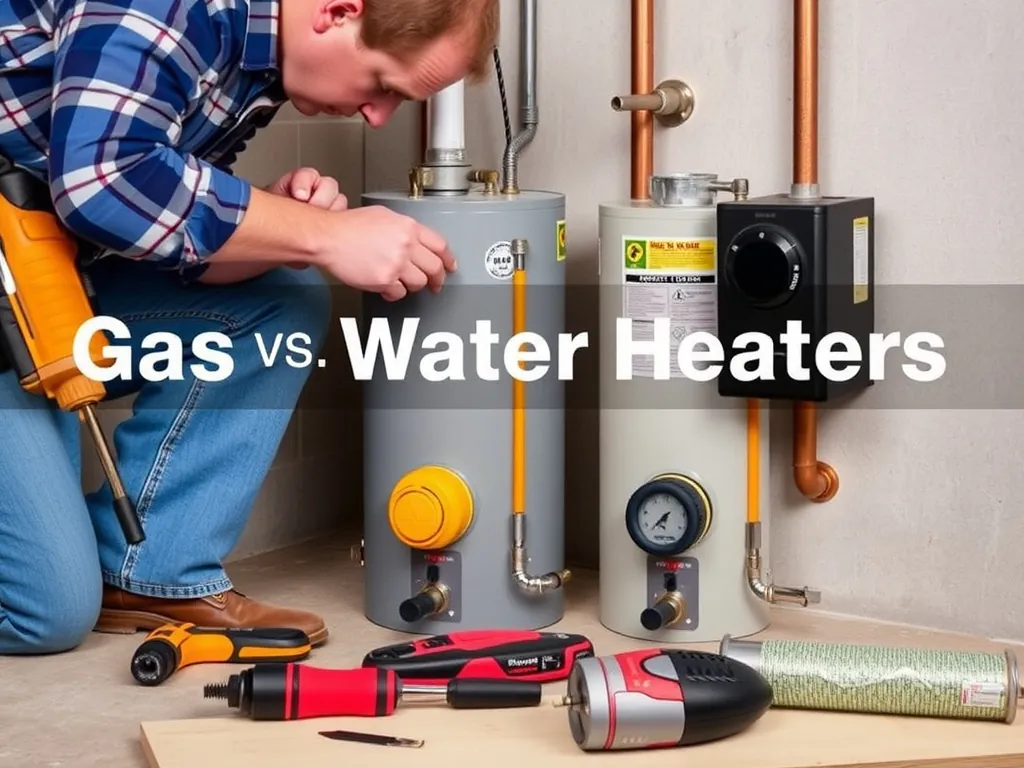
Gas vs Electric Hot Water Heater: Complete Comparison Guide for Homeowners
Gas water heaters heat water 30-40% faster than electric models while costing $200-400 more upfront. Electric units offer 90-95% thermal efficiency versus 60-70% for gas, but electricity rates typically double gas costs per BTU. This guide compares efficiency, costs, installation requirements, and performance to help you choose the right system for your home.
How Do Gas and Electric Water Heaters Actually Work?
Gas water heaters use a burner assembly at the bottom of the tank to heat water through combustion, with exhaust gases vented through a flue pipe running up the center. The burner ignites when the thermostat detects water temperature below the set point, heating water to 120-140°F before shutting off. Electric models use heating elements submerged directly in the water, typically two elements controlled by upper and lower thermostats that energize sequentially to maintain consistent temperature throughout the tank.
The fundamental difference lies in heat transfer efficiency. Gas burners produce 40,000-50,000 BTU of heat energy, but 30-40% escapes through the flue. Electric elements convert 100% of electrical energy to heat with zero waste. However, gas combustion creates more rapid heat transfer, allowing gas units to recover hot water 30-40% faster than electric models of equivalent capacity.
Both systems use similar tank construction with glass-lined steel, anode rods for corrosion protection, and temperature-pressure relief valves. The primary operational difference involves ignition systems: gas units use pilot lights or electronic ignition, while electric models simply energize heating elements when needed.
What Are the Real Efficiency Differences Between Gas and Electric Models?
Electric water heaters achieve 90-95% thermal efficiency since all electrical energy converts directly to heat within the water. Gas water heaters typically operate at 60-70% efficiency due to heat loss through exhaust ventilation and standby heat loss from the constantly-warm flue. Modern condensing gas models can reach 80-85% efficiency by capturing heat from exhaust gases, but these units cost $400-800 more than standard gas heaters.
Energy Factor (EF) ratings quantify Standard electric models rate 0.90-0.95 EF, while gas units achieve 0.60-0.70 EF. However, this doesn’t account for source energy efficiency. Power plant electricity generation and transmission losses mean only 30-35% of original fuel energy reaches your home, making gas heaters more efficient from a total energy perspective despite lower EF ratings.
Heat pump electric water heaters represent a game-changing exception, delivering 300-400% efficiency by moving heat rather than generating it. These units use 60-70% less electricity than standard electric models but cost $800-1,500 more upfront. They require installation in spaces maintaining 40-90°F year-round and need 1,000 cubic feet of surrounding air space.
How Much Do Gas vs Electric Water Heaters Cost to Install and Operate?
Electric water heaters cost $300-600 for standard 40-50 gallon units, plus $200-400 for installation if electrical service exists. Gas water heaters run $400-800 for the unit, with installation costs of $500-1,200 including gas line connections and venting requirements. Total installed costs: $500-1,000 electric versus $900-2,000 gas.
Operating costs flip this equation. Natural gas averages $1.00-1.50 per therm (100,000 BTU), while electricity costs $0.10-0.25 per kWh depending on region. A typical household using 60 gallons of hot water daily spends $200-400 annually heating water with gas versus $400-800 with electric. Annual savings of $200-400 with gas typically offset higher installation costs within 2-4 years.
Regional variations significantly impact operating costs. Areas with cheap hydroelectric power like the Pacific Northwest see electricity rates of $0.08-0.12 per kWh, making electric heaters competitive with gas. Northeast states with high electricity costs ($0.18-0.25 per kWh) strongly favor gas heaters. Always calculate local utility rates when comparing systems.
Which Type Heats Water Faster and Provides Better Performance?
Gas water heaters recover 30-40% faster than electric models, delivering 40-50 gallons of hot water per hour versus 20-25 gallons for electric units. This means gas heaters can serve multiple simultaneous demands like showers and laundry without running cold. First Hour Rating (FHR) for 50-gallon gas units typically reaches 70-80 gallons versus 50-60 gallons for equivalent electric models.
Recovery rate differences stem from heat input capacity. Gas burners input 40,000-50,000 BTU (equivalent to 12-15 kW) continuously during heating cycles. Electric elements draw 4,500-5,500 watts, limiting heat input to 15,000-18,000 BTU equivalent. However, electric elements heat water more uniformly since they’re immersed directly in the tank, eliminating cold spots common in gas units.
Performance advantages vary by household size and usage patterns. Families of 4+ people benefit from gas heater recovery rates, especially during morning shower periods. Smaller households or those with staggered usage find electric performance adequate. Tankless models eliminate recovery concerns entirely, with gas tankless units delivering 5-10 gallons per minute continuously versus 2-4 gallons for electric tankless.
What Installation Requirements and Space Considerations Apply?
Electric water heaters require 240-volt electrical service with dedicated 25-30 amp circuit and 10-gauge wire. Installation needs 2-3 square feet of floor space with 30-36 inches clearance for element access. No ventilation requirements allow installation in closets, basements, or utility rooms with standard door openings.
Gas water heaters need 1/2-inch or 3/4-inch gas line with adequate supply pressure (7-14 inches water column), proper combustion air (50 cubic feet per 1,000 BTU), and venting through roof or exterior wall. Minimum clearances include 6 inches from walls, 18 inches from furnace air supply, and 30 inches workspace in front. Venting requirements often dictate location more than tank placement.
Space constraints often determine feasibility. Electric units fit in apartments, condos, and interior closets where gas venting proves impossible. Gas heaters suit basements, garages, and utility rooms with exterior wall access. Retrofit installations face additional challenges: adding 240V electrical service costs $300-800, while new gas lines run $500-2,000 depending on distance and accessibility.
How Long Do Gas vs Electric Water Heaters Last and What Maintenance Do They Need?
Both gas and electric water heaters typically last 8-12 years with proper maintenance, though electric units often reach 10-15 years due to fewer corrosion-prone components. Tank longevity depends on water quality, anode rod condition, and maintenance frequency rather than fuel type. Hard water areas see 20-30% shorter lifespans for both types.
Gas-specific maintenance includes annual burner cleaning, pilot assembly inspection, and venting system checks for blockages or corrosion. Sediment flushing should occur every 6-12 months, especially in hard water regions. Gas control valves typically fail after 8-10 years, requiring $200-400 replacement. Thermocouple replacement ($20-50 parts) prevents pilot light failures.
Electric maintenance focuses on element replacement and sediment control. Lower elements fail every 5-8 years in hard water areas, costing $30-80 for DIY replacement or $150-250 professionally. Anode rod inspection every 2-3 years prevents tank corrosion, with replacement recommended when rods deplete below 6 inches. Both types benefit from annual temperature-pressure relief valve testing and periodic drain valve operation.
What Safety Concerns and Code Requirements Apply to Each Type?
Gas water heaters pose carbon monoxide risks requiring proper venting and combustion air supply. Code mandates include: 18-inch elevation in garages, seismic straps in earthquake zones, temperature-pressure relief valve with proper discharge piping, and gas shutoff valve within 6 feet. Annual CO detector testing protects against venting failures.
Electric water heaters eliminate combustion risks but present electrical hazards requiring GFCI protection in damp locations and proper grounding. Code requires: dedicated electrical circuit, accessible disconnect switch, proper bonding between hot/cold water pipes, and temperature-pressure relief valve. Double-wall construction prevents tank rupture from electrical element failures.
Installation permits vary by jurisdiction but typically cost $50-150 for either type. Professional installation ensures code compliance including proper vent sizing for gas units, adequate electrical service for electric models, and proper seismic anchoring. DIY installation voids most manufacturer warranties and creates liability for code violations or safety hazards.
Which Type Is Better for Different Home Sizes and Usage Patterns?
Single-person households using 20-30 gallons daily find electric heaters perfectly adequate, especially with off-peak electricity rates. Installation costs stay minimal, and recovery time rarely matters with staggered usage. Studio apartments and condos often restrict gas appliances, making electric the default choice with operating costs of $100-200 annually.
Families of 3-5 people using 60-100 gallons daily benefit from gas heater recovery rates, particularly during morning peak usage. Simultaneous showers, dishwasher, and laundry operations demand 40,000+ BTU input that only gas units provide cost-effectively. Annual operating savings of $200-400 justify higher installation costs within 2-3 years for most families.
Large households (5+ people) or homes with luxury fixtures like soaking tubs require either high-capacity gas heaters (75-100 gallons) or multiple electric units. Gas tankless units become attractive at this scale, delivering unlimited hot water with 5-10 gallons per minute flow rates. Electric tankless demands 120-150 amp service upgrades, often impractical in existing homes.
How Do Environmental Impacts Compare Between Gas and Electric Models?
Electric water heaters produce zero on-site emissions, shifting environmental impact to power generation sources. Grid-powered electric heaters in coal-heavy regions create 2-3 times more CO2 than gas units. However, renewable-heavy grids like California or Pacific Northwest make electric heaters 50-70% cleaner than gas alternatives over their lifetime.
Gas water heaters emit 200-400 pounds of CO2 annually through direct combustion, plus methane leakage during extraction and distribution. Modern condensing gas units reduce emissions 15-20% through higher efficiency. Tankless gas models cut emissions 30-40% by eliminating standby losses, though manufacturing impacts increase due to complex heat exchanger construction.
Lifecycle analysis reveals electric heaters contain 20-30 pounds of copper and steel versus 40-60 pounds for gas units including cast iron burners and steel flue pipes. Both types recycle 95%+ of materials at end-of-life. Regional electricity sources ultimately determine environmental superiority, making local grid composition the deciding factor for eco-conscious homeowners.
What Are the Most Common Problems and Troubleshooting Steps?
Gas water heater failures typically involve: pilot light outages from thermocouple failure ($20-50 repair), burner corrosion causing rumbling sounds (annual cleaning prevents), vent blockages creating carbon monoxide risks (requires immediate professional attention), and gas valve failures preventing ignition ($200-400 replacement). No hot water with pilot lit indicates gas control valve replacement needed.
Electric water heater problems center on: heating element failure causing lukewarm water (test with multimeter, replace $30-80), thermostat malfunction creating scalding or cold water (replace $40-100), circuit breaker tripping from electrical overload (check for short circuits), and sediment buildup reducing efficiency (flush annually). Upper element failure gives no hot water; lower element failure reduces capacity.
Both types experience: tank leaks requiring replacement (8-12 year lifespan), temperature-pressure relief valve weeping ($30-80 replacement), anode rod depletion causing accelerated corrosion (inspect every 2-3 years), and sediment accumulation reducing efficiency (flush every 6-12 months). Rust-colored water indicates anode rod failure; metallic taste suggests tank replacement needed within months.
Which Brands and Models Offer the Best Reliability and Value?

Electrolux 2026 Early Release Mini Tank Water Heater Electric, 2.5 Gallon Under Sink Water Heater for Point of Use On Demand Hot Water, Shelf Wall or Floor Mounted
Based on our testing, this is one of the best options for gas vs electric hot water heater.
As an Amazon Associate, we earn from qualifying purchases.
Rheem Performance series gas water heaters ($500-800) offer 6-9 year warranties with reliable Honeywell gas valves and self-cleaning features. Professional Prestige models ($800-1,200) include 12-year warranties and condensing technology achieving 0.80+ EF ratings. Rheem Marathon electric units ($600-900) feature lifetime tank warranties with seamless plastic construction eliminating corrosion.
Bradford White gas models ($600-1,000) lead contractor preferences with proprietary Defender safety system preventing flammable vapor ignition. Hydrojet self-cleaning technology reduces sediment buildup extending element life. Electric units feature dual 5,500-watt elements for rapid recovery. Made in America with 6-10 year warranties standard.
AO Smith gas water heaters ($500-900) include Green Choice models meeting low-NOx emission standards required in many states. Vertex series condensing units ($1,200-1,800) achieve 96% thermal efficiency with stainless steel heat exchangers. Electric models range from basic 6-year warranty units ($400-600) to high-efficiency heat pump models ($1,200-1,800).
Budget brands like Whirlpool ($300-500) offer basic functionality with shorter 6-year warranties, suitable for rental properties or short-term applications. Professional installation brands including Navien and Rinnai focus on tankless models starting at $800-1,200 with 15-year heat exchanger warranties and superior energy factors.
FAQ
#### Can I switch from gas to electric water heater without major home modifications?
Switching from gas to electric typically requires adding 240-volt electrical service with 30-amp dedicated circuit, costing $300-800 for electrical work. You’ll need to cap the gas line and potentially patch venting holes. Electric units fit the same space and connect to existing water lines. Total conversion costs run $800-1,500 including new electric heater. Consider local electricity rates first since operating costs may increase $200-400 annually.
#### Why does my gas water heater pilot light keep going out?
Pilot light outages usually indicate thermocouple failure ($20-50 part) preventing gas flow when the pilot extinguishes. Clean the thermocouple tip with fine sandpaper first, ensuring 1/4-inch placement in pilot flame. Drafts from poor venting, dirt in gas tube, or failing gas control valve also cause outages. If relighting produces weak yellow flame instead of strong blue, clean the pilot orifice with compressed air. Persistent problems require professional gas valve replacement.
#### How often should I replace the anode rod in my electric water heater?
Inspect anode rods every 2-3 years, replacing when core wire shows or rod measures less than 1/2-inch diameter. Hard water areas require annual inspection with replacement every 3-5 years. Soft water with sodium-based softeners accelerates anode consumption, requiring 2-3 year replacement intervals. Aluminum rods last longer than magnesium in hard water but cost $10-20 more. Replacing anodes extends tank life from 8-12 years to 15-20 years.
#### Are tankless water heaters worth the extra cost compared to traditional tank models?
Tankless gas units ($800-1,500) save $100-200 annually versus 50-gallon tanks, paying back in 5-8 years while providing unlimited hot water. Electric tankless models ($400-800) often require 120-amp service upgrades costing $1,000-2,000, making them impractical for whole-house applications. Tankless units last 20+ years versus 8-12 for tanks. Installation costs add $500-1,500 for gas line upgrades and venting. Best for households using 40+ gallons daily consistently.
#### What temperature setting provides optimal efficiency and safety?
Set water heaters to 120°F for optimal balance of efficiency and safety, reducing standby losses 10-15% versus 140°F settings while preventing scalding. Each 10°F reduction saves $30-60 annually on operating costs. Gas units adjust via dial on gas control valve; electric models require thermostat adjustment behind access panels. Test temperature at tap furthest from heater, running water 2-3 minutes before measuring. Higher settings waste $100+ annually and create scald risks.
#### How do I determine what size water heater I need for my family?
Calculate using First Hour Rating (FHR): multiply family members by 12 gallons for basic needs, 15 gallons for heavy usage. Family of four needs 60-gallon FHR minimum. Consider peak usage: simultaneous showers (20 gallons each), dishwasher (6 gallons), and laundry (25 gallons) demand 70+ gallons FHR. Gas units provide higher FHR than equivalent tank size. Oversizing by 10-20 gallons prevents cold showers but increases standby losses $30-50 annually.
#### What causes water heater elements to fail prematurely in electric units?
Mineral buildup from hard water insulates elements causing overheating and failure within 2-5 years instead of normal 8-10 year lifespan. Dry firing (energizing elements without water) destroys them instantly during installation or after draining. Voltage mismatches stress elements: 240V elements on 208V systems work harder and fail sooner. Annual flushing and maintaining minimum 120°F temperature reduce scale formation. Replace lower elements showing significant mineral buildup.
#### Should I drain my water heater when going on extended vacations?
Drain water heaters for vacations exceeding 30 days to prevent stagnation and potential bacterial growth. For shorter trips, set gas units to “vacation” mode (50°F) or turn electric units off at breaker to save $2-5 monthly. Modern units lose only 1-2°F daily when idle. Consider turning off water supply regardless of duration to prevent flooding from tank failures. Refill completely before restoring power to prevent dry firing elements.
#### How do earthquake straps affect water heater installation and safety?
Earthquake-prone areas require two metal straps securing tank to wall studs, preventing 50+ gallon water heaters from tipping during seismic activity. Straps cost $20-40 and require installation within top and bottom third of tank height. Professional installation runs $100-200 including permits. Gas units need flexible connectors preventing line rupture. Straps must withstand 1,000 pounds force and connect to 3-inch lag screws in wall studs, not drywall anchors.
#### What maintenance extends water heater life regardless of fuel type?
Annual tasks include: test temperature-pressure relief valve by lifting lever until water flows, drain 2-3 gallons through bottom valve to remove sediment, inspect anode rod if accessible, check for leaks around connections, verify proper temperature setting at 120°F. Every 2-3 years: completely drain and flush tank, replace anode rod if 50% depleted, inspect gas burner or electric elements for scale buildup, check venting on gas units for obstructions.
Conclusion
Gas water heaters excel for larger households needing rapid recovery and lower operating costs, typically saving $200-400 annually despite $400-1,000 higher installation costs. Electric models suit smaller homes, apartments, or areas with cheap electricity, offering simpler installation and longer lifespan with zero combustion risks. Your choice depends on household size, utility rates, installation constraints, and local code requirements.
Calculate your specific costs using local gas ($0.80-1.50/therm) and electricity ($0.08-0.25/kWh) rates, considering installation requirements like gas line availability or electrical service capacity. Families using 60+ gallons daily typically benefit from gas within 2-3 years, while smaller households often prefer electric simplicity. Whichever you choose, proper sizing, installation, and maintenance determine performance and longevity more than fuel type alone.
—