
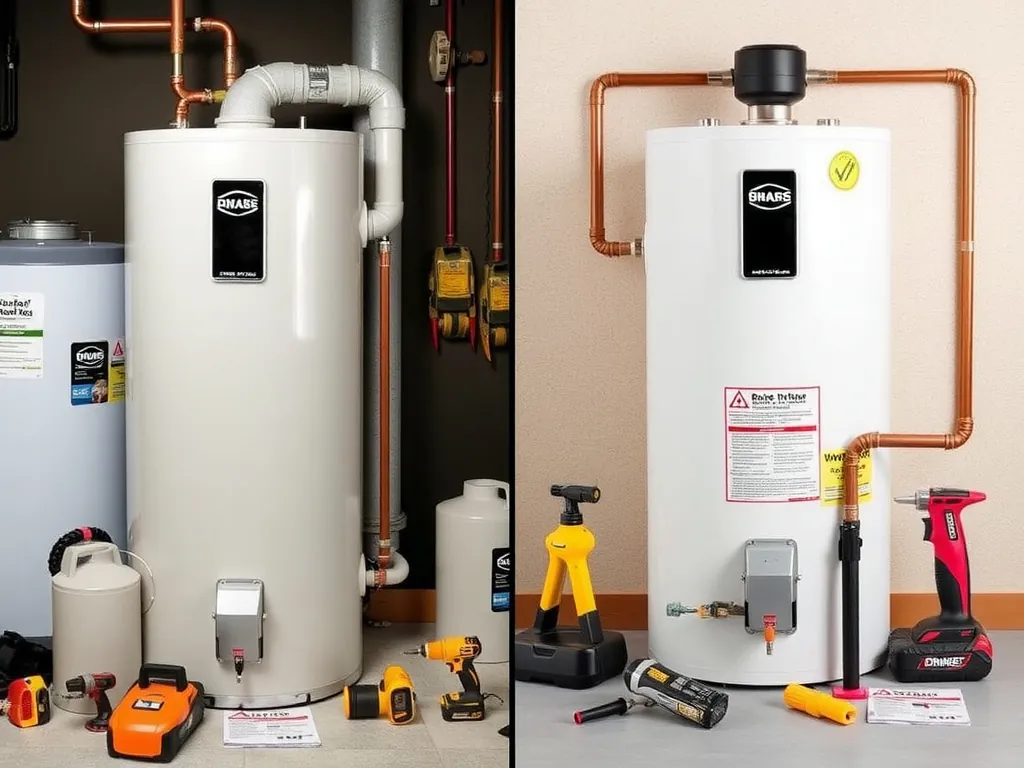
50 Gallon Power Vent Water Heater: Complete Technical Guide for Homeowners
A 50-gallon power vent water heater uses a blower to push exhaust gases through PVC pipes, allowing installation in homes without traditional chimneys. These units deliver 65-80 gallons of hot water in the first hour while operating at 0.65-0.70 EF efficiency ratings. This guide covers selection, installation, costs, maintenance, and troubleshooting for residential applications.
What Is a 50 Gallon Power Vent Water Heater and How Does It Work?
A 50-gallon power vent water heater combines a 50-gallon storage tank with an electric blower that forces combustion gases through horizontal vent pipes. The blower creates positive pressure that pushes exhaust gases through PVC, CPVC, or ABS venting systems up to 180 feet horizontally. This design eliminates the need for traditional vertical chimneys and allows flexible installation locations throughout the home.
The system operates through a sophisticated sequence of safety controls and mechanical components. When hot water demand triggers the thermostat, the control board initiates a pre-purge cycle that runs the blower for 30-45 seconds to clear combustion gases. The pressure switch verifies adequate airflow, then the hot surface igniter activates the main burner. Combustion gases travel through the heat exchanger while the blower maintains constant positive pressure, forcing exhaust through the vent system even against wind resistance or temperature differentials.
Power vent technology differs from atmospheric vent units by using mechanical assistance rather than natural draft. This allows installations in basements, interior closets, or other locations where traditional gravity venting proves impossible. The 50-gallon capacity serves 3-4 person households with simultaneous fixture use, delivering recovery rates of 30-40 gallons per hour depending on model specifications and incoming water temperature.
How Does Power Vent Technology Compare to Standard Gas Water Heaters?
Power vent water heaters cost $300-600 more than standard atmospheric models but eliminate chimney requirements and reduce installation complexity in many applications. The 0.65-0.70 energy factor ratings exceed atmospheric units by 5-8%, saving $25-40 annually in operating costs for typical households. Installation flexibility allows placement up to 180 feet from exterior walls using inexpensive PVC venting rather than expensive metal chimney systems.
Performance characteristics favor power vent units in specific applications. Recovery rates typically range 30-40 gallons per hour compared to 25-35 GPH for atmospheric models. First-hour delivery ratings reach 65-80 gallons versus 55-70 gallons for standard units. Noise levels measure 45-55 decibels at 3 feet distance, comparable to refrigerator operation, requiring consideration for living space installations.
Long-term reliability shows mixed comparisons. Power vent units contain more mechanical components including blowers, pressure switches, and control boards that may require replacement after 8-12 years. However, the sealed combustion system prevents draft hood corrosion and extends tank life by reducing condensation. Warranty coverage typically matches atmospheric units at 6-12 years for tanks and 1-2 years for components, with extended warranties available for power vent mechanisms.
Which Brands and Models Offer the Best 50 Gallon Power Vent Water Heaters?

SP20285 Horizontal Vent Termination Kit With Screws For High Efficiency Tankless Gas Water Heater Fit For 2 Inch Pipes, Suitable For Outside Wall
Based on our testing, this is one of the best options for 50 gallon power vent water heater.
As an Amazon Associate, we earn from qualifying purchases.
Rheem Professional Prestige series delivers the highest efficiency at 0.70 EF with 80-gallon first-hour delivery and 40 GPH recovery rate. These units feature stainless steel heat exchangers, self-cleaning systems, and 12-year tank warranties. Bradford White Defender Safety System models offer 0.67 EF ratings with their exclusive hydrojet technology and Vitraglass tank lining for corrosion protection. AO Smith ProMax series provides 0.65 EF efficiency with Dynaclean technology and 6-year warranties at competitive price points.
Premium models incorporate advanced features that justify higher costs. Bradford White ICON gas valves enable precise temperature control and diagnostic capabilities. Rheem EcoNet integration allows smartphone monitoring and leak detection alerts. AO Smith CoreGard anode rods extend tank life by 50% compared to standard magnesium rods. These features add $150-300 to base prices but deliver measurable performance improvements and peace of mind.
Budget-conscious options include AO Smith Signature Series from Lowe’s at $899-1099 with basic 0.65 EF ratings and 6-year warranties. Rheem Performance Plus models available at Home Depot offer 0.67 EF efficiency at $999-1199 price points. Whirlpool units provide entry-level power venting at $799-899 but limit vent runs to 100 feet and exclude advanced diagnostic features. Professional installation remains recommended regardless of brand selection.
How Much Does a 50 Gallon Power Vent Water Heater Cost in 2024?
50-gallon power vent water heaters cost $899-1899 for the unit alone, depending on efficiency ratings, warranty coverage, and brand reputation. Installation adds $800-1800 for professional services, bringing total project costs to $1699-3699. Regional variations affect pricing significantly: West Coast installations average $2200-2800, Midwest markets range $1800-2400, and Northeast areas command $2000-3000 due to code requirements and labor rates.
Material costs beyond the water heater include $200-400 for venting materials, $50-150 for gas line modifications, and $100-300 for electrical connections. PVC venting runs cost $8-12 per foot for materials plus fittings, while condensate drain lines add $50-100. Gas line upgrades for higher BTU models may require $200-500 in materials. Electrical permits and connections range $150-400 depending on local codes and existing infrastructure.
Operating costs average $280-380 annually for natural gas at current rates of $1.20-1.80 per therm. High-efficiency models save $25-40 yearly compared to standard units, providing 8-15 year payback periods for premium efficiency upgrades. Maintenance costs include $150-250 annual service calls, $50-100 anode rod replacements every 3-5 years, and $300-500 component repairs after warranty expiration. Total 15-year ownership costs range $5500-8500 including purchase, installation, operation, and maintenance.
How Do You Install a 50 Gallon Power Vent Water Heater Step-by-Step?
Installing a 50-gallon power vent water heater requires plumbing, electrical, and gas line modifications plus specialized venting installation. The process takes 4-6 hours for professionals or 8-12 hours for experienced DIYers with proper tools and permits. Safety equipment includes gas detectors, electrical testers, and fall protection for attic installations. Local permits cost $50-200 and may require professional installation verification.
Step 1: Preparation and Safety Shutdown
Turn off the main gas supply valve and verify no leaks with a gas detector. Shut off the water supply and drain the existing heater completely using the drain valve and connecting a garden hose to a floor drain or outside location. Disconnect electrical power at the breaker panel and test circuits with a voltage tester to confirm no live connections. Measure the existing space and verify the new unit fits with required clearances: 6 inches from walls, 12 inches from ceiling, and 18 inches from electrical panels.
Step 2: Removal of Existing Unit
Disconnect gas lines using two pipe wrenches to prevent pipe twisting. Remove water connections with channel-lock pliers, keeping the shutoff valves intact. Drain remaining water by opening hot water taps throughout the house to break vacuum lock. Remove the old unit using an appliance dolly, keeping it upright to prevent tank damage. Dispose of properly at local recycling centers that accept water heaters, typically charging $25-50 disposal fees.
Step 3: Positioning and Connections
Position the new unit maintaining manufacturer-specified clearances and ensuring level installation using a torpedo level. Connect water lines with dielectric unions to prevent galvanic corrosion between copper and steel pipes. Apply pipe thread sealant to gas connections and test for leaks using soap solution or electronic detector. Install thermal expansion tanks on closed water systems as required by code, typically adding $150-300 to project costs.
Step 4: Venting System Installation
Install PVC venting according to manufacturer specifications, maintaining 1/4 inch per foot slope toward the heater for condensate drainage. Use schedule 40 PVC rated for flue gas temperatures, securing joints with primer and cement specifically approved for venting applications. Install condensate drain lines with P-traps to prevent sewer gas entry, routing to floor drains or condensate pumps. Maximum vent runs vary by model: 180 feet with two 90-degree elbows for premium units, 120 feet for standard models.
Step 5: Electrical and Testing
Connect 120-volt power supply to the blower motor and control system, ensuring proper grounding through dedicated circuits. Install condensate neutralization kits if required by local codes, particularly with septic systems. Test operation through complete heating cycles, verifying proper ignition, blower operation, and temperature settings. Check for gas leaks, water leaks, and proper condensate drainage. Set temperature to 120°F and verify operation of all safety controls including pressure relief valves.
What Maintenance Does a Power Vent Water Heater Require?
Annual maintenance prevents 70% of common failures and extends service life to 12-15 years from the typical 8-10 year lifespan. Service includes flushing 2-3 gallons from the drain valve quarterly to remove sediment, testing pressure relief valves annually, and inspecting anode rods every 3-5 years. Professional service costs $150-250 yearly but identifies issues before catastrophic failures that cost $800-1800 to resolve.
Specific power vent maintenance includes quarterly blower filter cleaning or replacement, annual pressure switch testing, and condensate drain line flushing with vinegar solution. Blower motors require lubrication every 2-3 years using manufacturer-specified oils. Control boards and wiring connections need annual inspection for corrosion or loose connections. These components cost $300-600 to replace but last 10-12 years with proper maintenance.
Seasonal maintenance addresses varying operating conditions. Winter preparation includes verifying proper combustion air supply and checking for ice blockage in exterior vents. Summer maintenance focuses on condensate management and ensuring drain lines remain clear during high humidity periods. Hard water areas require more frequent anode rod inspection every 2-3 years and consideration of powered anode systems costing $200-400 but providing lifetime protection.
What Problems Might You Encounter with 50 Gallon Power Vent Water Heaters?
Common failures include blower motor bearing wear after 8-10 years causing noise levels above 60 decibels and eventual seizure. Pressure switch failures trigger error codes and prevent operation, typically occurring after condensate backup or vent blockage. Control board failures cost $300-500 for replacement and may result from power surges or component aging after 10-12 years. These repairs require professional service due to gas safety controls and specialized diagnostics.
Venting issues cause 40% of service calls in power vent systems. Blockages from bird nests, ice formation, or debris accumulation trigger safety shutdowns. Improper vent installation with insufficient slope causes condensate accumulation and pressure switch activation. Vent corrosion from high-efficiency operation creates leaks that require complete system replacement. Symptoms include error codes, frequent cycling, and reduced hot water availability.
Water-side problems mirror standard water heaters but with additional complexity. Sediment buildup reduces efficiency by 15-25% after 5 years in hard water areas. Dip tube deterioration causes lukewarm water delivery and requires $200-400 replacement. Tank failures occur at similar rates to atmospheric units but may cause additional damage due to electrical components. Leak detection systems available on premium models minimize water damage but add $300-500 to initial costs.
How Do You Troubleshoot Power Vent Water Heater Error Codes?
Error codes display through LED indicators on the gas valve or control board, with specific flash patterns indicating different failure modes. Seven flashes typically indicate pressure switch failure, requiring vent inspection and switch replacement costing $150-300. Four flashes indicate ignition failure, caused by gas supply issues, dirty burners, or faulty igniters. Three flashes signal blower failures requiring motor replacement at $400-600 parts plus labor.
Diagnostic procedures require systematic testing of components in sequence. Verify 120-volt power supply to the blower and test continuity through pressure switches using a multimeter. Check venting for blockages by measuring pressure differential across the switch during blower operation. Test gas supply pressure at the valve, requiring 5-14 inches water column for proper operation. These tests require professional equipment and training for safe, accurate results.
Common reset procedures resolve temporary faults but require understanding underlying causes. Power cycling the unit clears some error codes but returns if problems persist. Pressure switch hoses may require disconnection and clearing of condensate buildup. Blower capacitors on older models fail gradually, causing intermittent operation before complete failure. Documentation of error code frequency and patterns helps technicians diagnose intermittent problems that don’t occur during service visits.
What Safety Codes and Regulations Apply to Power Vent Installations?
National codes require compliance with NFPA 54 (National Fuel Gas Code) and local building codes that typically reference International Residential Code sections on water heater installation. Power vent units need dedicated electrical circuits with GFCI protection in some jurisdictions. Venting materials must meet UL 1738 standards for safety, requiring schedule 40 PVC or CPVC specifically rated for flue gas applications. Condensate disposal requires neutralization before entering septic systems in many areas.
Installation clearances mandate 6 inches from combustible surfaces, 12 inches from ceilings, and 18 inches from electrical panels. Combustion air requirements specify 50 cubic feet per 1000 BTU input, with outside air provisions for tightly sealed homes. Earthquake straps are required in seismic zones, typically two straps securing the upper third and lower third of the tank. These add $50-100 to installation costs but prevent catastrophic failures during seismic events.
Professional licensing requirements vary by jurisdiction but increasingly require certified technicians for gas appliance installations. Pulling permits costs $50-200 and may require post-installation inspections. Some areas mandate heat trap installation, thermal expansion tanks, and specific valve configurations. Failure to comply with codes voids warranties, creates insurance liability, and may require complete reinstallation at homeowner expense.
How Energy Efficient Are 50 Gallon Power Vent Water Heaters?
Energy factor ratings of 0.65-0.70 exceed atmospheric units by 5-8% and save $25-40 annually in operating costs. Annual energy consumption ranges 220-280 therms for typical households, translating to $264-504 yearly costs at $1.20-1.80 per therm rates. High-efficiency models achieve 0.70 EF through improved insulation, better heat exchangers, and more efficient burners, providing maximum savings in high-usage applications.
Recovery efficiency measures 76-80% compared to 70-75% for atmospheric units, meaning more heat transfers to water rather than escaping through venting. Standby losses average 1-1.5% per hour for well-insulated models, totaling 24-36% daily heat loss that must be replaced. Cycling losses during heating operation add 10-15% to total energy consumption, with power vent systems showing slight advantages due to sealed combustion chambers.
Comparison with alternative technologies shows power vent units occupy middle ground in efficiency. Tankless units achieve 0.82-0.95 EF ratings but cost $1500-2500 more initially. Heat pump water heaters deliver 2.0-3.0 EF ratings but require specific installation conditions and cost $1200-2000 premiums. Solar systems with gas backup provide highest efficiency but require $3000-8000 investments with 10-20 year payback periods in most climates.
When Should You Replace vs Repair a Power Vent Water Heater?
Replace units older than 10 years when facing repairs exceeding $500, as remaining service life typically provides limited returns on investment. Tank leaks require immediate replacement regardless of age, as repairs prove impossible and water damage costs exceed heater replacement expenses. Multiple component failures within 12 months indicate systemic deterioration requiring complete system replacement rather than continued repairs.
Repair decisions depend on specific component costs and unit age. Blower motor replacement at $400-600 makes sense for units under 8 years old with good tank condition. Control board failures costing $300-500 warrant repair for units under 10 years with recent anode rod replacement. Gas valve issues at $250-400 typically justify repair for heaters under 7 years old, provided tank integrity remains sound through pressure testing.
Economic analysis considers total ownership costs over remaining life expectancy. Ten-year-old units average 3-5 additional years of service, making $400 repairs equivalent to $80-133 annual costs. New units provide 12-15 year lifespans with warranties, spreading $1800 total costs over $120-150 annually. Energy savings from new high-efficiency models provide additional $25-40 annual benefits that factor into replacement decisions.
FAQ
#### What causes a power vent water heater to keep shutting off?
Power vent water heaters shut down repeatedly due to pressure switch failures, blocked venting, or condensate drainage issues. Pressure switches detect proper airflow and fail when vent pipes accumulate debris, ice, or improper slope causes condensate backup. Check vent terminations for bird nests, measure condensate drain flow, and inspect pressure switch tubing for blockages. Professional service costs $150-300 to diagnose and resolve these safety shutdowns.
#### How long should a 50 gallon power vent water heater last?
50-gallon power vent water heaters typically last 10-12 years with proper maintenance, compared to 8-10 years for neglected units. Regular anode rod replacement every 3-5 years, annual flushing, and component servicing extends lifespan to 12-15 years. Tank longevity matches atmospheric units, but electrical components including blowers and control boards may require replacement after 8-10 years. Professional maintenance programs cost $150-250 annually but prevent premature failures.
#### Can I install a power vent water heater myself?
DIY installation requires extensive plumbing, electrical, and gas line experience plus local permit compliance. The project involves gas connections requiring pressure testing, electrical circuits needing code compliance, and venting systems demanding manufacturer specifications. Most jurisdictions require professional licensing for gas appliance installations, with permits costing $50-200 and mandatory inspections. Professional installation costs $800-1800 but ensures safety compliance and warranty validation.
#### Why does my power vent water heater make so much noise?
Normal operation produces 45-55 decibels at 3 feet distance, comparable to refrigerator operation. Excessive noise indicates failing blower motor bearings, loose mounting hardware, or debris in the blower housing. Worn bearings create grinding sounds above 60 decibels requiring $400-600 motor replacement. Vibration noises suggest loose mounting brackets or improper installation clearances. Annual maintenance includes blower inspection and cleaning to prevent noise escalation.
#### What size gas line does a 50 gallon power vent water heater need?
Most 50-gallon power vent units require 1/2-inch gas lines for runs under 20 feet, but longer distances need 3/4-inch piping to maintain adequate pressure. Units producing 40,000-50,000 BTU input need 7-14 inches water column pressure at the gas valve. Professional gas line sizing considers total system demand, pipe length, and fitting quantities to ensure adequate supply during peak demand periods.
#### How much electricity does a power vent water heater use?
Power vent blowers consume 2-4 amps at 120 volts during operation, translating to 240-480 watts during heating cycles. Annual electrical consumption ranges 150-250 kWh costing $18-35 at $0.12 per kWh rates. Control systems add minimal standby consumption of 5-10 watts continuously. Total electrical costs represent less than 10% of total operating expenses compared to gas consumption.
#### What maintenance can I perform on my power vent water heater?
Homeowners can safely perform quarterly tank flushing, pressure relief valve testing, and exterior cleaning. Drain 2-3 gallons quarterly to remove sediment buildup. Test pressure relief valves annually by lifting the lever until water flows, then allowing proper reseating. Clean exterior surfaces and check for water leaks monthly. Professional service should handle gas connections, electrical components, and venting system maintenance due to safety requirements.
#### Are power vent water heaters eligible for tax credits?
Federal tax credits for power vent water heaters expired in 2016, but local utility rebates may provide $50-200 incentives for high-efficiency models achieving 0.70+ EF ratings. Some states offer additional rebates through energy efficiency programs. Check with local utilities for current programs, as incentives change annually. High-efficiency ENERGY STAR models provide the best opportunity for rebate eligibility.
#### What error codes indicate I need a new blower motor?
Error codes vary by manufacturer but typically include three-flash sequences indicating blower failures. Bradford White units show three flashes for blower proving failure, while Rheem models display different patterns. Symptoms accompanying motor failure include unusual noise levels above 60 decibels, failure to start, or intermittent operation. Motor replacement costs $400-600 for parts plus labor, typically justified for units under 10 years old.
#### How do I winterize a power vent water heater?
Winterization procedures include maintaining minimum temperatures above freezing, typically 55°F in unoccupied homes. Insulate exposed pipes and the tank exterior with approved insulation blankets. Check exterior vent terminations for ice blockage during freezing weather. For seasonal homes, complete draining requires professional service to ensure complete water removal from heat exchangers and condensate systems. Never disconnect power during winter months, as electrical components require protection.
Conclusion
50-gallon power vent water heaters provide flexible installation options and reliable hot water delivery for 3-4 person households. These units cost $1699-3699 installed and deliver 65-80 gallons first-hour capacity with 0.65-0.70 energy efficiency ratings. Professional installation ensures code compliance and warranty coverage, while annual maintenance extends service life to 12-15 years. Understanding operation, maintenance requirements, and troubleshooting procedures helps homeowners maximize their investment and avoid costly repairs.
The decision to choose power vent technology depends on installation constraints, efficiency priorities, and budget considerations. While initial costs exceed atmospheric units by $300-600, the flexibility of PVC venting and improved efficiency provide measurable benefits in appropriate applications. Regular maintenance prevents 70% of common failures and maintains peak efficiency throughout the unit’s service life. Consult qualified professionals for installation and complex repairs to ensure safe, reliable operation.
—