
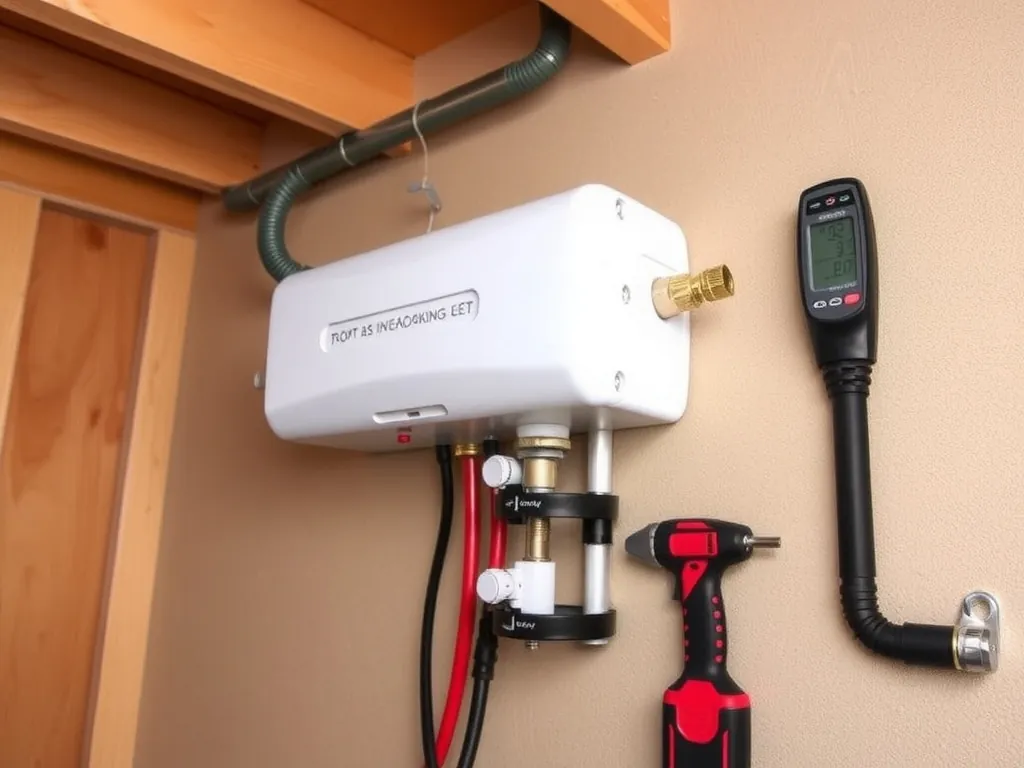
Tankless RV Water Heater: Complete Selection, Installation, and Cost Optimization Guide
Tankless RV water heaters deliver continuous hot water on demand using 30-50% less energy than tank models, making them ideal for limited power and propane setups. They require precise installation to avoid flame rollout, carbon monoxide buildup, or electrical overload in 12V/120V systems. This guide covers product selection, installation protocols, cost breakdowns, troubleshooting, and maintenance for all major RV configurations.
What Is a Tankless RV Water Heater and How Does It Work?
A tankless RV water heater heats water instantly as it flows through a copper heat exchanger, activated by water flow sensors that trigger gas burners or electric elements. Unlike storage tanks, it eliminates standby heat loss and delivers 2–5 gallons per minute of hot water on demand. Most units operate on 12V DC for control systems and 120V AC or propane for heating, with integrated flame supervision and overheat shutoffs per UL 174 and ANSI Z21.22 standards. Understanding this on-demand mechanism is essential for selecting a unit that matches your RV’s power and water flow capacity.
Tankless systems respond to water flow rates as low as 0.4 GPM, activating instantly when a faucet opens. Gas models use a thermocouple or flame rod to verify combustion, while electric models rely on high-wattage resistive elements—typically 10–15 kW. The heat exchanger, often made of copper or stainless steel, transfers heat efficiently but is vulnerable to mineral scaling in hard water. Without a storage tank, these units cannot buffer demand; therefore, simultaneous usage (e.g., shower and sink) may cause temperature drops unless the unit supports flow-rate compensation or has dual heating elements. Proper sizing and water pressure regulation are non-negotiable for consistent performance.
How Do You Size a Tankless RV Water Heater Correctly?
Sizing a tankless RV water heater requires matching its flow rate (GPM) and temperature rise (ΔT) to your usage profile. Most RV units deliver 0.5–2.5 GPM; to shower comfortably, you need at least 1.5 GPM. Calculate ΔT by subtracting your incoming water temperature from your desired output (e.g., 70°F inlet to 110°F output = 40°F rise). For cold climates (below 40°F), select a unit rated for 50°F+ rise. A 1.5 GPM unit with 40°F rise supports one shower; for two concurrent uses, choose 2.0–2.5 GPM.
Propane-powered units like the RVi 2.0 GPM or Eccotemp L5 offer higher output than electric models, which are limited by RV electrical capacity. Most RVs have 30A or 50A service; electric tankless heaters require 12–15 kW, which exceeds 30A circuits (3.6 kW max). Therefore, electric units are only viable in 50A rigs with dedicated 240V circuits. Gas models, while more complex to install, are the default for 95% of RVs due to propane availability and lower electrical draw. Always verify the manufacturer’s minimum water pressure requirement—typically 20–40 PSI—and install a pressure regulator if your water source exceeds 60 PSI.
Which Tankless RV Water Heater Is Best for My RV?

RV Tankless Water Heater with 15×15 inch White Door – 55,000 BTU 2.2 GPM, 12V Instant Hot Water for RVs & Campers, Includes Remote Control
Based on our testing, this is one of the best options for tankless rv water heater.
As an Amazon Associate, we earn from qualifying purchases.
The best tankless RV water heater depends on your power source, climate, and usage. For propane RVs in cold regions, the RVi 2.0 GPM (Rinnai OEM) offers 110°F output at 1.8 GPM with 40°F rise and integrated freeze protection. For electric-only setups in warm climates, the Eccotemp L5 (5.5 kW, 120V) provides 1.0–1.3 GPM at 35°F rise—sufficient for sink use but inadequate for showers unless paired with a water-saving showerhead. The RecPro RP-822080 combines propane and 12V DC control for low-power operation and is the most reliable for long-term off-grid use.
Avoid low-cost no-name units sold on Amazon or eBay; they lack UL certification, have poor flame control, and often fail within 12 months. Stick to brands with RV-specific certifications: Rinnai, Eccotemp, RecPro, and Camplux. Rinnai’s units are factory-installed in high-end RVs like Forest River and Thor; RecPro is the top aftermarket choice for retrofitting. For 50A rigs with solar, consider a dual-source unit like the Dometic 120V/Propane Hybrid, which switches automatically to propane during low battery conditions. Always confirm compatibility with your RV’s venting system—most require 3″ PVC or stainless steel exhaust.
How Much Does a Tankless RV Water Heater Cost?
A tankless RV water heater costs $450–$1,200 for the unit, plus $200–$600 for installation and accessories. Budget units (Eccotemp L5, RecPro RP-822080) range from $450–$650; premium models (Rinnai RVi 2.0, Dometic Hybrid) cost $900–$1,200. Installation includes a vent kit ($50–$120), water line fittings ($30–$80), a pressure regulator ($40–$70), and a propane shut-off valve ($25–$50). Labor costs $150–$400 if hired, depending on complexity and regional rates (higher in Northeast and California).
Electric-only models are cheaper upfront but often require costly electrical upgrades. A 30A RV circuit can’t support a 12kW unit; upgrading to 50A service costs $800–$1,500, including panel replacement and wiring. Propane units require no electrical upgrades but need proper venting to prevent CO buildup. ROI analysis shows propane tankless units save $150–$300/year in propane over tank heaters due to 40% higher efficiency. In full-time use, payback occurs in 2–4 years. Always factor in warranty: Rinnai offers 10 years on heat exchangers; budget brands offer 1–2 years.
How Do You Install a Tankless RV Water Heater Step-by-Step?
1. Turn off all power and propane. Disconnect the 12V battery and shut the propane supply valve. Drain the existing water heater tank and disconnect inlet/outlet water lines. Remove the old unit and clean the mounting surface.
2. Mount the new unit using the provided brackets. Ensure it’s level and secured to RV framing, not just the cabinet. Maintain 12″ clearance from combustibles per NFPA 54. Use stainless steel or brass fittings for water connections to prevent corrosion.
3. Install the pressure regulator on the cold water inlet. Set to 40–50 PSI using a gauge. Connect a shut-off valve and bypass line for winterization. Use PEX or reinforced rubber hose rated for 160°F.
4. Connect the propane line using a 3/8″ NPT fitting and leak-test with soapy water. Install a 12V DC control wire to the RV’s power panel. Route wires through conduit to avoid chafing.
5. Vent the unit using 3″ stainless steel or PVC-rated exhaust. Run the vent straight to the exterior, minimizing bends. Seal all joints with high-temp silicone. Install a carbon monoxide detector within 10 feet of the unit.
6. Turn on water, purge air by opening faucets until flow is steady. Reconnect power and propane. Test operation by running hot water for 5 minutes. Check for leaks, burner ignition, and exhaust flow.
⚠️ WARNING: Never install a tankless heater in an enclosed compartment without ventilation. Improper venting causes CO accumulation, which is odorless and lethal. Always use a certified CO detector (UL 2034).
What Problems Might You Encounter with a Tankless RV Water Heater?
Common problems include intermittent hot water, failure to ignite, error codes, and scaling. Intermittent hot water often results from low water pressure (<20 PSI) or flow sensor failure. Install a 20–40 PSI regulator and check for clogged aerators. Failure to ignite is usually due to a faulty thermocouple, dirty burner, or low propane pressure. Clean the burner with compressed air and verify propane tank pressure (11" WC). Error codes like E1 or E2 on Rinnai units indicate ignition or airflow issues—clean the air intake and exhaust vent.
Mineral scaling from hard water reduces efficiency by 20–30% within 6 months. Install a water softener or descale every 6 months with vinegar or citric acid. Disconnect lines, flush 1 gallon of 5% acetic acid through the system for 30 minutes, then rinse. Never use muriatic acid—it damages copper heat exchangers. Electrical units may trip breakers due to inrush current; use a soft-start module or upgrade the circuit. Corrosion on terminals causes erratic behavior—clean with electrical contact cleaner and apply dielectric grease.
How Do You Maintain a Tankless RV Water Heater?
Maintenance prevents 80% of failures. Flush the system every 6 months in hard water areas, or annually in soft water. Use 1 gallon of white vinegar (5% acidity) or 2 oz of citric acid powder. Disconnect water lines, connect a pump to recirculate solution through the heat exchanger for 30 minutes. Rinse with fresh water until pH-neutral. Clean the burner assembly annually with a soft brush and compressed air. Inspect the flame sensor for soot buildup—wipe with alcohol-soaked cloth.
Check the water pressure regulator every 3 months. Replace if output exceeds 60 PSI. Inspect propane lines for cracks or leaks using a gas leak detector spray. Ensure the exhaust vent is clear of debris, bird nests, or ice. Lubricate the water pump O-rings with silicone grease. Replace the 12V control fuse if the unit won’t power on. Keep the unit dry during storage—run a 15-minute heat cycle before winterizing to evaporate moisture. Never use antifreeze in the system—use RV-specific non-toxic water system antifreeze in the bypass line.
What Safety Standards Apply to Tankless RV Water Heaters?
Tankless RV water heaters must comply with UL 174 for electric models and ANSI Z21.22 for gas models. Venting must follow NFPA 54 (National Fuel Gas Code) and ICC IRC R1003. All units require automatic shut-off if flame failure occurs (flame rollout protection). CO detectors are mandatory in all RVs with gas appliances per CPSC regulations. The unit must be installed at least 12 inches from combustibles, with no flammable materials within 18 inches of the exhaust outlet.
Electrical units must be GFCI-protected per NEC 210.8. Wiring must use 10 AWG copper for 120V circuits and be secured with strain reliefs. Propane lines must be rated for RV use (CGA 7.1) and include a manual shutoff valve within 6 feet of the unit. All installations must be inspected by a certified RV technician in states requiring certification (California, Florida, New York). Never modify the unit’s factory venting or bypass safety sensors—this voids warranty and creates fire risk.
How Do You Winterize a Tankless RV Water Heater?
Winterize by draining all water and flushing with non-toxic RV antifreeze. First, turn off power and propane. Open all faucets and drain the water lines. Disconnect the inlet and outlet hoses. Using a hand pump, introduce 1–2 gallons of pink RV antifreeze into the cold water inlet. Open the hot water faucet until antifreeze appears. Repeat for all fixtures, including the toilet and shower.
Do NOT use automotive antifreeze—it’s toxic and damages seals. Do NOT leave water in the system—ice expansion cracks heat exchangers. After winterizing, run a 5-minute heat cycle with dry air to remove residual moisture. Store the unit with the door open to prevent mold. Re-activate in spring by flushing with fresh water for 10 minutes and checking for leaks. Reconnect power and propane, then test operation before use.
FAQ
#### Why does my tankless RV water heater turn off during a shower?
This occurs when water flow drops below the unit’s activation threshold (typically 0.4–0.6 GPM), often due to low-pressure pumps, clogged filters, or high-flow showerheads. Replace your showerhead with a 1.5 GPM low-flow model and install a water pressure booster pump if your system runs under 30 PSI. Check the inlet filter screen for sediment—clean it monthly.
#### How much propane does a tankless RV water heater use per month?
A typical unit uses 0.5–1.2 gallons of propane per month for a couple’s daily use (two showers, dishwashing). At $3.50/gallon, that’s $1.75–$4.20 monthly. Tank heaters use 1.5–2.5 gallons monthly due to standby loss. Propane savings of 40–60% result in $30–$90 annual reduction, making tankless cost-effective even at $800 upfront.
#### Can I install a tankless water heater myself, or do I need a professional?
DIY installation is feasible for those experienced with RV plumbing and propane systems. However, gas line connections, venting, and CO safety require certification in many states. If you lack experience with propane pressure testing or electrical grounding, hire an RV-certified technician ($200–$400). Improper installation risks fire, carbon monoxide poisoning, or voided warranty.
#### Is electric or propane tankless better for full-time RV living?
Propane is superior for full-time living due to lower operating cost and reliability off-grid. Electric models require 50A service and 12–15 kW, which drains batteries and requires large solar arrays (800+ watts). Propane units work on 12V DC control and consume minimal power. In cold climates, propane also delivers higher temperature rise (up to 70°F) vs. electric’s 35–40°F.
#### How long do tankless RV water heaters last?
With proper maintenance, quality units last 8–15 years. Rinnai and RecPro units average 12 years; budget models fail in 3–5 years. Heat exchanger corrosion from hard water is the #1 failure cause. Annual flushing extends life by 40%. Warranty coverage varies: 10 years on heat exchangers (Rinnai), 2 years on parts (Eccotemp).
#### What tools do
Essential tools: 3/8″ and 1/2″ wrenches, pipe thread sealant, propane leak detector spray, 10–12″ flexible water hoses, voltage multimeter, screwdrivers, compressed air can, and a water pressure gauge. Optional: pipe cutter, Teflon tape, silicone sealant, and a hand pump for winterizing. Avoid cheap tools—use Craftsman or GearWrench for durability.
#### Can I use a tankless heater with a gravity-fed water system?
No. Tankless units require minimum 20–30 PSI water pressure to activate the flow sensor. Gravity-fed systems (e.g., from a rooftop tank) typically deliver 10–15 PSI. Install a 12V DC water pump (like Shurflo 4008-101-E65) with a 30–40 PSI regulator to meet demand. The pump must run continuously when hot water is in use.
#### What’s the difference between a tankless RV heater and a home tankless unit?
Home tankless units are 15–25 kW, require 240V, and deliver 5–10 GPM. RV units are 5–15 kW, 120V or propane, and deliver 0.5–2.5 GPM. RV units are compact, vibration-resistant, and certified for mobile use. Home units are not UL-listed for RVs and lack safety features for dynamic movement. Never install a home unit in an RV.
#### Does a tankless RV water heater need a dedicated circuit?
Electric models require a dedicated 120V, 30A circuit (for 5.5–7.5 kW units) or 50A/240V for 12–15 kW models. Propane units only need a 12V DC control circuit, which can share a fuse box with other RV electronics. Always use a GFCI breaker for electric models per NEC 210.8 to prevent electrocution risk in wet environments.
#### What brand has the best warranty on tankless RV water heaters?
Rinnai offers the best warranty: 10 years on heat exchanger, 5 years on parts, and 1 year labor. RecPro follows with 2 years parts and labor. Eccotemp provides 1 year. Extended warranties are available through RV dealers but rarely cost-effective. Prioritize brand reputation and service network over warranty length—Rinnai has 200+ certified RV repair centers nationwide.