
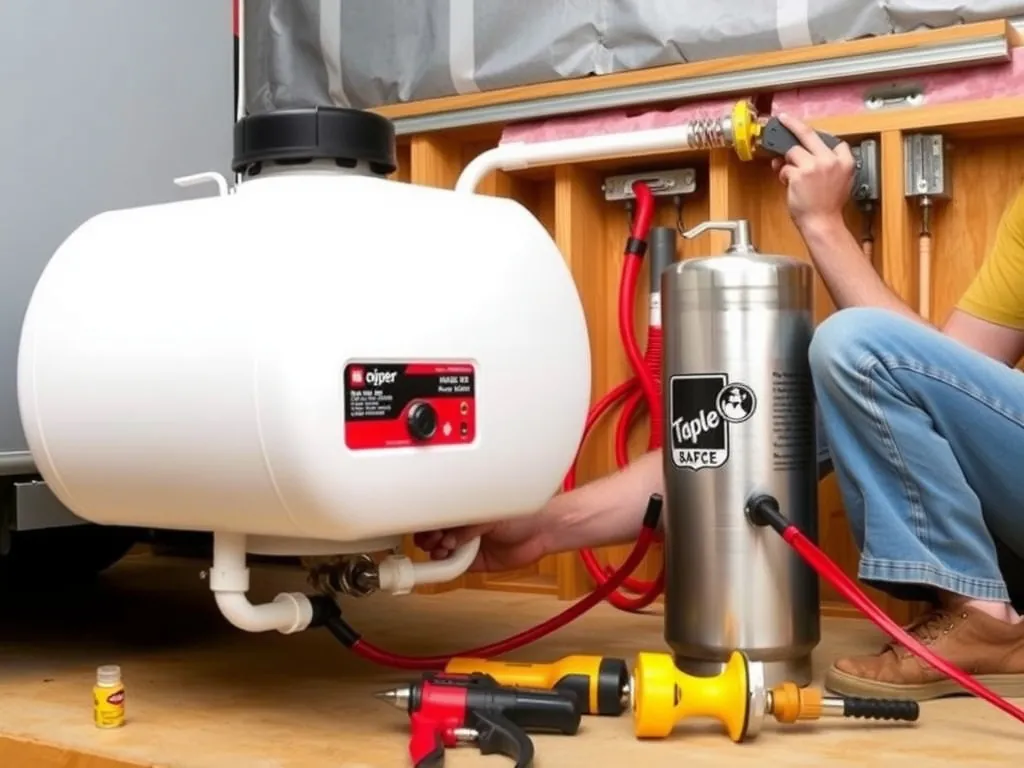
Camper Propane Water Heater: Complete Guide to Selection, Installation, Maintenance, and Troubleshooting
A camper propane water heater provides on-demand hot water using liquefied petroleum gas, typically delivering 6–10 gallons per hour at 105–120°F for showering and dishwashing. Unlike residential units, camper models are compact, vented directly to the exterior, and designed for 12V DC power and propane efficiency. This guide covers selection criteria, installation codes, maintenance schedules, troubleshooting protocols, and cost breakdowns for RV owners seeking reliable hot water on the road.
What Is a Camper Propane Water Heater and How Does It Work?
A camper propane water heater is a compact, direct-vent, tank-style or tankless system that heats water using propane combustion, powered by 12V DC electricity for ignition and control. It operates by igniting propane in a sealed combustion chamber, transferring heat via a copper heat exchanger to water stored in a 6–10 gallon tank (or flowing through a coil in tankless models). The system uses a thermocouple or electronic ignition to maintain flame, a thermostat to regulate temperature (typically 120°F), and a flue to vent exhaust through the RV’s roof or sidewall. Most units draw power from the RV’s house battery for circuit control and fan operation, making them functional during dry camping.
How Do You Size a Camper Propane Water Heater for Your RV?
Sizing a camper propane water heater depends on occupancy, usage patterns, and available space. For solo travelers or couples, a 6-gallon tank (e.g., Atwood AT60106) is sufficient for one 8-minute shower and light dishwashing. Families of three to four require an 8–10 gallon unit (e.g., Suburban SW6DE or Dometic BR500) to avoid running out of hot water. Tankless models like the Eccotemp L5 or Truma Combi 6E provide continuous flow (up to 2.5 GPM) but demand higher propane pressure (11–14 inches WC) and 12V power stability. Measure your RV’s water heater compartment: standard cutouts are 14.5”W × 15.5”H × 17”D. Always check manufacturer clearance requirements—minimum 1” on all sides for ventilation and 6” from combustibles. Oversizing wastes propane and increases weight; undersizing causes chronic cold showers.
Why Does a Camper Propane Water Heater Fail to Ignite?
A camper propane water heater fails to ignite primarily due to low propane pressure, a faulty thermocouple, a blocked burner orifice, or a dead 12V power supply. Low propane pressure (below 11” WC) prevents the solenoid valve from opening fully, triggering the safety lockout. A worn thermocouple fails to generate the 25–30 mV needed to keep the gas valve open after ignition. Carbon buildup in the burner orifice—common after 1–2 seasons of use—restricts gas flow, causing incomplete ignition or flameout. A blown 12V fuse or corroded battery terminal cuts power to the control board, disabling the spark igniter. Test propane pressure with a manometer; clean orifices with a 0.012” wire; replace thermocouples every 3–5 years. If the igniter clicks but no flame appears, the issue is gas delivery or airflow—not electrical.
How Do You Test a Camper Propane Water Heater’s Ignition System?
To test the ignition system, first confirm 12V DC power at the control board using a multimeter set to DC volts—probe the red and black wires; voltage must read 11–14V. If voltage is low, check the house battery’s state of charge and fuses (typically 5–10A in-line). Next, listen for the igniter clicking when you turn the thermostat dial to “Pilot” or “On”—if silent, the spark module is dead. If it clicks, remove the access panel and visually inspect the electrode gap—should be 3/16” from the burner. Use a propane leak detector or soapy water solution on all gas connections to check for leaks before igniting. If the flame lights briefly then dies, the thermocouple is weak. Hold a multimeter on the thermocouple leads while lighting: it should generate 25–30 mV DC. Below 18 mV requires replacement. Always shut off propane before testing.
Which Camper Propane Water Heater Is Best for Dry Camping?

RV Tankless Water Heater with 15×15 inch White Door – 55,000 BTU 2.2 GPM, 12V Instant Hot Water for RVs & Campers, Includes Remote Control
Based on our testing, this is one of the best options for camper propane water heater.
As an Amazon Associate, we earn from qualifying purchases.
The best camper propane water heater for dry camping is a 10-gallon tank-style unit with low-power consumption and high efficiency, such as the Suburban SW6DE or Dometic BR500. These models use only 0.5–1.2 amps during ignition and 0.1–0.3 amps in standby, preserving battery life. Tankless units like the Eccotemp L5 offer unlimited hot water but require 3–4 amps continuously, draining a 100Ah battery in under 20 minutes of showering. For extended off-grid use, pair a 10-gallon tank with a 200Ah lithium battery and 100W solar panel. The Suburban SW6DE has a 91% thermal efficiency rating and an insulated tank that retains heat for 4–6 hours after shutdown—ideal for overnight stays. Avoid units requiring 120V AC-only operation (e.g., some RV park hookups) if you plan dry camping. Check for Energy Star ratings and low-flame-standby technology.
How Much Does a Camper Propane Water Heater Cost?
A new camper propane water heater costs $400–$850 for the unit, $100–$250 for professional installation, and $20–$150 for replacement parts. Entry-level 6-gallon tanks (e.g., Atwood AT60106) retail for $400–$500. Mid-range 8–10 gallon units (Suburban SW6DE, Dometic BR500) cost $550–$750. High-end tankless models (Eccotemp L5, Truma Combi 6E) range from $700–$850. Installation labor averages $150–$250 depending on complexity—replacing an old unit with a similar size and venting takes 2–3 hours. Labor increases to $300+ if ducting or electrical rewiring is required. Replacement thermocouples cost $25–$40, igniters $50–$80, and control boards $120–$180. Budget $150–$300 annually for maintenance (cleaning, inspection, gas line checks). Regional labor rates vary: $65–$85/hour in urban areas, $45–$60 in rural regions.
How Do You Install a Camper Propane Water Heater Step-by-Step?
1. Shut off all systems: Turn off propane at the tank, disconnect 12V battery, and drain the water heater tank completely using the drain valve.
2. Remove old unit: Unscrew mounting brackets, disconnect water lines (use adjustable wrench), and detach gas line (use flare nut wrench). Disconnect the 12V wiring harness and vent pipe. Label wires for reconnection.
3. Prepare new unit: Install the anode rod if not pre-installed (critical for tank longevity). Attach the temperature-pressure relief valve (must be rated for 150 PSI/210°F).
4. Mount unit: Secure the new heater to the frame using the provided brackets. Maintain 1” clearance on all sides per IRC Section 1312.4.
5. Connect water lines: Use PEX or braided stainless steel lines with compression fittings. Tighten until snug—do not overtighten to avoid cracking fittings.
6. Connect propane line: Use 1/2” copper or corrugated stainless steel tubing. Apply pipe dope or Teflon tape to threads. Check for leaks with soapy water—bubbles indicate a leak.
7. Wire 12V power: Connect positive (red) to the 12V supply, negative (black) to ground. Use a 10A fuse in-line per NEC Article 551.13.
8. Reattach vent: Secure the flue pipe to the draft hood with stainless steel clamps. Seal joints with high-temperature silicone.
9. Test system: Open propane valve slowly. Turn on 12V power. Set thermostat to “Pilot.” Press and hold ignition button for 30 seconds. If flame lights, hold for 60 seconds to heat thermocouple. Switch to “On.”
10. Check for leaks and function: Run hot water at sink. Verify water temperature is 115–125°F. Inspect all connections for bubbles or water seepage.
What Problems Might You Encounter with a Camper Propane Water Heater?
Common problems include weak flame, water temperature fluctuations, no hot water after ignition, excessive soot, and vent condensation. A weak, yellow flame indicates dirty burner or low propane pressure—clean orifices with a wire and check regulator. Temperature swings from 100°F to 130°F suggest a failing thermostat or scale buildup in the tank—flush annually. No hot water after ignition points to a dead thermocouple or faulty gas valve—replace thermocouple first. Black soot on the burner or flue means incomplete combustion due to blocked air intake or improper venting—inspect external vent cap for debris. Condensation dripping from the vent pipe in cold weather is normal but can freeze and block exhaust—install a heat tape on the vent line below the roof line. If the water heater shuts off after 2–3 minutes, the high-limit switch is tripping due to overheating—clean the flue and check for insulation gaps.
How Often Should You Maintain a Camper Propane Water Heater?
Maintain a camper propane water heater every 6–12 months, depending on usage and water hardness. Perform a visual inspection every 3 months: check for rust, loose fittings, and soot. Annually, drain the tank completely to remove sediment—attach a hose to the drain valve and flush until water runs clear. Clean the burner orifice with a 0.012” wire; inspect the thermocouple for corrosion and test its voltage output. Replace the anode rod every 2–3 years (or when it’s 50% corroded)—this prevents tank corrosion. Lubricate the gas valve stem with silicone grease every 2 years. Inspect the flue for blockages from bird nests or leaves—clean with a chimney brush. Check propane pressure with a manometer quarterly in heavy-use seasons. Use a water softener or filter if your water source is hard (above 7 grains per gallon)—scale reduces efficiency by 25% and shortens tank life by 40%.
What Safety Regulations Apply to Camper Propane Water Heaters?
Camper propane water heaters must comply with ANSI Z21.10.3 (standard for RV water heaters), NFPA 58 (Liquefied Petroleum Gas Code), and IRC Section 1312. All units must have a pressure-temperature relief valve rated at 150 PSI and 210°F, vented directly to the exterior via a non-combustible flue. The flue must terminate at least 2 feet above the roofline and 10 feet from windows or air intakes per NFPA 58 §8.8. Gas lines must be secured every 3 feet and protected from abrasion. Never install a water heater in a bedroom, bathroom, or enclosed closet without forced ventilation. Propane tanks must be stored upright and outside the living compartment. Always install a carbon monoxide detector within 10 feet of the water heater and a propane leak detector in the same compartment. Per UPC Section 610.2, all gas connections must be pressure-tested at 10 PSI for 15 minutes before commissioning. Failure to comply voids warranty and violates RV insurance policies.
How Do You Replace the Thermocouple on a Camper Propane Water Heater?
1. Shut off propane and power: Turn off the propane tank valve and disconnect the 12V battery.
2. Remove access panel: Unscrew the front panel to expose the burner and thermocouple assembly.
3. Locate thermocouple: Identify the copper tube running from the gas valve to the pilot flame area—it’s typically 6–8” long.
4. Disconnect thermocouple: Use a 7/16” wrench to loosen the nut connecting the thermocouple to the gas valve. Gently pull it free.
5. Remove old unit: Unscrew the thermocouple from its mounting bracket near the pilot burner.
6. Install new thermocouple: Slide the new thermocouple into the bracket, ensuring the tip is centered in the pilot flame.
7. Reconnect to valve: Thread the new thermocouple into the gas valve and tighten with wrench until snug—do not overtighten.
8. Reassemble and test: Reattach the access panel. Reconnect the 12V battery. Open propane valve. Set thermostat to “Pilot.” Press and hold the ignition button for 30 seconds. If flame ignites, hold for 60 seconds to heat thermocouple. Switch to “On.” If flame stays lit, replacement succeeded.
⚠️ Warning: Never use a generic thermocouple—use the OEM part (e.g., Suburban #102006 or Atwood #020632). Mismatched length or voltage output causes unreliable operation.
What Is the Lifespan of a Camper Propane Water Heater?
The average lifespan of a camper propane water heater is 8–12 years with proper maintenance. Units with steel tanks (e.g., Suburban, Atwood) last 8–10 years; those with copper heat exchangers and stainless steel tanks (e.g., Dometic BR500) last 10–12 years. Tankless models like the Truma Combi 6E can exceed 15 years due to absence of sediment buildup. Premature failure occurs from neglect: water heater tanks corrode in 3–5 years if the anode rod isn’t replaced. Hard water accelerates scaling, reducing efficiency and causing overheating—reducing lifespan by 30–50%. Propane regulators that fail to maintain 11–14” WC pressure cause incomplete combustion, damaging burners and heat exchangers. Replace the unit if you notice rust on the outer casing, water leaks from the tank, or repeated ignition failures after replacing parts. Warranties typically cover 1–3 years for parts, 5–10 years for the tank—register your unit with the manufacturer immediately after purchase.
FAQ
#### Why does my camper water heater only work when plugged into shore power?
Your camper water heater requires 12V DC power for ignition and control circuits—not 120V AC. If it only works on shore power, your house battery is discharged, the battery disconnect switch is off, or the converter/charger isn’t charging the battery. Test battery voltage: it must be above 12.4V. Check the 10A fuse in the 12V line to the water heater. If voltage is low, the converter may be faulty—replace with a 45A+ model like the Progressive Dynamics 9200 series. Some units have a “DC Only” mode—ensure it’s enabled.
#### Can I replace my 6-gallon water heater with a 10-gallon unit?
Yes, if the compartment dimensions allow. Standard RV water heater openings are 14.5”W × 15.5”H × 17”D. Measure your space—10-gallon units like the Suburban SW6DE are 16.5” deep, so verify clearance behind the unit. Ensure the vent flue can be extended to the roof and the gas line has sufficient pressure (11–14” WC). Upgrade your 12V system if adding a larger draw—10-gallon units use up to 1.5A during ignition. Install a 200Ah lithium battery if dry camping frequently.
#### Is it safe to run a propane water heater while driving?
Yes, modern camper propane water heaters are designed to operate while driving, provided the flue is properly vented and the unit is securely mounted. The flame is sealed within the combustion chamber, and ignition is electronically controlled. However, some states prohibit propane use in tunnels or enclosed structures—check local regulations. Always turn off the water heater before refueling at a gas station. Never bypass the safety shutoffs or use aftermarket adapters.
#### Which is better: tank or tankless for full-time RVers?
For full-time RVers, a 10-gallon tank-style heater is better than tankless. Tankless units demand high propane pressure and continuous 12V power (3–4 amps), draining batteries quickly during showers. A 10-gallon tank with 91% efficiency (e.g., Suburban SW6DE) provides 2–3 showers on a single propane fill and uses only 0.3A in standby. Tankless systems require frequent regulator adjustments and are prone to flameout during wind or altitude changes. Save tankless for short-term use or as a secondary unit.
#### Should I use a water softener with my camper water heater?
Yes, especially if using hard water (above 7 grains per gallon). Hard water causes scale buildup on the heating element and tank walls, reducing efficiency by up to 30% and increasing the risk of overheating. Install an inline RV water filter with ion-exchange resin (e.g., Camco 40043) or use a portable softener like the Aqua Systems AS4. Flush the tank monthly if softener is not installed. Scale buildup shortens tank life by 50% and voids most warranties.
#### How do I winterize my camper propane water heater?
Drain the tank completely via the drain valve. Bypass the water heater using the factory bypass kit (if equipped). Blow out water lines with compressed air (30 PSI max). Add 1–2 quarts of non-toxic RV antifreeze (pink) to the fresh water tank and run the water pump until antifreeze appears at all faucets. Disconnect propane and cover the vent opening with a waterproof cap to prevent moisture ingress. Store in a dry location. Do not leave water in the tank during freezing temperatures—expansion cracks the tank.
#### What tools do
Essential tools: adjustable wrench, flare nut wrench, 7/16” socket, multimeter, propane leak detector, wire cutters/strippers, screwdrivers, and a 0.012” wire for orifice cleaning. Optional: pipe dope, silicone sealant, and a chimney brush for vent cleaning. Use only copper or stainless steel fittings for gas lines—never use PVC or galvanized. Recommended brands: Knipex for wrenches, Klein Tools for multimeter, and the Sper Scientific 840010 leak detector.
#### Does my camper water heater need a dedicated circuit?
Yes, per NEC Article 551.13, the water heater must be on a dedicated 12V circuit with a 10A fuse or circuit breaker. Do not share the circuit with lights, fans, or other high-draw devices. Use 14 AWG wire for runs under 15 feet, 12 AWG for longer runs. Route wires away from heat sources and moving parts. Label the circuit in the fuse box as “Water Heater – DC Only.” A shared circuit can cause voltage drops, leading to ignition failure or control board damage.
#### How do I know if my water heater’s control board is bad?
Signs of a bad control board: no clicking sound during ignition, no display on digital thermostats, or the heater turns on randomly without thermostat input. Test voltage at the board’s input—12V must be present. If voltage is correct and there’s no output to the igniter or gas valve, the board is faulty. Use a multimeter to check continuity on the control board’s relay contacts. Replacement boards cost $120–$180 (Suburban #41221 or Atwood #020631). Avoid aftermarket boards—they lack safety certifications and may not comply with ANSI Z21.10.3.
#### Can I use butane instead of propane in my camper water heater?
No. Camper water heaters are calibrated for propane (C3H8) at 11–14 inches water column pressure. Butane (C4H10) has lower vapor pressure and higher ignition temperature, causing weak flame, incomplete combustion, and soot buildup. Butane also fails to vaporize below 31°F, rendering the heater useless in cold weather. Only use propane labeled for RV use—do not substitute with camping stove fuel or mixed gases. Always use a regulator designed for RVs (11–14” WC output).