
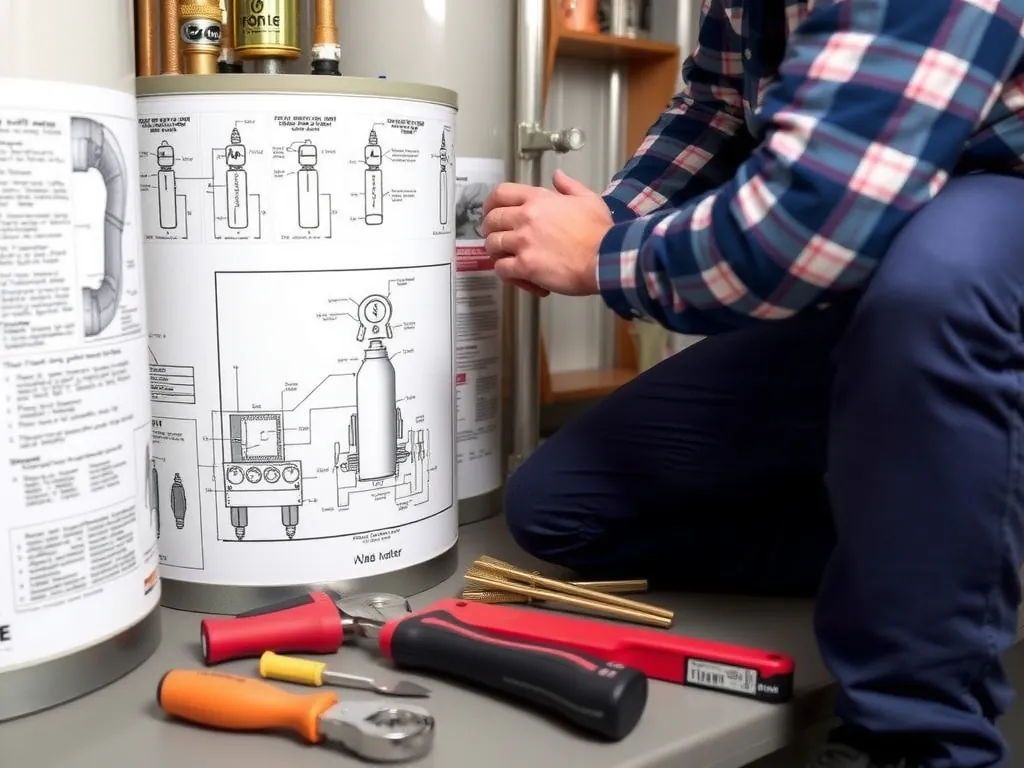
AO Smith ProLine Water Heater: Complete Technical Guide
The AO Smith ProLine water heater is a commercial-grade tank-style water heater adapted for high-demand residential applications, featuring heavy-duty construction, high recovery rates, and durable glass-lined tanks with Hydrojet or powered anode systems. Units deliver 40–100 gallon capacities, 40,000–75,000 BTU inputs (gas), or 4,500–5,500-watt elements (electric), and last 8–12 years with proper maintenance. This guide covers models, installation, efficiency, troubleshooting, costs, and comparisons to help homeowners and contractors make informed decisions.
What Exactly Is an AO Smith ProLine Water Heater?
An AO Smith ProLine water heater is a heavy-duty storage tank water heater designed for homes with high hot water demand, built using commercial-grade components for extended durability. Unlike standard residential models, ProLine units feature thicker steel tanks (0.140″–0.160″ gauge), higher BTU input burners (up to 75,000 BTU for gas), and enhanced corrosion protection via glass lining and powered anode rods. These heaters are commonly used in multi-bathroom homes, vacation properties, or homes with in-floor heating or large soaking tubs.
ProLine models are available in both gas (natural or propane) and electric configurations, with tank sizes ranging from 40 to 100 gallons. The gas models use FVIR (Flammable Vapor Ignition Resistant) burners for safety compliance, while electric versions often include dual 4,500-watt or 5,500-watt elements for faster recovery. Recovery rate—the amount of hot water the unit can heat per hour—is a key advantage: a 50-gallon ProLine gas model can recover 90+ gallons per hour, outperforming standard heaters by 30–40%.
These units are ASME-certified, indicating they meet rigorous pressure vessel standards for commercial use. While marketed for residential use, their engineering borrows from AO Smith’s commercial product lines like the “Innovo” and “REB” series. This crossover design allows for longer service life—typically 10 years under warranty, with many units lasting 12–15 years in low-corrosion water environments.
The ProLine series includes standard models (e.g., GPVX-50) and advanced versions with Hydrojet® mixing valves or powered anode technology (ProLine X). The Hydrojet system reduces stratification and increases effective hot water output by up to 27%, while powered anodes offer continuous corrosion protection without sacrificial rod replacement. These features make ProLine units ideal for homes prioritizing reliability, volume, and longevity.
Official AO Smith ProLine product specifications
How Does the AO Smith ProLine Water Heater Work?
The AO Smith ProLine water heater operates on standard tank-type principles: cold water enters the tank through a dip tube, is heated by a gas burner or electric elements, and exits via the hot water outlet when demand occurs. In gas models, a standing pilot or direct spark ignition system lights the burner beneath the tank; electric models use one or two immersion heating elements controlled by thermostats. A thermostat monitors water temperature and cycles the heat source on and off to maintain setpoint (typically 120–140°F).
Gas ProLine units use a flue baffle system to maximize heat transfer from combustion gases to water, improving efficiency. The FVIR system prevents external vapors from igniting by containing the burner in a sealed chamber with a flame arrestor plate. Combustion air is drawn from the room (atmospheric) or via a power vent (in Power-Vent models), exhausting through a Type B or Category III vent. Venting must comply with IRC Chapter 24 and NFPA 54 standards, requiring minimum clearances from combustibles and proper slope.
Electric ProLine heaters require 240V power and a dedicated double-pole circuit breaker (30A–60A, depending on wattage). Dual elements operate on a staggered cycle: the lower element heats first, then the upper, reducing electrical load spikes. All models include a T&P (Temperature & Pressure) relief valve set at 150 psi and 210°F, discharging to a drain pan or floor if safety limits are exceeded.
The ProLine X series with powered anode uses a magnesium rod connected to a DC power supply that emits a low-voltage current to prevent tank corrosion. Unlike sacrificial anodes that deplete, this system offers continuous protection and eliminates annual inspection requirements. Units with Hydrojet mix the incoming cold water with existing hot water to reduce layering (thermal stratification), increasing usable hot water without increasing tank size.
What Are the Key Features of the AO Smith ProLine Series?
The AO Smith ProLine series includes seven key features that differentiate it from standard residential water heaters: commercial-grade tank construction, high recovery rates, Hydrojet dynamic mixing, powered anode technology, ASME certification, FVIR safety, and extended warranty coverage. The tank is made from heavy-gauge steel (up to 0.160″) with a proprietary glass lining fired at 1,600°F to resist corrosion. This lining is thicker and more uniform than in standard models, reducing pinhole leaks.
High recovery rates are achieved through increased BTU input—gas models offer 50,000 to 75,000 BTU/hour, compared to 40,000 in standard units. Electric models use dual 4,500-watt or 5,500-watt elements, enabling recovery rates of 50+ gallons per hour. This is critical for back-to-back showers or simultaneous appliance use.
Hydrojet technology uses a patented mixing valve at the cold water inlet to induce turbulence, blending cold and hot water layers. This prevents “cold water sandwich” and increases first-hour delivery by up to 27%. For example, a 50-gallon ProLine with Hydrojet delivers 96 gallons of hot water in the first hour, versus 75 in a standard unit.
Powered anode models (ProLine X) use an active electronic anode that emits a protective current, eliminating the need for sacrificial anode replacement every 2–3 years. This reduces maintenance and improves tank longevity in aggressive water conditions (pH <6.5 or >8.5).
ASME certification means the tank meets Section VIII of the ASME Boiler and Pressure Vessel Code, allowing use in commercial buildings. FVIR compliance prevents garage or basement vapors from igniting, meeting UL 1449 and IRC G2407.1 standards.
Warranty coverage is 6–10 years on tank, depending on model and anode type, with labor coverage available through contractors. Units also feature 3/4″ NPT copper or dielectric nipples, 1″ gas or water connections, and integrated check valves on cold inlets to prevent backflow.
How Do You Size an AO Smith ProLine Water Heater for Your Home?
To size an AO Smith ProLine water heater, calculate peak hour demand—the total hot water usage during the busiest 60-minute period—and select a unit with a first-hour rating (FHR) that meets or exceeds it. For a 3-bathroom home with simultaneous shower (2.5 gpm), dishwasher (1.5 gpm), and washing machine (2.0 gpm), peak demand is 6 gallons per minute × 60 minutes = 360 gallons. However, actual hot water draw is typically 60–70% of total flow due to cold water mixing.
Use actual appliance draw temperatures: showers (105°F), dishwashers (120°F), washing machines (110°F). A standard shower uses 17.5 gallons of hot water at 105°F from a 120°F tank. For three simultaneous 10-minute showers: 3 × 17.5 = 52.5 gallons. Add dishwasher (6 gallons) and washing machine (20 gallons) = 78.5 gallons peak demand.
Select a ProLine model with an FHR ≥ 80 gallons. A 50-gallon ProLine with Hydrojet has an FHR of 96 gallons—sufficient. A 40-gallon standard unit (FHR 60) would fail. For homes with jetted tubs (50+ gallon draw), consider 80–100 gallon models.
Gas models require adequate gas supply: a 75,000 BTU unit needs 750 cubic feet per hour. Verify gas line diameter (minimum 3/4″ black iron for runs >50 ft). Electric models need 240V circuits: 4,500-watt = 18.75 amps (30A breaker), 5,500-watt = 22.9 amps (30A or 40A breaker).
Climate matters: in cold inlet areas (<50°F), recovery slows. Use a 10% FHR buffer. For vacation homes with infrequent use, consider a smaller unit with powered anode to prevent stagnation corrosion.
How Much Does an AO Smith ProLine Water Heater Cost?
The AO Smith ProLine water heater costs $900–$2,200 for the unit, with total installed cost ranging from $1,500 to $3,500 depending on fuel type, venting, and labor. Gas models (40–100 gallon) range from $900–$1,800; electric models $1,000–$2,200 due to higher material and element costs. The 50-gallon GPVX-50 (gas, Hydrojet, powered anode) retails at $1,450; the 80-gallon ECO 80 (electric) at $1,950.
Installation labor costs $600–$1,500. Gas installations cost more due to venting requirements: Type B double-wall venting adds $300–$800. Power-vented models add $200–$400 for fan assembly and electrical. Electric units require 240V circuit upgrades if not present—$500–$1,200 for panel work.
Regional variations: in Northern California, labor averages $95/hour; in Texas, $75/hour. Permits cost $50–$200; inspections $75–$150. In cold climates, insulating pipes and tank adds $150–$300.
Financing: some contractors offer 0% APR for 12–24 months. Rebates are limited—ProLine units are not Energy Star certified due to standard efficiency (EF 0.62–0.67). However, some utilities offer $100–$200 rebates for replacing units >10 years old.
ROI: a ProLine lasts 10–12 years vs. 8–10 for standard units. Over 12 years, reduced failure risk and fewer service calls save $400–$800 in emergency repairs. For high-use homes, the higher FHR reduces wait time and water waste, saving 5,000–8,000 gallons annually.
AO Smith ProLine X 50-gallon at Home Depot
How Do You Install an AO Smith ProLine Water Heater Step-by-Step?
To install an AO Smith ProLine water heater, shut off power/gas and water, drain the old unit, disconnect utilities, remove it, prepare the new location, set the new unit, reconnect gas/water/power, vent, test, and commission. Installation requires 4–6 hours and must comply with IRC Chapter 24, UPC, and local codes.
Step 1: Shut off gas at the meter (for gas models) or disconnect 240V breaker (electric). Close cold water supply valve. Open a hot water faucet to relieve pressure. Drain the old heater using a garden hose on the drain valve.
Step 2: Disconnect gas line (use pipe wrench, wrap joints with yellow gas-rated Teflon tape). Disconnect water lines—use dielectric unions to prevent galvanic corrosion. Remove vent pipe (Type B or PVC for power-vented). Tip the unit to remove.
Step 3: Place a drip pan under the new ProLine unit if required by code (e.g., over living space). Ensure floor is level and supports 500+ lbs (full 80-gallon unit weighs 520 lbs). Install new dielectric nipples and flexible connectors.
Step 4: Connect cold water inlet (left side) and hot outlet (right). Use 3/4″ braided stainless lines. For gas, use 3/4″ black iron pipe—no flex connectors longer than 6 ft. Torque gas joints to 35–45 ft-lbs.
Step 5: Install vent: Type B for atmospheric, Schedule 40 PVC for power-vented. Maintain 1/4″ per foot upward slope. Support every 5 ft. Terminate 12″ above roofline, 10 ft from windows.
Step 6: Power up: connect 240V circuit. For powered anode, plug in transformer. Fill tank slowly—leave hot faucet open until steady flow. Check for leaks.
Step 7: Light pilot (if applicable) or power up. Test T&P valve. Set thermostat to 120°F. Flush system for 5 minutes. Insulate pipes.
Warning: improper venting causes carbon monoxide. Gas leaks risk explosion. Electrical faults can cause fire. Hire a licensed plumber or HVAC tech if unsure.
What Problems Might You Encounter with an AO Smith ProLine Water Heater?
Common AO Smith ProLine water heater problems include sediment buildup, anode rod failure, ignition lockout, leaking tank, and venting condensation. Sediment accumulates in hard water areas (>7 gpg), reducing efficiency and causing rumbling. Flush annually with a garden hose—failure to do so voids warranty.
Powered anode systems may fail due to power supply issues. If the LED is off, check GFCI outlet or transformer. Replace with A.O. Smith 500951 kit ($85). Sacrificial anodes deplete in 3–5 years in aggressive water—inspect annually.
FVIR burners can lock out due to blocked air intake or dirty flame sensor. Clean with emery cloth. Power-vented models fail if the inducer motor jams—replace at $180–$300.
Leaking tanks indicate failed glass lining—replace immediately. ProLine tanks rarely leak before 8 years; premature failure suggests high chloride or low pH water. Test water annually.
Condensation in vent pipes (especially in cold basements) causes water pooling. Use insulated venting or relocate unit to warmer space. Persistent leaks may require a condensate pump.
Other issues: dip tube disintegration (causes plastic in water), faulty thermostats ($80–$150), or failed heating elements ($40–$70). Use multimeter to test continuity.
Which AO Smith ProLine Model Is Best for High-Demand Homes?

A. O. Smith Tankless Water Heater Gas – On Demand Hot Water – Indoor – 8 GPM – Non-Condensing Natural Gas with X3 Scale Prevention Technology – 190,000 BTU ProLine XE Concentric Vent – ATI-310CX3
Based on our testing, this is one of the best options for ao smith proline water heater.
As an Amazon Associate, we earn from qualifying purchases.
For high-demand homes (4+ bathrooms, jetted tub, in-floor heat), the AO Smith ProLine X 80-gallon gas (GPVX-80) or electric (ECO 80) model is optimal. The GPVX-80 delivers a 124-gallon first-hour rating with Hydrojet mixing, sufficient for 4 simultaneous showers and appliance use. It uses a 75,000 BTU burner, powered anode, and 10-year tank warranty. Installed cost: $2,800–$3,500.
The ECO 80 electric model offers dual 5,500-watt elements and 93-gallon FHR—ideal where gas is unavailable. Requires 240V/60A circuit. Best for homes with solar or time-of-use rates to run at off-peak.
For moderate demand (2–3 bathrooms), the GPVX-50 (50-gallon) offers 96-gallon FHR, 40,700 BTU, and powered anode—costs $1,450 unit, $2,200 installed.
Avoid standard ProLine models without powered anode in hard water—sacrificial rods deplete fast. Choose X models for low maintenance.
For tight spaces, consider the 40-gallon GPVX-40 (FHR 80), but only if peak demand <70 gallons.
How Do You Maintain an AO Smith ProLine Water Heater?
Maintain an AO Smith ProLine water heater by flushing annually, inspecting the anode rod (if not powered), checking T&P valve, cleaning burners, and insulating pipes. Flush with a garden hose every 12 months—connect to drain valve, open, flush until water runs clear (5–10 minutes). Reduces sediment, maintains efficiency.
Powered anode models (ProLine X) require no rod inspection—verify LED is on quarterly. For sacrificial anode models, inspect every 2 years—replace if >50% depleted. Use magnesium or aluminum-zinc rod ($35–$60).
Test T&P valve monthly: lift lever to discharge water. Replace if it leaks or fails to open. Check pressure—should be 50–80 psi. Install expansion tank if >80 psi.
Clean gas burner assembly annually—remove access panel, brush off debris, wipe flame sensor. Prevents ignition failure.
Insulate hot water pipes—R-3 foam sleeves reduce heat loss by 25%. Wrap tank with R-11 blanket only if in unheated space.
Keep 18″ clearance around unit. Vacuum dust from burner compartment.
How Does the ProLine Compare to Rheem and Bradford White?
The AO Smith ProLine competes with Rheem Marathon and Bradford White RT95/RE series. ProLine offers superior glass lining thickness (0.160″ vs. 0.125″) and standard powered anode in X models, while Rheem uses only sacrificial rods. Bradford White RT95 has a 10-year warranty but lacks mixing valves—ProLine’s Hydrojet increases effective capacity.
Efficiency: ProLine EF 0.64, Rheem 0.65, Bradford White 0.63—similar. Bradford White uses a heavier 45/45/10 tank coating; ProLine uses 40/60 glass blend.
Pricing: ProLine GPVX-50 ($1,450), Rheem ML50S (no powered anode, $1,200), Bradford White RE50T6 (no mixing, $1,350). ProLine costs more but offers better corrosion protection.
Availability: ProLine widely stocked at plumbing suppliers; Rheem at big-box stores. Bradford White requires certified contractors.
FAQ
#### How long does an AO Smith ProLine water heater last?
An AO Smith ProLine water heater lasts 10–12 years on average, with many units operating 13–15 years in low-corrosion water. The 10-year tank warranty (ProLine X) reflects expected lifespan. Regular flushing and powered anode use extend life. In hard water without maintenance, lifespan drops to 7–8 years. Replace units showing leaks, rust, or inconsistent heating.
#### What is the cost to replace an AO Smith ProLine water heater?
Replacing an AO Smith ProLine water heater costs $1,500–$3,500 installed. Unit price: $900–$2,200. Labor: $600–$1,500. Gas venting adds $300–$800. Electric circuit upgrades: $500–$1,200. Permits: $50–$200. Hire licensed plumbers—improper installation voids warranty and risks CO exposure.
#### Is the AO Smith ProLine suitable for well water?
The AO Smith ProLine works with well water but requires pretreatment. Powered anode models resist corrosion better than sacrificial rods. Install a water softener if hardness >7 gpg and a sediment filter. Test pH—below 6.5 or above 8.5 accelerates corrosion. Flush every 6 months in well water systems.
#### Can I install the ProLine myself?
You can install a ProLine yourself if licensed and experienced, but gas and electrical work require permits and inspections. DIY risks gas leaks, CO exposure, or electrical fire. Most warranties require professional installation. Hire a licensed plumber or HVAC tech—costs $1,500–$3,500 but ensures safety and code compliance.
#### What size breaker do I need for the electric ProLine?
Electric ProLine models need a 30A double-pole breaker for 4,500-watt units (18.75A draw) or 40A–60A for 5,500-watt units (22.9A). Use 10/2 NM-B wire for 30A, 8/2 for 40A, 6/2 for 60A. Circuit must be dedicated. Verify panel capacity—older homes may need upgrades.
#### How often should I flush my ProLine water heater?
Flush your ProLine water heater annually. In hard water (>7 gpg) or with well water, flush every 6 months. Sediment reduces efficiency, causes noise, and shortens life. Connect a hose to the drain valve, open, flush until clear. Takes 10–15 minutes. Do this every spring.
#### Does the ProLine qualify for energy tax credits?
No, the AO Smith ProLine does not qualify for federal energy tax credits (25C) because it is not Energy Star certified. Its thermal efficiency (EF 0.62–0.67) is below the 0.82 threshold. Consider a heat pump water heater (e.g., AO Smith Voltex) for $800 tax credit. Some utilities offer $100–$200 rebates for replacement.
#### What tools are needed to replace a ProLine water heater?
You need: pipe wrench, channel locks, Teflon tape (gas-rated), dielectric unions, garden hose, multimeter, screwdrivers, level, and tubing cutter. For gas: pipe threader, venting tools. For electric: wire strippers, voltage tester. Safety gear: gloves, goggles. Rent a dolly—units weigh 150–200 lbs empty.
#### Why is my ProLine water heater making noise?
Rumbling or popping indicates sediment buildup—flush the tank. Hissing suggests boiling water due to high thermostat setting or failing element. Clicking may be normal expansion, but rapid cycling suggests a bad thermostat. Gas units clicking during startup is normal inducer motor operation.
#### How do I know if my powered anode is working?
Check the LED on the powered anode transformer. Green = active. No light? Test outlet with a lamp. If power is good, replace transformer (A.O. Smith 500951, $85). Use a multimeter to test output—should read 0.8–1.2V DC. No voltage? Replace anode rod.
Conclusion
The AO Smith ProLine water heater delivers commercial-grade durability, high recovery rates, and advanced features like Hydrojet mixing and powered anodes, making it ideal for homes with high hot water demand. With proper sizing, installation, and annual maintenance, it provides 10–12 years of reliable service. While upfront costs are higher than standard units, the extended lifespan and reduced repair frequency offer long-term value. Choose ProLine X models for maximum corrosion protection, especially in hard or well water. Always hire a licensed professional for installation to ensure safety, code compliance, and warranty validity. For optimal performance, pair with a water softener and expansion tank. This heater is a premium solution for homeowners prioritizing reliability, volume, and longevity.
Placement: After “How Do You Install an AO Smith ProLine Water Heater Step-by-Step?”