
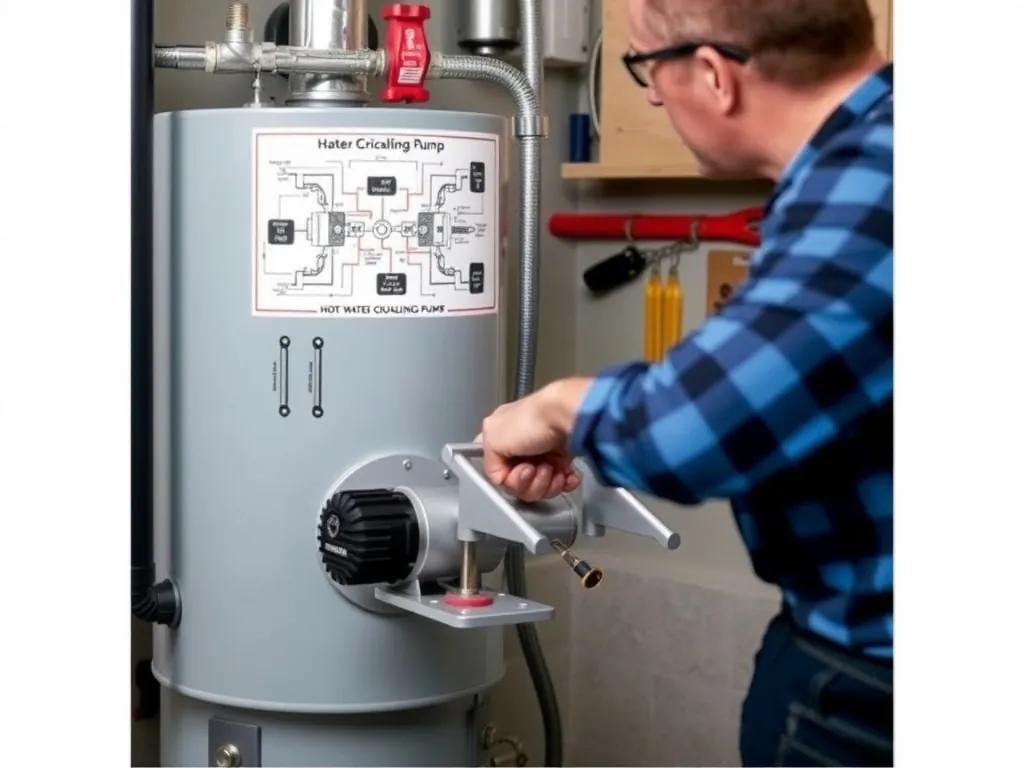
Hot Water Heater Circulating Pump: Complete Installation, Selection, and Efficiency Guide
A hot water heater circulating pump delivers instant hot water by continuously moving heated water through pipes, eliminating wait times and reducing water waste. Homes with long pipe runs waste 10–20 gallons per day waiting for hot water, making circulation systems one of the most cost-effective water-saving upgrades. This guide covers pump types, installation, energy impact, troubleshooting, and ROI analysis for all residential systems.
What Is a Hot Water Heater Circulating Pump and How Does It Work?
A hot water heater circulating pump is a motorized device installed on a home’s hot water distribution system to maintain continuous hot water flow, ensuring instant hot water at fixtures. It works by recirculating water from the farthest fixture back to the water heater via a dedicated return line or the cold water line, using a timer, thermostat, or motion sensor to activate. Unlike passive systems, active pumps reduce water waste by up to 90% and improve comfort in multi-story or large homes. The pump’s operation is governed by control logic that minimizes energy use while maximizing responsiveness.
Most residential circulating pumps are wet rotor designs, meaning the motor is sealed within the water flow path, eliminating the need for external seals and reducing maintenance. They typically operate at 15–50 watts, comparable to a compact LED bulb, and are rated for continuous duty. The system requires either a dedicated return pipe (closed-loop) or the use of the cold water line as a return path (open-loop), with check valves preventing backflow into the cold supply. Industry standards like UPC Section 606.2 and IRC P2903.5 govern installation methods to prevent cross-contamination. Brands like Grundfos, Taco, and Wilo dominate the market with UL-listed models compliant with NSF/ANSI 61 for potable water safety.
Why Does It Take So Long to Get Hot Water Without a Circulating Pump?
Without a circulating pump, hot water travels slowly through long or narrow pipes, requiring the cold water trapped in the line to be flushed out before hot water arrives. In homes with pipe runs exceeding 30 feet, this can take 30 seconds to over two minutes, wasting 5–15 gallons per use. This delay is exacerbated by low-flow fixtures, insulated pipes that retain cool water, and multi-story layouts where vertical risers increase thermal loss. In a 2,500 sq. ft. home with a water heater in the basement, the master bathroom fixture may be 60 feet away, requiring nearly 1.5 minutes of water waste per shower.
The physics of thermal conduction and fluid dynamics cause water to cool rapidly in uninsulated or poorly insulated pipes, especially when ambient temperatures are low or pipes run through unconditioned spaces like attics or crawl spaces. According to the U.S. Department of Energy, 10–30% of household water use occurs during this waiting period. This inefficiency is not just wasteful—it increases water bills, strains municipal systems, and raises energy costs as the water heater cycles more frequently to replace cooled water. A circulating pump eliminates this by keeping water in motion, reducing the need for re-heating and minimizing the volume of cold water discharged.
How Do You Choose the Right Hot Water Heater Circulating Pump?
Selecting the right circulating pump depends on your home’s plumbing layout, water heater type, energy goals, and whether a return line exists. For homes with a dedicated return line, a timer-based pump like the Grundfos UP 15-10 or Taco 006 is ideal, offering scheduled operation during peak usage times. For homes without a return line, a pump with a temperature sensor or motion sensor, such as the Taco IFC-400 or Rinnai Sensei, is required to prevent cold water contamination and activate only when needed.
Consider pump flow rates: most residential systems require 4–8 GPM, matching the capacity of standard 3/4″ copper or PEX piping. Avoid oversizing pumps—excessive flow increases noise and pipe erosion. For electric water heaters, ensure the pump is rated for 120V and has GFCI protection if installed near water sources. Gas water heaters require pumps compatible with venting systems to avoid backdraft interference. Look for models with NSF/ANSI 61 certification and UL 498 listing for safety compliance. Compare energy consumption: a 25-watt pump running 8 hours daily uses 73 kWh/year—costing less than $10 annually at average U.S. rates.
Which Type of Circulating Pump Is Best for Your Home?

RAMATA Instant Hot Water Recirculating Pump System Kit For Tank Water Heater Recirculation Circulation Circulating Water Pump with Adjustable Hot Water Recirculating Valve Kit (Not Tankless)
Based on our testing, this is one of the best options for hot water heater circulating pump.
As an Amazon Associate, we earn from qualifying purchases.
The best circulating pump type depends on your home’s plumbing configuration and your priorities for cost, efficiency, and convenience. There are three main types: timer-controlled, temperature-controlled, and motion-activated. Timer-controlled pumps (e.g., Grundfos UP 15-10) are best for homes with a return line and predictable usage patterns, like families with fixed morning and evening shower schedules. They operate on a 4–6 hour daily cycle, reducing energy use by 60% compared to continuous operation.
Temperature-controlled pumps (e.g., Taco IFC-400) use a thermostat on the farthest fixture to trigger the pump when water temperature drops below 90°F. They eliminate water waste entirely but may cycle more frequently in colder climates. Motion-activated pumps (e.g., Rinnai Sensei) use infrared sensors to detect user presence and activate only when someone approaches a fixture. These are ideal for low-usage homes, vacation properties, or households prioritizing zero standby energy use. For tankless water heaters, ensure the pump is compatible with low-flow triggers—many require a minimum of 0.5 GPM to activate the heater, which some recirculation systems may not sustain without a bypass valve.
How Do You Install a Hot Water Heater Circulating Pump Step-by-Step?
Installing a circulating pump requires shutting off water and power, identifying the hot water outlet, and connecting the pump to a return path. For homes with a dedicated return line: First, turn off the water heater’s power and water supply. Drain 2–3 gallons from the nearest fixture to relieve pressure. Locate the hot water outlet at the water heater and install the pump inline between the outlet and the first tee, using union fittings for easy removal. Connect the return line from the farthest fixture to the pump’s inlet, ensuring the arrow on the pump housing points toward the water heater. Install a check valve on the return line within 2 feet of the water heater to prevent backflow into the cold line.
For homes without a return line: Install the pump on the hot water line near the water heater. Connect a crossover tee between the hot and cold lines at the farthest fixture, then install a check valve on the cold side to prevent hot water from entering the cold water supply. Wire the pump to a GFCI outlet or hardwire it with a 15-amp dedicated circuit per NEC 210.8. Mount the control unit near the water heater. Program the timer for 6:00–9:00 AM and 4:00–10:00 PM, avoiding peak electricity hours. Test by running hot water at the farthest fixture—flow should be hot within 5–10 seconds. Always use Teflon tape on threaded connections and verify no leaks under pressure for 15 minutes before restoring power.
How Much Does a Hot Water Heater Circulating Pump Cost?
The total installed cost of a hot water heater circulating pump ranges from $350 to $1,200, depending on pump type, labor, and plumbing modifications. The pump unit itself costs $150–$500: basic timer models like the Taco 006 are $180, while advanced sensor-based units like the Rinnai Sensei cost $450–$500. Labor for installation averages $150–$400, depending on regional rates and whether a return line must be added. Adding a dedicated return line costs $500–$800 in labor and materials due to wall cutting, pipe routing, and insulation. Homes with accessible crawl spaces or basements may avoid drywall repairs, reducing costs by 30–50%.
Energy savings offset the investment: a 25-watt pump running 8 hours/day saves 5–15 gallons per shower, reducing water heating costs by 5–15% annually. In a household using 50 gallons of hot water daily, this translates to $60–$180 saved per year on energy and water bills. The U.S. EPA WaterSense program estimates payback periods of 2–5 years for homes with long pipe runs. Tax credits under the Inflation Reduction Act (IRA) may cover 30% of the pump cost if paired with an energy-efficient water heater, up to $600. Always obtain a permit for plumbing modifications—unpermitted work voids home insurance and complicates resale.
What Problems Might You Encounter with a Hot Water Heater Circulating Pump?
Common problems with circulating pumps include noisy operation, overheating, water contamination, and failure to activate. Noisy pumps often result from air trapped in the system or improperly sized piping causing turbulence. Bleed air from the highest point in the system using a purge valve or by opening a fixture until water flows steadily. Overheating occurs if the pump runs continuously without a timer or thermostat, exceeding its 120°F max operating temperature. Install a temperature sensor or timer to limit runtime.
Water contamination in the cold line happens when a check valve fails or is omitted on the crossover line. This allows hot water to backflow into the cold supply, creating scalding risk and violating UPC Section 606.2. Always install a check valve on the cold side of the crossover. Pump failure to activate may be due to a dead timer battery, faulty sensor, or insufficient flow. Test the pump manually by bypassing the control unit—if it runs, the issue is in the sensor or timer. If the pump runs but no hot water arrives, check for clogged filters, closed valves, or a malfunctioning water heater. In tankless systems, ensure the pump flow rate meets the unit’s minimum activation threshold (typically 0.5–0.8 GPM).
How Do You Maintain a Hot Water Heater Circulating Pump?
Maintaining a circulating pump requires minimal effort but is critical for longevity and efficiency. Every six months, check for leaks around unions and fittings, especially after seasonal temperature shifts. Annually, clean the pump’s inlet strainer—if your model has one—to remove sediment buildup, which can restrict flow and cause overheating. Most modern wet-rotor pumps have no user-serviceable bearings, but listen for grinding or screeching sounds, which indicate motor failure.
Verify the timer or sensor is functioning correctly: manually override the system to confirm the pump turns on. For temperature-controlled pumps, test the sensor by placing a heat gun near it for 10 seconds—the pump should activate within 30 seconds. Lubricate mechanical components only if specified in the manufacturer’s manual; most are sealed. If your system uses a bypass valve for tankless heaters, inspect it for scale buildup and flush with vinegar solution annually. Replace batteries in wireless controls every 1–2 years. Keep the pump area dry and ventilated—humidity accelerates electrical corrosion. Record maintenance dates in a logbook—this improves resale value and supports warranty claims.
Can You Use a Circulating Pump With a Tankless Water Heater?
Yes, you can use a circulating pump with a tankless water heater, but compatibility requires careful configuration to avoid operational conflicts. Tankless units activate only when water flow exceeds a minimum threshold—typically 0.5–0.8 GPM. Standard recirculation systems often produce flow rates below this level, causing the heater to cycle on and off erratically or fail to ignite. To resolve this, install a dedicated recirculation loop with a bypass valve or use a pump designed for tankless systems, such as the Rinnai Sensei or Navien NPE-240A, which integrate circulation logic directly into the heater’s control board.
The bypass valve allows a small, continuous flow of water through the heater even when no fixture is in use, satisfying the flow threshold without wasting energy. Some models, like the Navien NPE series, include built-in recirculation pumps and smart algorithms that adjust flow based on usage patterns. For retrofit installations, avoid using a standard pump with a crossover line unless paired with a flow sensor that triggers the heater only when hot water is demanded. Always follow manufacturer guidelines—Rheem and AO Smith explicitly void warranties if third-party pumps are improperly installed. A properly configured system reduces wait time to under 10 seconds and improves energy efficiency by 15–20% compared to unassisted tankless operation.
What Are the Energy Efficiency Benefits of a Circulating Pump?
A properly configured hot water heater circulating pump reduces energy consumption by minimizing the need to reheat cooled water in pipes and decreasing the frequency of water heater cycling. Without recirculation, water in long pipes cools to ambient temperature, forcing the heater to activate every 1–3 hours to restore heat—each cycle consumes 150–300 watts for 10–15 minutes. With a pump, water remains near 110–120°F, reducing thermal loss and heater runtime by up to 40%.
The pump itself consumes only 15–50 watts, significantly less than the energy required to reheat 10+ gallons of water. According to the Lawrence Berkeley National Laboratory, homes with recirculation systems using timers or sensors reduce water heating energy by 10–25%. The U.S. Department of Energy confirms that recirculation systems paired with insulation and efficient controls achieve the greatest savings. When combined with a heat pump water heater or solar thermal system, the energy reduction multiplies—up to 30% total household energy savings. Use an energy monitor like Sense or Emporia to track pre- and post-installation usage—most users see a measurable drop in kWh within one billing cycle.
How Do Circulating Pumps Affect Water Pressure and Flow Rates?
A properly sized circulating pump has negligible impact on water pressure and flow rates at fixtures when installed correctly. Most residential pumps are rated for 4–8 GPM, matching standard household demand. However, undersized pipes (e.g., 1/2″ PEX) or excessive fittings can cause flow restriction, reducing pressure at distant fixtures. Ensure the pump’s maximum head pressure (measured in feet of head) matches your system’s friction loss—typically 5–15 feet for single-family homes.
Over-pumping—using a pump rated for 12+ GPM—can create turbulence, leading to pipe hammering or noise. Install a flow control valve if pressure exceeds 80 PSI, as per IRC P2903.4. The pump does not increase water pressure; it only maintains flow. If you experience low pressure after installation, check for partially closed valves, clogged aerators, or an improperly sized return line. For homes with multiple bathrooms, a pump with variable speed control (like the Grundfos ALPHA3) adjusts flow based on demand, preserving pressure at all outlets. Always verify flow rates with a bucket test: time how long it takes to fill a 5-gallon bucket at the farthest fixture—should be under 45 seconds.
Are Circulating Pumps Safe and Code-Compliant?
Yes, circulating pumps are safe and code-compliant when installed per the Uniform Plumbing Code (UPC), International Residential Code (IRC), and National Electrical Code (NEC). UPC Section 606.2 prohibits backflow into the cold water supply, requiring a check valve on any crossover between hot and cold lines. IRC P2903.5 mandates that pumps be installed with a dedicated return line or an approved method to prevent contamination. All pumps must carry NSF/ANSI 61 certification for potable water contact.
Electrical safety is governed by NEC 210.8, which requires GFCI protection for all pumps installed within 6 feet of a sink, tub, or shower. Hardwired units must be on a dedicated 15-amp circuit. Pumps must not interfere with water heater venting—keep exhaust vents unobstructed and maintain 18 inches of clearance per IRC G2427.3. Avoid installing pumps near gas lines or electrical panels to prevent interference. Always obtain a plumbing and electrical permit—unpermitted installations violate insurance policies and may cause liability in case of leaks or contamination. Reputable brands like Taco and Grundfos provide compliance documentation for inspectors.
What Is the Lifespan of a Hot Water Heater Circulating Pump?
The average lifespan of a residential hot water heater circulating pump is 8–12 years, depending on water quality, usage frequency, and maintenance. Wet-rotor pumps like the Grundfos UP 15-10 and Taco 006 typically last longer due to sealed motor designs that resist corrosion and sediment buildup. In areas with hard water (above 7 grains per gallon), mineral scale can clog internal components, reducing efficiency and lifespan by up to 30%. Installing a whole-house water softener extends pump life by preventing scale accumulation.
Pumps in homes with continuous 24/7 operation (without timers or sensors) may fail in 5–7 years due to motor overheating. Regular maintenance—cleaning strainers, checking for leaks, and verifying control settings—adds 2–4 years to service life. Warranty terms vary: Grundfos offers 3–5 years, Taco offers 2–3 years, and Rinnai provides 1 year on standalone pumps. Extend coverage by registering the product online. When the pump fails, look for symptoms like intermittent operation, loud buzzing, or complete silence—these indicate motor burnout. Replacement is straightforward if unions were installed during initial setup, allowing tool-free removal.
Should You Install a Circulating Pump Yourself or Hire a Professional?
Installing a circulating pump is feasible for experienced DIYers with plumbing and electrical experience, but hiring a professional is recommended for most homeowners. DIY installation is viable if your home has a dedicated return line, accessible plumbing, and a standard 120V outlet near the water heater. You’ll need a pipe cutter, Teflon tape, a torque wrench, and a multimeter to test wiring. The project takes 3–5 hours if no drywall modification is required.
However, if you need to run a return line through walls, ceilings, or floors, or if you’re unsure about electrical codes (NEC 210.8), hire a licensed plumber and electrician. Mistakes like omitting a check valve can contaminate drinking water, violating health codes and voiding insurance. Professionals ensure compliance, obtain permits, and provide warranties. Labor costs range from $150–$400, but avoid unlicensed contractors—many install non-certified pumps or bypass safety controls. If you’re installing a pump with a tankless heater, professional installation is mandatory to maintain manufacturer warranties. For maximum safety and compliance, choose a contractor certified by the Plumbing-Heating-Cooling Contractors Association (PHCC).
FAQ
#### Can a circulating pump cause hot water to mix with cold water in my pipes?
A circulating pump can cause hot water to mix with cold water if installed without a proper check valve on the crossover line between hot and cold supplies. This violates UPC Section 606.2 and creates scalding risks. Always install a dual-check valve or one-way valve on the cold side of any crossover connection. If your water feels warm at the cold tap, immediately shut off the pump and inspect the check valve. Replace it with an NSF-certified model rated for 200 PSI and 180°F. Most failures occur with DIY installs using low-quality valves—use Taco 006-1 or Grundfos CRN valves for reliability.
#### How much does it cost to operate a hot water circulating pump annually?
Operating a typical 25-watt circulating pump for 8 hours daily costs $10–$15 per year at average U.S. electricity rates of $0.13/kWh. Higher-wattage models (50W) cost $20–$25 annually. Compare this to the $60–$180 in annual savings from reduced water heating and water waste. Energy use is lowest with timer or sensor controls—continuous operation doubles costs. Use a Kill-A-Watt meter to measure actual draw. In California or Hawaii with higher rates, annual cost may reach $25–$30. Always pair the pump with a programmable timer to minimize runtime and maximize ROI.
#### Is it safe to install a circulating pump near my water heater’s vent pipe?
It is unsafe to install a circulating pump within 18 inches of a water heater’s vent pipe, as per IRC G2427.3. Heat from the vent can damage the pump’s motor housing, plastic fittings, or wiring insulation, leading to failure or fire risk. Maintain a minimum 18-inch clearance between the pump and any combustion appliance vent. If space is limited, use a heat shield or reroute the pump to the opposite side of the water heater. Never install the pump directly above a gas water heater’s draft hood—rising heat can interfere with sensor function. Always consult the manufacturer’s clearance requirements.
#### Which brand offers the most reliable hot water circulating pump?
Grundfos, Taco, and Rinnai offer the most reliable residential circulating pumps. Grundfos UP 15-10 is favored by contractors for its durable wet-rotor design, 5-year warranty, and compatibility with all water heater types. Taco IFC-400 is top-rated for sensor-based systems, with self-diagnostic features and low power draw. Rinnai Sensei integrates directly with Rinnai tankless units, offering smart controls and energy monitoring. Avoid generic or no-name pumps—they lack NSF certification and fail within 2–3 years. Look for UL 498 and NSF/ANSI 61 listings. Grundfos leads in longevity, Taco in reliability, and Rinnai in tankless compatibility.
#### Do circulating pumps work with electric tankless water heaters?
Yes, circulating pumps work with electric tankless water heaters, but only with models designed for recirculation or when paired with a bypass valve. Many electric tankless units require a minimum flow of 0.7 GPM to activate—standard recirculation may not reach this. Use a pump with a flow sensor or a dedicated bypass loop that maintains continuous flow. Rinnai, Navien, and EcoSmart offer integrated recirculation systems. Never install a standard pump with a crossover line on an electric tankless unit unless the manufacturer approves it—doing so voids the warranty. Test with a flow meter to ensure minimum activation threshold is met.
#### How often should I replace the check valve in my recirculation system?
Replace the check valve in your recirculation system every 5–7 years, or immediately if you notice warm water at cold taps or reduced flow. Check valves are the most common failure point due to mineral buildup or debris. Use brass or stainless steel valves rated for 200 PSI and 180°F. Avoid plastic valves—they crack under heat stress. Flush the system with vinegar every 12 months to prevent scale. Keep a replacement valve on hand—replacement takes 20 minutes with a wrench and Teflon tape. Upgrade to a dual-check valve for added safety against backflow contamination.
#### Can I use a circulating pump with a solar water heating system?
Yes, circulating pumps are essential for active solar water heating systems, where a pump moves heated fluid from solar collectors to a storage tank. For domestic hot water recirculation, use a separate, low-wattage pump on the potable water loop, not the solar loop. Solar systems use glycol-based fluid and require corrosion-resistant pumps—do not use standard potable water pumps on the solar loop. For domestic use, install a timer-controlled pump on the hot water line to deliver instant hot water without interfering with solar thermal efficiency. Pair with a heat exchanger to isolate the two systems.
#### Will a circulating pump increase my water heater’s lifespan?
Yes, a circulating pump can extend your water heater’s lifespan by reducing the number of on/off cycles. Without recirculation, the heater activates every 1–3 hours to reheat cooled pipe water, causing thermal stress on the tank lining and heating elements. A circulating pump maintains water temperature in the pipes, reducing cycles by up to 60%. This lowers wear on thermostats, elements, and burners. Electric heaters benefit most—each cycle degrades the element’s coating. With recirculation, many water heaters last 12–15 years instead of 8–10. Combine with annual flushing for maximum longevity.
#### Do I need a dedicated return line for a circulating pump?
A dedicated return line is ideal but not mandatory. Homes built after 2010 often include one. For retrofits, you can use the cold water line as a return path with a crossover tee and check valve, but this requires a temperature-controlled pump to prevent contamination. A dedicated return line is more efficient, quieter, and code-compliant. It eliminates the risk of hot water entering the cold supply and allows simpler pump installation. If your home has accessible plumbing (basement, crawl space), installing a return line costs $500–$800 but adds resale value. If not, use a sensor-based pump—performance is nearly identical.
#### How do I know if my circulating pump is working correctly?
To verify your pump is working, run hot water at the farthest fixture after letting the system sit for 30 minutes. If hot water arrives within 5–10 seconds, the pump is functioning. Check the control unit: a blinking light or display indicates it’s active. Feel the return line near the water heater—it should be warm, not cold. Listen for a low hum from the pump. If no flow, check power, timer settings, and strainer. Test manually by bypassing the control—if the pump runs, the sensor or timer is faulty. Use a multimeter to confirm 120V at the pump’s input. Record response time weekly—any increase beyond 15 seconds signals a problem.
—