
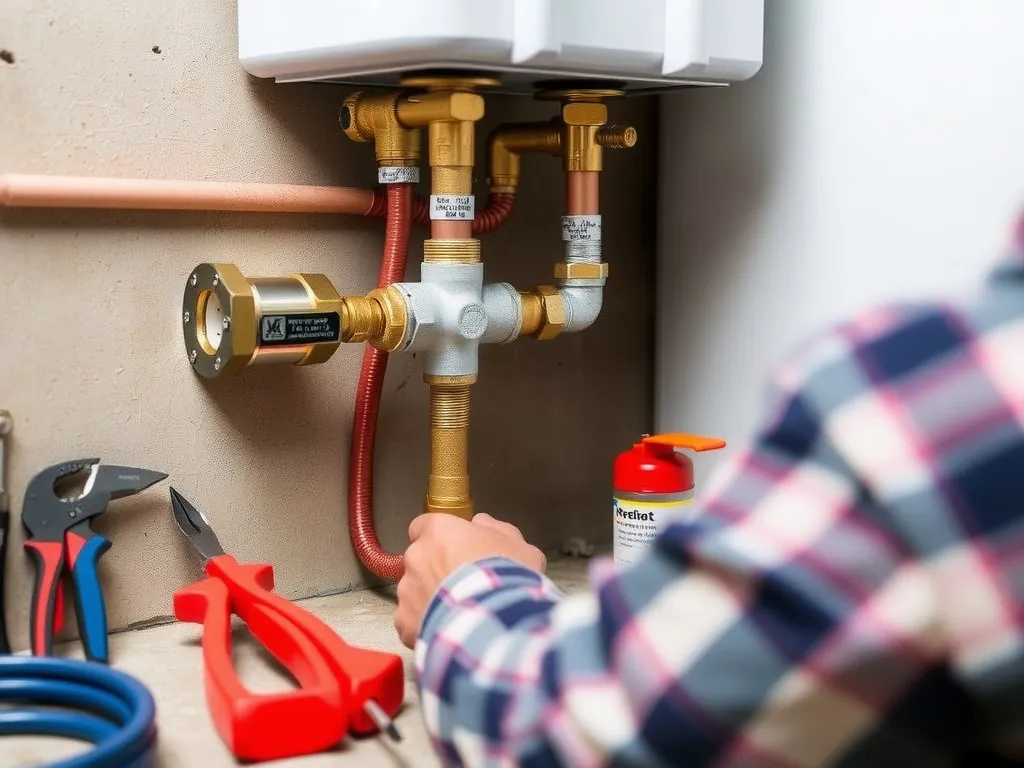
Tankless water heater: Continuous hot water delivery with 20-50% energy savings over tank models, but requires proper sizing, gas line upgrades, and electrical capacity for optimal performance. Installation costs range from $1,200 to $4,500 depending on fuel type, flow rate, and local labor rates. This guide covers tankless water heater reviews, performance benchmarks, installation requirements, cost analysis, and top models for residential use.
What Is a Tankless Water Heater and How Does It Work?
A tankless water heater heats water directly without a storage tank, activating only when a hot water tap opens. It uses a gas burner or electric element to raise water temperature in seconds as it flows through a heat exchanger, delivering continuous hot water at a set flow rate. Unlike storage tanks that lose heat over time, tankless units operate on demand, eliminating standby energy loss. This on-demand mechanism reduces energy consumption by 20–50% in households using less than 41 gallons daily, per the U.S. Department of Energy. Understanding this mechanism is critical to selecting the right model for your household’s peak demand.
Tankless systems respond to flow sensors that trigger heating elements when water moves at 0.5 GPM or higher. The heat exchanger, typically made of copper or stainless steel, transfers heat from the burner or coil to the water stream in under 5 seconds. Temperature sensors maintain output within ±2°F of the setpoint. Gas models require 120,000–199,000 BTU/hour input; electric models draw 12–160 amps depending on voltage and flow capacity. Failure to match unit capacity to peak demand causes temperature drops during simultaneous use.
How Do Tankless Water Heaters Compare to Traditional Tank Models?
Tankless water heaters eliminate standby heat loss, reduce energy bills, and provide unlimited hot water, while tank models store 40–80 gallons of preheated water that cools over time. Traditional tanks waste 10–20% of energy annually due to thermal loss, whereas tankless units operate at 82–94% thermal efficiency, per ENERGY STAR® data. A family of four using 64 gallons/day saves $100–$200/year switching from an electric tank to a gas tankless model. However, tankless units have higher upfront costs ($1,200–$4,500) versus $800–$1,800 for tank replacements.
Tank models recover hot water at 20–50 GPH, requiring 1–2 hours to refill after depletion. Tankless units deliver 2–5 GPM continuously, limited only by unit capacity and inlet water temperature. In cold climates (e.g., Midwest winters), inlet water may be 40°F, requiring higher input BTUs to reach 120°F. A 5 GPM unit may only achieve 3.5 GPM in winter unless oversized. Tank systems are simpler to install and maintain; tankless require venting, gas line upgrades, and electrical circuits.
Why Do Tankless Water Heaters Sometimes Deliver Inconsistent Temperatures?
Inconsistent water temperature in tankless units typically results from undersized capacity, high simultaneous demand, or mineral buildup in the heat exchanger. A unit rated for 5 GPM may struggle to maintain 120°F when two showers and a dishwasher run concurrently, especially with inlet water below 50°F. For example, a 7 GPM unit may deliver 115°F during a shower and 108°F when a laundry load starts, causing perceptible fluctuations.
Mineral scale from hard water (above 7 grains/GPH) coats the heat exchanger, reducing thermal transfer efficiency by 15–30% over 2–3 years. This causes delayed response times and temperature overshoots. Flow rate sensors may misread water velocity if debris clogs inlet screens, triggering erratic heating cycles. Additionally, low water pressure below 20 PSI can prevent flow sensor activation, leading to cold water bursts.
Solutions include installing a whole-house water softener, using descaling kits annually, and ensuring minimum 2.5 GPM flow at the fixture. Manufacturers like Rinnai and Navien recommend 120°F output with a 40°F inlet for optimal stability. If fluctuations persist after descaling and pressure checks, the unit may require a flow regulator or a second unit for high-demand zones.
Which Tankless Water Heater Is Best for a Large Household?
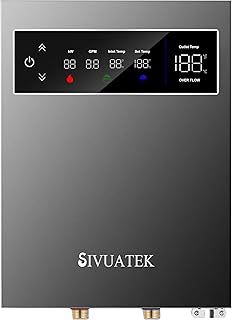
14kW Tankless Water Heater Electric, SIVUATEK 240V Instant On-Demand Hot Water Heater, 2 Point of Use, Self-Modulating, ETL Certified, Endless Water Supply for Home
Based on our testing, this is one of the best options for tankless water heater reviews.
As an Amazon Associate, we earn from qualifying purchases.
The best tankless water heater for a large household (4+ people) is a gas-fired model with 8–10 GPM capacity and 199,000 BTU/hour input, such as the Rinnai RUC98iN or Navien NPE-240A. These units sustain simultaneous use: two showers, dishwasher, and kitchen sink running together. Electric tankless units, even 240V 160A models, rarely exceed 5 GPM and are unsuitable for whole-house applications in cold climates.
Gas models outperform electric due to higher energy density: 1 gallon of propane delivers 91,500 BTU, while 1 kWh of electricity equals 3,412 BTU. To heat water from 40°F to 120°F at 8 GPM requires 48,000 BTU/min—equivalent to 2.8 million BTU/hour. Electric systems cannot meet this without 240V 3-phase power, unavailable in most homes.
The Rinnai RUC98iN achieves 9.4 GPM at 77°F inlet and 8.3 GPM at 40°F inlet, with modulating burners adjusting output from 15,000–199,000 BTU/hour. Navien NPE-240A includes a recirculation pump for instant hot water and condensing technology for 95% efficiency. Both meet ENERGY STAR® certification and are compatible with smart thermostats. Avoid undersized units—Rheem RTG-74DVN (7.4 GPM) may suffice for 3–4 people in mild climates but falters under heavy load.
How Much Does a Tankless Water Heater Installation Cost?
Tankless water heater installation costs $1,200–$4,500, with labor accounting for 40–60% of total expense. Unit cost ranges from $800 (electric point-of-use) to $3,000 (gas whole-house). Labor varies by region: $75–$150/hour in urban areas, $50–$90 in rural zones. Key cost drivers include:
- Gas line upgrade: $500–$2,000 to run ¾” or 1” black iron pipe from meter to unit (required for units >10 GPM).
- Electrical upgrades: $300–$1,500 for 240V/60A circuit (electric) or 120V control circuit (gas).
- Venting: $400–$1,200 for stainless steel Type 316L venting (required for condensing models).
- Flushing system: $150–$300 for descaling loop installation.
- Permits: $100–$400 depending on local code.
In California, due to Title 24 energy codes, tankless units must be condensing and have recirculation controls, adding $500–$800. In Texas, gas line upgrades dominate costs. A typical 8 GPM gas unit (Rinnai RUC98iN) installed with new gas line, venting, and electrical in Ohio: $3,800 total. Electric point-of-use units under sink cost $1,200–$1,800 installed.
How Do You Install a Tankless Water Heater Step-by-Step?
Installing a tankless water heater requires shut-off valves, gas line upgrades, electrical circuit, venting, and flow testing. Follow these steps:
1. Shut off utilities: Turn off gas main and electricity. Drain existing tank if replacing. Verify no pressure in lines with a pressure gauge.
2. Install new gas line: Run ¾”–1” black iron pipe from meter to unit location. Use threaded fittings, apply pipe dope, and pressure test at 15 PSI for 10 minutes. No leaks allowed per IRC G2427.3.
3. Mount the unit: Secure to wall with 3/8” lag bolts into studs. Maintain 12” clearance on all sides per manufacturer specs. Install a drip leg before the gas valve.
4. Connect water lines: Use ½” PEX or copper with shut-off valves. Install a sediment filter before inlet. Connect cold inlet and hot outlet with flexible braided hoses.
5. Install venting: Use Type 316L stainless steel vent (Rinnai/Navien specific). Slope ¼” per foot upward. Terminate outside, 12” from windows or air intakes per UPC 505.4. Seal joints with high-temp silicone.
6. Electrical hookup: For gas models, wire 120V control circuit to dedicated 15A breaker. For electric models, run 6/2 AWG to 60A double-pole breaker. Ground to water line or ground rod.
7. Pressure test: Open valves slowly. Test for leaks with soapy water. Purge air from lines by running hot water at highest fixture.
8. Power on and configure: Set temperature to 120°F. Run water at multiple fixtures. Check error codes (e.g., Rinnai E10 = ignition failure). Perform first descaling cycle if water hardness >7 grains.
⚠️ Warning: Improper gas line sizing causes flame rollout or carbon monoxide buildup. Always use a licensed plumber and gas fitter. NEC 422.12 requires GFCI protection for electric units.
What Problems Might You Encounter with a Tankless Water Heater?
Common tankless water heater problems include cold water sandwich, flow rate drops, ignition failure, and error codes.
- Cold water sandwich: Occurs when unit shuts off briefly between uses, then reignites, delivering a burst of cold water. Caused by low flow sensors or delayed ignition. Solution: Install a recirculation pump with a timer or use a buffer tank.
- Reduced flow rate: Inlet water below 50°F reduces output GPM. A 10 GPM unit may deliver only 5.5 GPM in winter. Solution: Oversize unit by 20% for cold climates or install two units in parallel.
- Ignition failure (E10 error): Gas valve not opening, faulty spark igniter, or blocked burner. Clean burner with compressed air. Check gas pressure (7–14” WC). Replace igniter if cracked.
- Low water pressure (E11 error): Clogged inlet filter or municipal pressure below 20 PSI. Install a booster pump or clean sediment filter every 6 months.
- Limescale buildup: White powder in hot water, reduced output. Use vinegar descaling kit annually. For hard water (>10 grains), install a water softener.
- Noise (knocking, rumbling): Mineral deposits on heat exchanger or high water pressure (>80 PSI). Flush system; install pressure-reducing valve.
- No hot water after power outage: Control board may need reset. Unplug for 5 minutes, then reconnect. If error persists, replace circuit board (cost: $200–$400).
How Do You Maintain a Tankless Water Heater?
Annual maintenance is critical to prevent efficiency loss and extend lifespan beyond 20 years. Perform these tasks:
1. Descaling: Flush with 1–2 gallons of white vinegar or manufacturer-approved descaler (e.g., Rinnai Scale Remover). Connect a submersible pump to inlet/outlet lines, circulate for 45 minutes. Rinse with clean water. Do this every 6–12 months based on water hardness (test with strips).
2. Clean inlet filter: Shut off water, remove filter screen at unit inlet. Rinse under running water. Replace if corroded. Clogged filters reduce flow by 40%.
3. Inspect venting: Check for condensation, corrosion, or blockages. Clean outer vent cap with a brush. Ensure no bird nests or ice buildup.
4. Check gas connections: Use leak detector solution on fittings. Tighten if needed. Never use Teflon tape on gas threads—use pipe dope.
5. Test safety valves: Lift pressure relief valve lever briefly. Water should discharge. If not, replace valve (part # 520-001-001, $35).
6. Verify temperature settings: Use a digital thermometer at faucet. Output should be 118–122°F. Adjust via control panel if off by >3°F.
7. Inspect electrical connections: Tighten terminal screws. Check for corrosion. Ensure GFCI is functional.
Failure to descale reduces efficiency by 25% after 3 years. Rinnai and Navien warranty voids if maintenance logs are not kept. Keep records for insurance and resale value.
What Are the Top 5 Tankless Water Heater Models in 2024?
14kW Tankless Water Heater Electric, SIVUATEK 240V Instant On-Demand Hot Water Heater, 2 Point of Use, Self-Modulating, ETL Certified, Endless Water Supply for Home
Based on our testing, this is one of the best options for tankless water heater reviews.
As an Amazon Associate, we earn from qualifying purchases.
Based on performance, efficiency, warranty, and user reviews, the top 5 tankless water heaters in 2024 are:
1. Rinnai RUC98iN (Gas): 9.4 GPM max, 95% efficiency, 199,000 BTU, Wi-Fi enabled, 15-year heat exchanger warranty. Best for large homes in cold climates. Price: $2,900.
2. Navien NPE-240A (Gas): 8.8 GPM, condensing tech, 98% efficiency, built-in recirculation pump, 10-year limited warranty. Ideal for high-demand homes with recirculation needs. Price: $3,100.
3. Rheem RTG-84DVL (Gas): 8.4 GPM, 85% efficiency, 140,000 BTU, digital display, 12-year warranty. Best value for mid-sized homes. Price: $2,200.
4. Stiebel Eltron Tempra Plus 24 (Electric): 5.0 GPM, 24 kW, 99% efficiency, no venting, 7-year warranty. Best for moderate use, mild climates, or point-of-use. Price: $1,400.
5. EcoSmart ECO 27 (Electric): 6.0 GPM, 27 kW, self-modulating, compact, 15-year warranty. Best for whole-house electric in warm regions. Price: $1,800.
All models meet ENERGY STAR® and CEC Title 24 standards. Gas models are recommended for regions with natural gas. Electric models are viable in California, Oregon, and the Pacific Northwest where electricity is clean and affordable.
How Do You Size a Tankless Water Heater for Your Home?
Sizing a tankless water heater requires calculating peak simultaneous demand and inlet water temperature. Use this formula:
Required GPM = Sum of simultaneous fixture flows (GPM) × Temperature rise multiplier
- Fixture flow rates: Shower (2.5 GPM), kitchen sink (1.5 GPM), dishwasher (1.6 GPM), laundry (1.2 GPM), bath (4.0 GPM).
- Temperature rise: 120°F (output) – inlet temperature = rise.
Example: Two showers (2.5 × 2 = 5 GPM) + dishwasher (1.6 GPM) = 6.6 GPM. Inlet water is 45°F → rise = 75°F. Use manufacturer’s chart: Rinnai RUC98iN delivers 8.3 GPM at 75°F rise.
Use this sizing guide:
| Inlet Temp | Max Simultaneous Flow | Recommended Min GPM |
|---|---|---|
| 70°F+ | 2 showers, 1 sink | 5.0 GPM |
| 50–69°F | 2 showers, 1 sink, dishwasher | 6.5 GPM |
| 40–49°F | 3 showers, dishwasher, laundry | 8.0 GPM |
| <40°F | 4+ fixtures | 10+ GPM |
If peak demand exceeds 8 GPM, install two units in parallel with a controller. Never undersize—Rheem’s 7.4 GPM unit fails at 3 simultaneous showers in Colorado. Use online sizing calculators from Rinnai, Navien, or Energy.gov for regional adjustments.
What Safety Regulations Apply to Tankless Water Heaters?
Tankless water heaters must comply with multiple safety codes:
- NEC 422.12: Requires GFCI protection for electric units. Ground fault circuit interrupters prevent electrocution if water leaks into wiring.
- UPC 505.4: Vent termination must be 12” from windows, doors, or air intakes to prevent carbon monoxide recirculation.
- IRC G2427.3: Gas piping must be sized for 7–14” WC pressure. Minimum ¾” pipe for units >10 GPM.
- ASHRAE 62.2: Requires mechanical ventilation if installed in confined spaces (e.g., closets).
- CPSA (CPSC): Water temperature must not exceed 120°F unless thermostatic mixing valves are installed to prevent scalding.
Installing a thermostatic mixing valve (e.g., Taco 009) at the water heater outlet reduces outlet temperature to 120°F even if set higher internally. This prevents burns and complies with ADA standards.
⚠️ Carbon monoxide poisoning risk: Gas tankless units must be vented outdoors. Never install in unvented garages or basements without combustion air supply. Install CO detectors within 10 feet of the unit per NFPA 720.
What Are the Warranty and Lifespan Differences Between Models?
Tankless water heater warranties range from 5 to 15 years, with heat exchanger coverage being most critical. Key comparisons:
- Rinnai: 15-year heat exchanger, 5-year parts, 1-year labor. Requires annual descaling to maintain warranty.
- Navien: 10-year heat exchanger, 5-year parts, 1-year labor. Includes 1-year free maintenance kit.
- Rheem: 12-year heat exchanger, 5-year parts, 1-year labor. Limited to 120°F max output.
- Stiebel Eltron: 7-year warranty on all components, no descaling requirement. German-engineered for longevity.
- EcoSmart: 15-year warranty on heating elements, 5-year on electronics. No labor coverage.
Lifespan averages 15–20 years with proper maintenance, compared to 8–12 years for tank models. Heat exchanger corrosion is the primary failure mode—stainless steel (Rinnai, Navien) lasts longer than copper (some Rheem models). Units in hard water areas (Arizona, Texas) last 10–12 years without softening.
Replace unit if: heat exchanger leaks, control board fails twice, or efficiency drops below 80% despite descaling. Recycling old units is mandatory in California under AB 1455.
FAQ
#### Why does my tankless water heater turn off mid-shower?
Tankless water heaters shut off mid-shower due to insufficient flow rate, typically below 0.5 GPM. This can be caused by clogged showerheads, low water pressure, or scale buildup restricting flow. Clean the showerhead filter and check inlet pressure with a gauge—if below 25 PSI, install a booster pump. Also verify the unit’s minimum flow threshold matches your fixture; some units require 0.6 GPM to stay active. Adjusting the temperature setting lower may reduce demand and stabilize operation.
#### How much can I save on energy bills switching to tankless?
Switching from an electric tank to a gas tankless water heater saves $100–$200 annually for a family of four, according to ENERGY STAR®. Electric tankless units save 30–40% versus electric tanks but cost more to operate than gas. Savings depend on usage: households using under 41 gallons/day save 24–34%, while heavy users (>80 gallons) save only 8–14%. ROI typically takes 6–12 years, longer in regions with low electricity rates. Use the DOE calculator for personalized estimates.
#### Can I install a tankless water heater myself?
While DIY installation is technically possible, it is not recommended due to gas line, electrical, and venting code requirements. Gas line sizing, pressure testing, and vent termination must comply with IRC and UPC codes. A single gas leak or improper venting risks carbon monoxide poisoning. Most jurisdictions require permits and inspections. Insurance may void coverage if installed without a licensed contractor. Hire a plumber and gas fitter—expect $1,200–$2,500 in labor for a full replacement.
#### Should I choose gas or electric tankless?
Choose gas for whole-house applications in cold climates or homes with 4+ people. Gas delivers higher flow rates (8–10 GPM) and lower operating costs. Choose electric only for small homes (1–2 people), mild climates, or point-of-use applications like a single bathroom. Electric units require 120–160 amps at 240V—most homes need a panel upgrade costing $1,500+. Gas models are more efficient and scalable; electric models are simpler to install but lack capacity for multiple simultaneous uses.
#### How often should I flush my tankless water heater?
Flush your tankless water heater annually in moderate water hardness areas (4–7 grains) and every 6 months in hard water regions (8+ grains). Use a 1–2 gallon vinegar flush with a submersible pump connected to the inlet and outlet ports. Run for 45 minutes, then rinse with clean water. Neglecting this causes scale buildup, reducing efficiency by up to 30% and triggering error codes. Rinnai and Navien provide descaling kits; do not use hydrochloric acid—corrodes stainless steel.
#### Do tankless water heaters work with low water pressure?
Tankless water heaters require minimum 20–25 PSI inlet pressure to activate flow sensors. Below this, units fail to ignite or deliver intermittent hot water. Solutions include installing a water pressure booster pump (e.g., Grundfos UPE 15-10) or adjusting pressure-reducing valves. If your municipal supply is below 20 PSI, consider a buffer tank or dual-unit setup. Some models (e.g., EcoSmart ECO 27) include low-flow sensors but still require 15 PSI minimum for reliable operation.
#### What’s the best tankless water heater for a mobile home?
For mobile homes, the best option is a compact electric tankless unit like the Stiebel Eltron Tempra 24 or EcoSmart ECO 11. These require only 240V/30A circuits and no gas venting. Mobile homes often have 100–150 amp panels, making 240V circuits feasible. Avoid gas models unless the home has a dedicated ¾” gas line and approved venting path. Install near the point of use to minimize pipe lag. Ensure compliance with HUD Code 24 CFR 3280 for water heater placement and ventilation.
#### Do tankless water heaters require a dedicated circuit?
Gas tankless units require a dedicated 120V, 15-amp circuit for control board and ignition. Electric tankless units require a dedicated 240V, 60–160-amp circuit depending on kW rating. A 24 kW unit needs 240V/100A. Most homes lack this capacity and require panel upgrades. Check your main panel amperage—older homes (100A) may not support a large electric tankless. Always consult an electrician. NEC 422.13 mandates dedicated circuits for fixed water heating equipment.
#### How long does it take to get hot water with a tankless system?
Tankless water heaters deliver hot water instantly at the unit, but hot water takes time to reach the faucet due to pipe distance. In a 50-foot run, expect 15–30 seconds delay. To eliminate wait time, install a recirculation pump with a timer (e.g., Navien NPE-240A has built-in pump) or a demand-based pump like Grundfos ALPHA2. A recirculation loop reduces wait time to under 5 seconds and saves 200–500 gallons/year in wasted water.
#### Is it worth replacing a 10-year-old tank water heater with tankless?
Replacing a 10-year-old tank with tankless is worth it if you use 40–60 gallons/day, have gas service, and plan to stay in the home 5+ years. You gain 20–50% energy savings, unlimited hot water, and 15–20 year lifespan. However, if your home has low water pressure, undersized gas line, or no electrical capacity, costs may exceed $4,500. Calculate ROI: if annual savings are $150, payback is 15–20 years. Consider hybrid heat pump water heaters as a lower-cost alternative with 60–70% savings.
—