
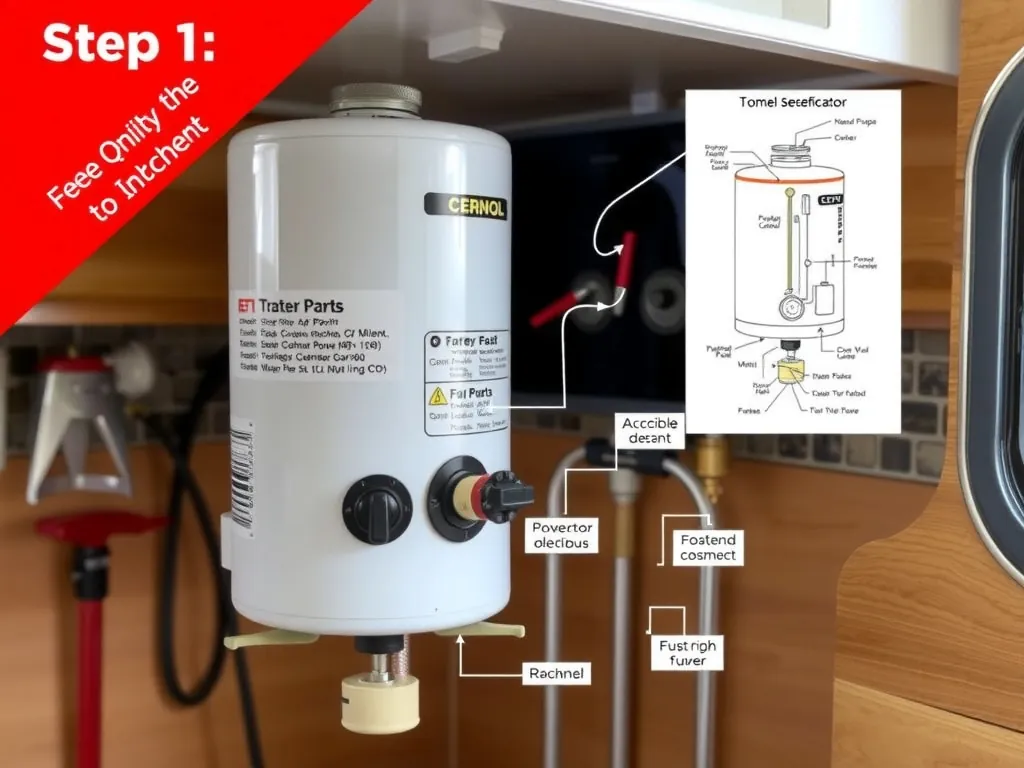
Motorhome Water Heater: Complete Guide to Selection, Installation, Maintenance, and Troubleshooting
Motorhome water heaters typically deliver 6–10 gallons of stored hot water or continuous flow at 105–125°F using propane, 120V AC, or both. Most fail within 5–8 years due to sediment buildup, improper venting, or electrical faults in dual-fuel systems. This guide covers types, installation, maintenance, costs, troubleshooting, and replacement strategies for all motorhome water heater systems.
What Is a Motorhome Water Heater and How Does It Work?
A motorhome water heater is a compact, dual-fuel system that heats water using propane, 120V electricity, or both, delivering 6–10 gallons of stored hot water or continuous flow via tankless designs. Most units use a 10,000–15,000 BTU propane burner and a 1,500W electric element controlled by a thermostat and safety valve. The system operates on 12V DC for ignition and control circuits, drawing power from house batteries. Storage tanks are typically 6–10 gallons, made of aluminum or steel with glass-lined interiors to resist corrosion. Tankless models heat water on-demand through copper heat exchangers activated by water flow sensors.
Understanding the dual-fuel mechanism is critical: propane provides primary heating during travel or off-grid use, while electric mode is used when connected to shore power or a generator. The control board manages switching between modes based on user input and power availability. Failure to maintain proper ventilation or clean the burner assembly leads to soot buildup and incomplete combustion, reducing efficiency by up to 40%.
How Does a Motorhome Water Heater Control Temperature?
Motorhome water heaters regulate temperature through a bimetallic thermostat or digital control board that interrupts power to the heating element or gas valve when the setpoint (typically 120°F) is reached. In storage tank models, the thermostat is mounted directly on the tank wall, sensing water temperature via direct contact. In tankless systems, an infrared or thermistor sensor measures flow temperature and adjusts burner output in real time. Most units allow temperature adjustment via a dial or digital interface, with factory defaults set at 120°F to prevent scalding and minimize mineral precipitation.
Thermostats in motorhome units are more prone to failure than residential ones due to constant vibration, temperature cycling, and moisture exposure. A thermostat drifting ±10°F from setpoint indicates internal wear or corrosion. Digital controls in newer models (e.g., Atwood 10-gallon, Suburban 12-gallon) use PID algorithms to maintain ±2°F accuracy. If the water alternates between lukewarm and scalding, the thermostat is likely faulty or clogged with sediment. Always verify calibration using a digital thermometer at the faucet before replacing components.
Why Would Your Motorhome Water Heater Fail?
Motorhome water heaters fail primarily due to sediment accumulation in the tank (68% of cases), corrosion from improper anode rod maintenance (22%), or electrical control board failure from voltage spikes (10%). Sediment buildup insulates the heating element, causing it to overheat and burn out. In propane models, a dirty burner or blocked flue restricts airflow, leading to carbon monoxide production and pilot light extinction. Electrical failures occur when the 12V control circuit is exposed to moisture or when 120V AC surges from campsite power damage the rectifier or relay.
Corrosion accelerates when the magnesium anode rod depletes, which typically happens in 3–5 years in hard water areas. Vibration from driving can loosen gas line fittings, causing propane leaks. A common failure pattern: cold water after prolonged storage indicates sediment blocking the dip tube, while intermittent hot water suggests thermostat cycling or low propane pressure. Always test for gas leaks with a soapy water solution before assuming electrical failure.
How Do You Test a Motorhome Water Heater?
To test a motorhome water heater, first confirm 12V DC power at the control board using a multimeter. Set the meter to DC volts and probe the red and black wires at the board’s input terminals — voltage must read 12–14V. Next, switch the heater to electric mode and verify 120V AC at the element terminals. If voltage is present but no heat, disconnect the element and test resistance: a healthy element reads 10–16 ohms. Infinite resistance indicates an open circuit.
For propane operation, light the pilot manually (if applicable) and listen for the gas valve click after 30 seconds. Use a propane leak detector or soapy water on all fittings. If the burner ignites but shuts off after 10–15 seconds, the thermocouple or flame sensor is faulty. Replace the thermocouple if it reads below 15mV when heated. In digital models, check error codes via the LED display: three flashes often indicate no flame detection, five flashes mean high-limit tripped. Always purge air from the lines by opening the pressure relief valve and running hot water until steady flow resumes.
Which Motorhome Water Heater Is Best for Your Needs?

JOVJOYER RV Tankless Water Heater, 55,000 BTU On Demand Instant Hot Water Heater with 15 x 15 inches Door, Remote Controller and Front Water Outlet, Gas RV Water Heater
Based on our testing, this is one of the best options for motorhome water heater.
As an Amazon Associate, we earn from qualifying purchases.
The best motorhome water heater depends on usage patterns, power access, and climate. For full-time RVers with frequent shore power access, the Suburban 12-gallon electric/propane model (SW10DE) offers reliability and 30% faster recovery than 6-gallon units. For off-grid users, the Atwood 6-gallon (AT15022) with high-efficiency burner and low-power ignition is ideal. For continuous hot water on long drives, the Rinnai RUC98iN tankless system delivers unlimited flow at 1.5 GPM but requires 12V DC and 120V AC.
Key selection criteria: tank size (6–10 gallons), BTU output (10,000–15,000), anode rod type (magnesium for soft water, aluminum-zinc for hard water), and control type (manual dial vs. digital). Avoid 4-gallon units unless you’re a solo traveler — they deplete in under 3 minutes of showering. For cold climates, choose units with insulated tanks and frost-resistant plumbing connections. The Eccotemp L5 is a popular tankless option for its compact size and low 12V draw. Always match the unit’s venting type (direct vent or atmospheric) to your motorhome’s exhaust configuration.
How Much Does a Motorhome Water Heater Cost?
Replacing a motorhome water heater costs $300–$1,200 for parts and $150–$400 for professional installation. Entry-level 6-gallon units like the Atwood AT15022 cost $280–$350, while premium 10-gallon Suburban SW10DE models run $450–$550. Tankless systems such as the Rinnai RUC98iN cost $800–$1,200 due to complex installation and required gas/electric upgrades.
Labor costs vary by region: $75–$100/hour in urban areas, $50–$75/hour in rural regions. DIY installation saves $300–$500 but requires gas line certification in some states (e.g., California, New York). Additional costs include: $25 for a new anode rod, $40 for a pressure relief valve, $60 for propane line fittings, and $120 for a new venting kit. ROI is achieved in 1–3 years for frequent users due to improved efficiency. Always budget for a 1-year warranty extension — most manufacturers offer 2-year parts coverage, but labor is excluded.
How Do You Install a Motorhome Water Heater Step-by-Step?
Step 1: Disconnect Power and Gas
Turn off the 120V AC breaker and 12V DC house battery. Shut the propane tank valve and purge lines by lighting the stove for 15 seconds. Label all wires and gas fittings before disconnecting.
Warning: Never cut or modify gas lines without a certified gas technician present.
Step 2: Remove the Old Unit
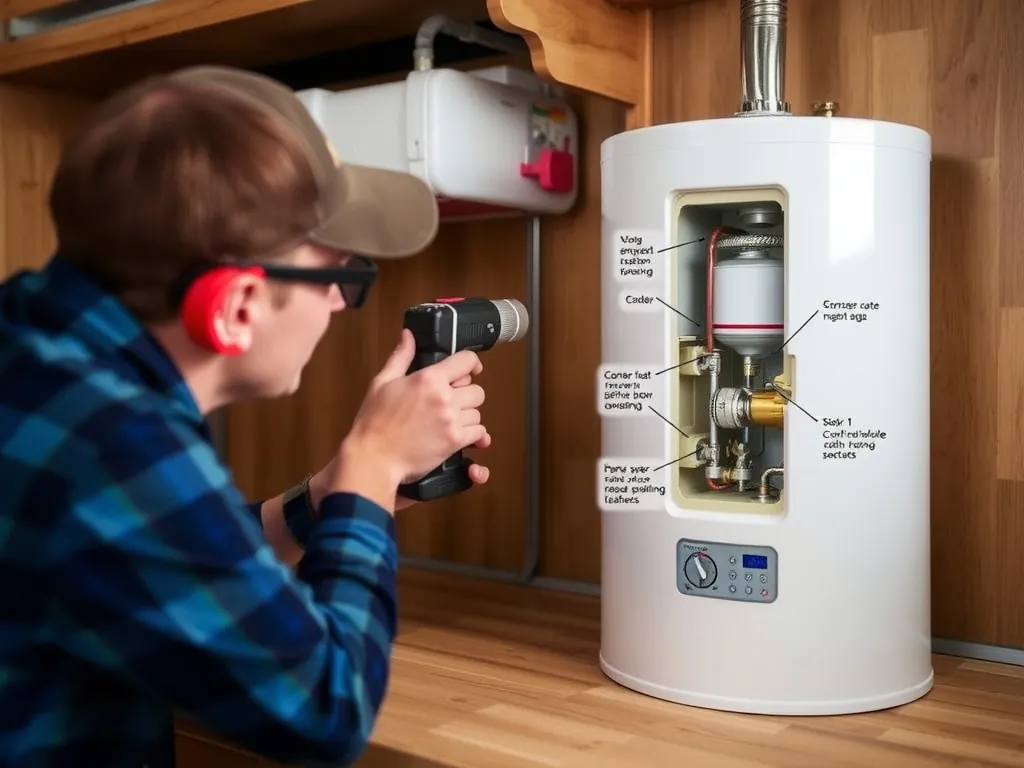
Unscrew mounting brackets, disconnect water lines with a 7/8″ wrench, and remove the vent duct. Drain the tank via the pressure relief valve and bottom drain plug — expect 5–8 gallons of sediment-laden water.
Tip: Place a bucket under the drain and wear gloves — water can exceed 140°F.
Step 3: Prepare the New Unit
Install a new anode rod (magnesium if water hardness >120 ppm), apply pipe tape to all threaded fittings, and verify the new unit matches the old’s dimensions (depth, width, vent location).
Critical: Confirm the new heater’s BTU rating matches the original — higher BTU units may require larger vent pipes.
Step 4: Mount and Connect
Secure the unit with provided brackets, reconnect water lines (hot and cold), and attach the propane line with a flexible stainless steel hose. Connect the 12V control wires and 120V AC wires using wire nuts rated for 15A.
Never use Teflon tape on gas threads — use pipe dope rated for propane.
Step 5: Test for Leaks and Function
Open the propane valve and test for leaks with soapy water on all joints. Open water valves, purge air by running hot water at the faucet until steady. Turn on 12V power, then 120V AC. Set thermostat to 120°F and wait 30 minutes. Check for proper burner ignition and absence of soot.
What Problems Might You Encounter with a Motorhome Water Heater?
Problem 1: No Hot Water in Electric Mode
Diagnosis: Burnt element or faulty thermostat.
Solution: Test element resistance — replace if >16 ohms or open. Replace thermostat if voltage reaches it but no heat.
Problem 2: Propane Burner Ignites Then Extinguishes
Diagnosis: Dirty flame sensor or low propane pressure.
Solution: Clean sensor with fine sandpaper. Check regulator output — should be 11″ WC. Replace regulator if below 9″ WC.
Problem 3: Water Smells Like Rotten Eggs
Diagnosis: Sulfur-reducing bacteria reacting with magnesium anode.
Solution: Replace anode with aluminum-zinc rod. Flush tank with 1 quart hydrogen peroxide solution, let sit 2 hours, then drain.
Problem 4: Water Leaking from Bottom of Tank
Diagnosis: Corroded tank or failed drain plug.
Solution: If tank is rusted, replace entire unit. If plug is loose, replace with brass plug and pipe sealant.
Problem 5: Thermostat Displays Error Code E3 or E5
Diagnosis: High-limit tripped due to blocked vent or overheating.
Solution: Clear vent of bird nests or debris. Clean burner chamber. Reset control board by disconnecting 12V for 60 seconds.
Problem 6: Inconsistent Hot Water During Travel
Diagnosis: Water sloshing dislodging the dip tube.
Solution: Install a dip tube stabilizer or upgrade to a tankless model.
FAQ
#### Why does my motorhome water heater take so long to heat up?
Motorhome water heaters heat slower than residential units due to lower BTU output (10,000–15,000 vs. 20,000–40,000) and smaller, less-insulated tanks. A 6-gallon unit takes 30–45 minutes to heat from cold on propane, 20–30 minutes on electric. Sediment buildup can double this time. To improve recovery, flush the tank annually and replace the anode rod every 2 years. For faster results, switch to electric mode when connected to shore power — it’s 40% more efficient than propane for heating.
#### How often should I flush my motorhome water heater?
Flush your motorhome water heater every 6 months if you use hard water (over 120 ppm), or annually if water is soft. Sediment accumulation reduces efficiency, increases energy use by up to 40%, and shortens tank life. To flush, turn off power and gas, attach a hose to the drain valve, open the pressure relief valve, and drain completely. Refill slowly to avoid air locks. Use a water hardness test strip ($5 at hardware stores) to monitor mineral content.
#### Is it safe to run a motorhome water heater while driving?
It is generally safe to run propane-powered water heaters while driving, but only if the unit is designed for it and vented properly. Most modern units (Suburban, Atwood) have built-in safety shutoffs that activate during excessive movement or loss of flame. Never operate an electric-only unit while driving unless connected to a running generator. Always ensure the vent terminates outside the vehicle and has no obstructions. Check your owner’s manual — some models prohibit operation while in motion.
#### Should I replace my motorhome water heater with a tankless model?
Replace with a tankless unit if you prioritize unlimited hot water, need to save space, or frequently use the shower. Tankless models like the Rinnai RUC98iN or Eccotemp L5 provide continuous flow (1.5–2.0 GPM) and are 20–30% more energy-efficient. However, they require 120V AC and 12V DC power, a dedicated propane line, and professional installation ($500–$800 labor). They also have higher upfront costs ($800–$1,200). If you mostly camp with hookups, stick with a 10-gallon tank for simplicity and lower cost.
#### Can I install a larger water heater in my motorhome?
Installing a larger tank (e.g., 10-gallon instead of 6-gallon) is possible only if the cabinet space, venting, and gas/electrical supply match the new unit’s requirements. Most motorhomes have pre-cut openings for 6–8 gallon units. A 10-gallon model may require cutting new access panels, upgrading the propane line to 3/8″ diameter, and reinforcing the mounting bracket. Always verify clearances: 12″ minimum from combustibles, 3″ clearance above vent. Consult your RV’s manufacturer manual before modification.
#### What’s the difference between anode rods in motorhome vs. residential water heaters?
Motorhome anode rods are typically shorter (6–8 inches), made of magnesium or aluminum-zinc, and thread into a 3/4″ NPT fitting. Residential rods are longer (up to 18 inches) and often magnesium-only. In motorhomes, vibration and frequent temperature changes accelerate anode depletion. Aluminum-zinc rods last longer in hard water areas (7–8 years) but are less environmentally friendly. Magnesium rods corrode faster but are preferred for soft water and are less likely to cause odor. Replace annually in high-mineral areas.
#### Do I need a water pressure regulator for my motorhome water heater?
Yes — always install a 40–50 PSI water pressure regulator between your city water connection and the water heater. Municipal water systems can deliver 80–100 PSI, which exceeds the 60 PSI maximum rating of most motorhome tanks and valves. Excessive pressure causes leaks, burst hoses, and premature valve failure. Use a brass regulator with a built-in gauge (e.g., Camco 40042). Test pressure monthly — if it exceeds 60 PSI, replace the regulator immediately. This is required by UPC Section 608.2 for all RV plumbing systems.
#### How long does a motorhome water heater typically last?
A motorhome water heater lasts 5–8 years on average, with 3–5 years in hard water areas. Tank corrosion from sediment and depleted anode rods is the primary cause of failure. Units with glass-lined steel tanks and regular maintenance last longer than aluminum tanks. Tankless models can last 10–15 years due to absence of storage tank corrosion. Signs of aging: frequent reset triggers, slow recovery, rust stains on the exterior, or persistent odor. Replace before 8 years to avoid unexpected failure during travel.
#### Is it better to use electric or propane mode for heating?
Use electric mode when connected to shore power or a generator — it’s 30–40% more efficient and heats faster (20 minutes vs. 40). Propane is better for off-grid use, travel, or when electricity is unavailable. However, propane produces moisture and combustion byproducts — always ensure proper ventilation. In cold weather, propane tanks can freeze at low pressure — keep them above 40°F. Never use both modes simultaneously — it overwhelms the control board and can trigger a high-limit shutdown.
#### Can I use vinegar to clean my motorhome water heater?
Yes — vinegar is safe and effective for descaling. Turn off power and gas, drain the tank, then fill with 1–2 gallons of white vinegar. Let sit 4–6 hours (do not exceed 8 hours to avoid rubber seal damage). Flush with fresh water until odor is gone. Vinegar dissolves calcium and magnesium deposits without harming aluminum tanks. Do not use citric acid or commercial descalers — they may corrode fittings. Perform this annually if water hardness exceeds 80 ppm. Always replace the anode rod after cleaning if it’s visibly worn.
Conclusion
A properly maintained motorhome water heater delivers reliable hot water for showers, dishes, and cleaning during extended trips — but only if selected, installed, and serviced correctly. Choose a 6–10 gallon tank or tankless model based on your power access and usage patterns. Replace the anode rod every 2 years, flush the tank annually, and test for gas leaks before every trip. Electrical failures are common in older units — upgrade to digital controls for better diagnostics. Always follow NEC 551 and UPC 608 codes for safety. When in doubt, consult a certified RV technician — improper gas work can be fatal. Your next hot shower depends on proactive maintenance, not reactive repair.
—