

GE Water Heater: Complete Guide to Models, Installation, Troubleshooting, and Costs
GE water heaters are manufactured by Rheem and include gas, electric, heat-pump, and tankless models sold through Home Depot and authorized dealers. Prices range from $429 for a 40-gal electric unit to $2,199 for a 65-gal hybrid heat-pump model. This guide covers model selection, sizing, installation codes, maintenance schedules, and troubleshooting for every GE water heater series.
What Exactly Is a GE Water Heater and Who Makes It?
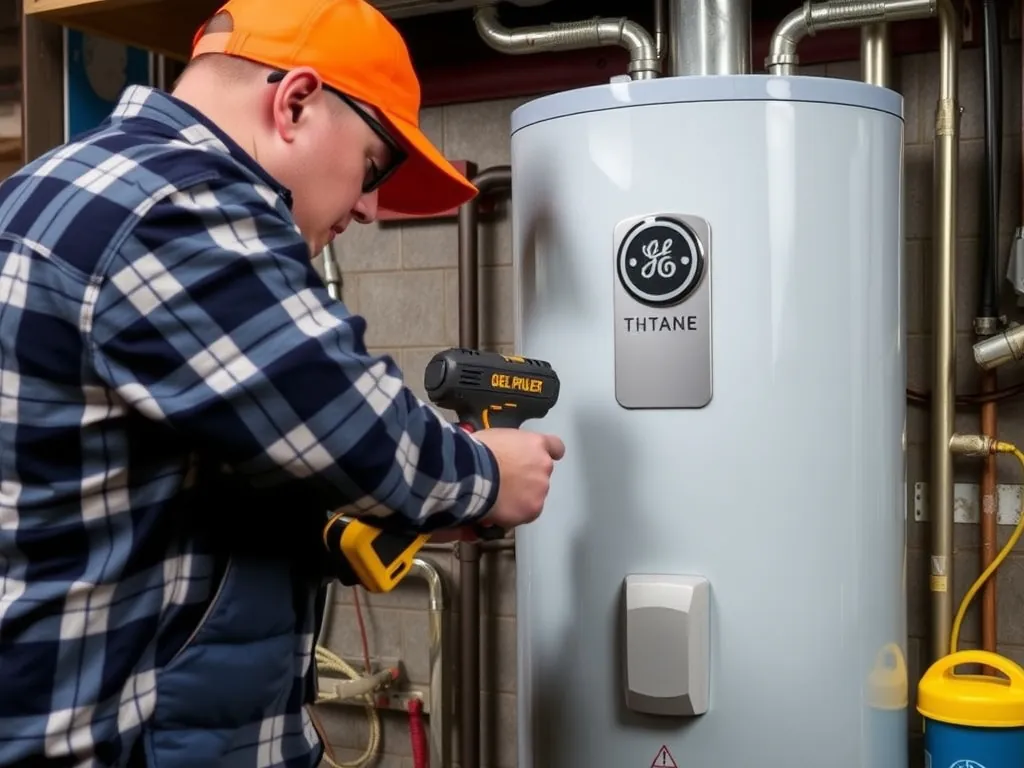
GE water heaters are residential and light-commercial units licensed by General Electric but engineered and manufactured by Rheem under the GE Appliances brand. Every tank carries a Rheem serial number and uses Rheem parts, yet retains GE-specific control interfaces, warranty terms, and Home Depot distribution. The lineup spans 30–80 gallon tank models, 4–11 GPM tankless units, and 50–65 gallon heat-pump hybrids, all certified to UL 174, ANSI Z21.10.1, and ASHRAE 90.1 standards.
How Do GE Gas, Electric, and Heat-Pump Water Heaters Work?
GE gas models ignite a sealed-combustion burner that heats a spiral steel flue, transferring 76–83 % of the fuel energy to surrounding water. Electric units immerse one or two 4,500 W Incoloy elements directly in the tank, achieving 98–99 % thermal efficiency but higher operating cost per BTU. Heat-pump hybrids pull 65–70 % of their energy from ambient air via a top-mounted refrigeration circuit, delivering 3.45–3.55 UEF and operating at 58 dB—similar to a refrigerator.
Which GE Water Heater Model Should You Choose?
Select by household size, fuel type, first-hour delivery (FHD), and energy factor (UEF). A 3-person home with 2.5 bathrooms and 65 °F incoming water needs 50 gal gas (GE50T10BLM) delivering 81 gal FHD, or 65 gal electric (GE65T12BEM) with 72 gal FHD. Heat-pump hybrids (GEH50DFE, GEH65DFE) suit basements or utility rooms ≥ 700 ft³ and cut annual operating cost 62 % versus standard electric. Tankless models (GENG4, GENG6) work where space is tight and gas line capacity ≥ ¾ in. at 11 in. W.C.
| Model | Type | Gallons/GPM | UEF | Annual OpEx $ | Home Depot SKU |
|---|---|---|---|---|---|
| GE40T10BLM | Gas | 40 gal | 0.69 | $278 | 1004776134 |
| GE50T10BEM | Electric | 50 gal | 0.93 | $612 | 1004776135 |
| GEH50DFE | Heat-pump | 50 gal | 3.55 | $189 | 1004776136 |
How Much Does a GE Water Heater Cost in 2024?
40-gallon electric GE units retail $429–$549, 50-gallon gas $599–$749, and 65-gallon hybrid $1,899–$2,199. Installation adds $400–$1,200 depending on fuel conversion, code upgrades, and region. A like-for-like electric swap in Texas averages $550 labor, while a gas-to-hybrid switch in California runs $1,150 including 240 V wiring, condensate pump, and permit. Energy rebates shave $150–$1,000 off hybrids via local utilities and federal 25C tax credits.
How Do You Size a GE Water Heater Correctly?
Size by peak demand gallons, not tank volume. Add flow rates: shower 2.5 GPM, dishwasher 1.5 GPM, clothes washer 3.0 GPM. A 10-minute overlapping use equals 60 gal draw; choose a 50-gal gas GE with 81 gal FHD or 65-gal electric with 72 gal FHD. Inlet water temperature matters: 40 °F northern groundwater requires 70 % more BTU rise than 65 °F southern supply. Use GE’s online calculator entering ZIP, bedrooms, and fixture count; it outputs model numbers with 15 % safety margin.
What Installation Codes and Permits Apply to GE Water Heaters?
IRC P2801, UPC 510, and NEC 422.13 govern installation. Gas models need ¾ in. minimum gas line, 6 in. clearance on sides, 12 in. top, and Category III vent for tankless. Electric units require dedicated 240 V/30 A circuit for 4,500 W elements; hybrids need 30 A double-pole breaker plus ¾ in. condensate line to floor drain or pump. Expansion tank mandatory when backflow preventer or check valve exists; set to house pressure +20 psi. Permit fees run $50–$125 and inspection takes 24–48 h in most jurisdictions.
How Do You Install a GE Electric Water Heater Step-by-Step?
1. Shut off 30 A breaker, close cold-water ball valve, attach hose to drain bib, open T&P lever, and empty tank below spigot level (15–25 min).
2. Disconnect 10 AWG conductors, label white to L1, black to L2, green to ground. Remove ½ in. conduit connector and save for reuse.
3. Dolly out old tank; measure rough-in: 21-¼ in. diameter, 57-¼ in. height for GE50T10BEM. Clean slab, check level within ¼ in.
4. Position new GE unit, align cold (blue) and hot (red) marked nipples. Install ¾ in. brass dielectric unions hand-tight plus ¼ turn.
5. Solder 6 in. copper stubs to existing lines, cool, then connect to dielectrics with Teflon tape and pipe dope. Install thermal expansion tank vertically on cold line; pre-charge to 60 psi.
6. Wire 10 AWG through Romex connector into junction box: red to L1, black to L2, green to ground screw. Torque 20 in-lb.
7. Open cold valve slowly, purge air at highest hot tap until steady stream, check for leaks.
8. Set upper thermostat to 120 °F, lower to 115 °F. Restore power, verify 240 V across elements, amp-draw 18.8 A within 5 %.
9. Test T&P valve by lifting lever; should discharge then reseat. Insulate first 6 ft of hot line with ¾ in. ID foam.
10. Schedule inspection; post permit sticker on electrical panel.
How Do You Install a GE Gas Water Heater Safely?
Gas installation adds venting and combustion-air steps. Turn gas cock 90 °, verify 0 in. W.C. at drip leg. Remove vent connector, measure 4 in. B-vent length; replace if corroded. Set new GE gas heater on 18 ga. metal pan if in living space; connect ¾ in. gas line with new yellow Teflon, test joints with 10 psi air for 30 min per NFPA 54. Install 3 in. Category I vent with ¼ in. per foot upward slope, two sheet-metal screws per joint, and draft hood gap 1/8–¼ in. Check spillage within 60 s of burner ignition using mirror or smoke test. Set gas valve to 4.0 in. W.C. manifold pressure; clock meter for ±5 % of nameplate BTU.
What Problems Might You Encounter with GE Water Heaters?
Common failures: thermocouple degradation (gas, 8–10 yr), lower element scale burnout (electric, 6–8 yr), and heat-pump condensate overflow (hybrid, 3–5 yr if pump fails). Error codes: four-flash on gas valve means high-temperature limit open; reset red button behind upper panel. Electric units display E1 for dry-fire element; replace and refill before restoring power. Hybrid models flash F1 when evaporator coil freezes; clear debris from air filter and verify ≥ 700 ft³ room volume. Dip-tube failure (pre-2013 models) causes lukewarm water at 5 gpm; replace with cross-linked polyethylene tube.
How Do You Maintain a GE Water Heater for Maximum Lifespan?
Flush sediment every 6 months in hard-water areas (>7 gpg). Attach brass hose bib, open T&P, drain 2–3 gal until clear. Test T&P annually; should open at 150 psi or 210 °F. Replace anode rod when diameter < ½ in. or core wire visible (typically 4–5 yr). Heat-pump hybrids need evaporator coil vacuumed quarterly and condensate line treated with ¼ cup white vinegar to prevent algae. Gas units require burner inspection yearly; yellow tipping indicates lint blockage—clean with compressed air. Keep temperature at 120 °F to reduce tank stress and Legionella risk.
When Should You Call a Professional for GE Water Heater Repairs?
Call a licensed plumber if you smell gas (mercaptan odor), see water pooling >1 gal/day, or measure >10 ppm CO at the draft hood. Electrical work beyond swapping elements or thermostats requires a permit in most states. Heat-pump sealed-system repairs (compressor, refrigerant) must be handled by EPA 608-certified technicians. If tank age exceeds 9 yr and leakage appears at weld seams, replacement is more cost-effective than repair—labor warranties do not cover subsequent failure.
FAQ
#### Why is my GE heat-pump water heater showing error code F6?
F6 indicates condensate pump failure or blocked drain. Check ⅜ in. vinyl tube for kinks, verify pump reservoir is empty, and test float switch continuity. If open, replace pump assembly (Part #SP-637436, $89). Clear trap with wet/dry vac; restore power and confirm code clears within 5 min.
#### How long do GE water heater warranties last?
Standard GE tank warranty is 6 years on tank, 2 years on parts. Hybrid models add 10-year compressor coverage if registered within 60 days. Labor allowances: 1 yr full, then $75 tank replacement credit. Extended 10-year plans cost $89–$129 at purchase and require professional installation records.
#### Can I install a GE gas water heater in a closet?
Yes, provided closet volume ≥ 50 ft³ per 1,000 BTH input and louvered doors supply 1 in² free area per 1,000 BTH. Direct-vent models (GEGD40T10) use sealed combustion and require only 1 in. side clearance. Never install standard atmospheric units in bedrooms or bathrooms per IRC G2406.2.
#### What electrical work is needed to switch from gas to a GE hybrid?
Upgrade to 240 V/30 A circuit using 10 AWG copper, install 2-pole 30 A breaker, and add disconnect within sight of unit. Condensate pump needs 115 V receptacle. Permit and inspection required; cost averages $350 in Midwest, $550 on coasts. Load calculation must verify panel capacity ≥125 % of 18.8 A draw.
#### How do I flush a GE electric water heater?
Close cold valve, open T&P, attach garden hose to drain valve, route to floor drain. Open hot tap to break vacuum. After 5 gal, briefly open cold valve to stir sediment; repeat until water runs clear. Close T&P, remove hose, refill tank, restore power. Duration: 30 min; frequency: every 6 months.
#### Are GE water heaters Energy Star rated?
Only hybrid heat-pump models (GEH50DFE, GEH65DFE) carry ENERGY STAR; they achieve 3.55 UEF and qualify for $300 federal tax credit plus local rebates. Gas models reach 0.69–0.72 UEF, below STAR threshold of 0.77. Electric tanks top at 0.93 UEF but are excluded from STAR because they exceed baseline by <5 %.
#### What is the anode rod size for a 50-gal GE heater?
Use 0.750 in. NPT × 42 in. magnesium rod (Part #SP6375R). Hex head fits 1-1/16 in. socket. Inspect after 3 yr; replace if >6 in. core wire exposed or diameter < ½ in. Aluminum-zinc rods recommended for odor issues but void 10-yr warranty unless Rheem-approved.
#### Can I use a GE tankless water heater with ½-inch gas line?
No. GE GENG4 (140 kBTU) and GENG6 (160 kBTU) require minimum ¾ in. gas pipe from meter and 3/4 in. at 11 in. W.C. manifold pressure. A ½ in. line at 30 ft delivers only 95 kBTU, causing flame failure and error code A2. Upgrading pipe costs $4–$6 per linear foot black iron, $6–$8 CSST.
#### How noisy is a GE heat-pump water heater?
Measured at 58 dB at 3 ft—comparable to a refrigerator. Install on rubber isolation pads to cut vibration 3–4 dB. Requires 700 ft³ air volume; closet installation increases noise 5 dB due to echo. Sleep mode locks compressor, running only elements, raising operating cost 250 %.
#### Where is the serial number on my GE water heater?
Serial plate is located on upper right side of tank; viewable by removing outer jacket access panel. Format: RHMMYY123456 (RH=Rheem, MM=month, YY=year). Needed for warranty registration, parts lookup, and recall verification. Take photo during installation for future reference.
Conclusion
GE water heaters—built by Rheem—deliver reliable performance across gas, electric, and heat-pump platforms when sized, installed, and maintained per code. Key takeaways: match first-hour delivery to peak demand, budget $429–$2,199 plus $400–$1,200 install, flush sediment twice yearly, and replace anode rods at year 4. Heat-pump hybrids yield the lowest operating cost but need 240 V and condensate management. Keep temperature at 120 °F, test T&P annually, and call pros for gas or sealed-system work. Use this guide’s model tables, step-by-step procedures, and troubleshooting codes to secure hot water for 10–15 years while maximizing rebates and warranty coverage.
—