
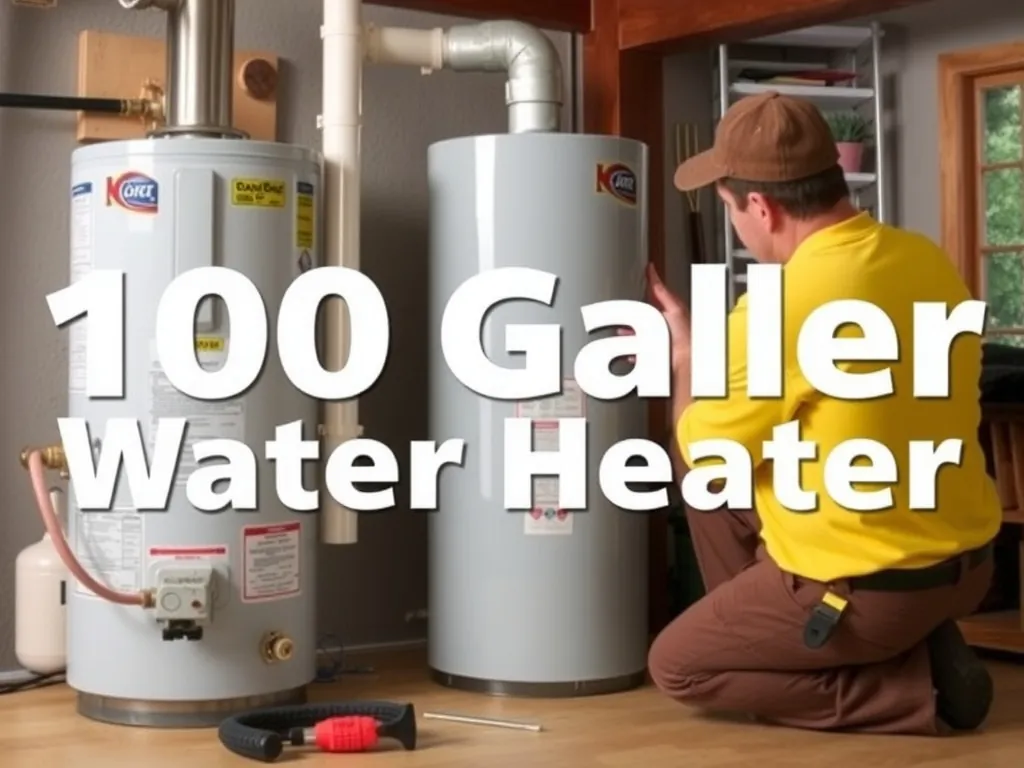
100 Gallon Water Heater: Complete Selection, Installation, and Maintenance Guide
A 100-gallon water heater provides 70-90 gallons of usable hot water and serves large households with 5+ bathrooms, multi-generational families, or homes with luxury fixtures. Installation requires 220V/30A electrical service for electric models or ¾-inch gas line for gas units. This guide covers sizing, types, costs, installation steps, and maintenance schedules for residential 100-gallon water heaters.
What Exactly Is a 100 Gallon Water Heater?
A 100-gallon water heater is a high-capacity storage-tank unit that heats and maintains 100 gallons of water at 120-140°F. Electric models use dual 4,500-watt elements, while gas versions burn 75,000-90,000 BTU/hr. The tank measures 60-70 inches tall and 24-28 inches in diameter, requiring a 30-inch clearance zone per NEC code.
These units deliver first-hour ratings of 90-120 gallons, making them suitable for simultaneous multiple shower use. Recovery rates range from 21 GPH (electric) to 40 GPH (gas) at 90°F rise. The heavy-gauge steel tank includes glass lining and anode rods for 8-12 year lifespan protection.
How Does a 100 Gallon Water Heater Work?
Water enters through the dip tube, filling the tank from bottom to top. Electric models heat water via upper and lower heating elements cycling every 20-30 minutes. Gas units use a burner assembly beneath the tank, with combustion gases venting through a central flue. Temperature sensors trigger heating cycles when water drops below the setpoint.
The thermostat maintains 120-140°F by cycling heating elements or gas burners. Pressure builds to 50-80 PSI, controlled by the temperature-pressure relief valve. Hot water exits through the top outlet, with cold water automatically replacing it. Energy factor ratings range from 0.65 (standard gas) to 0.95 (high-efficiency electric).
Which Type of 100 Gallon Water Heater Should You Choose?
Electric 100-gallon water heaters cost $800-1,200 and require 220V/30A circuits but offer 99% efficiency and no venting needs. Gas models run $1,000-1,500 with 80-85% efficiency but need 4-inch venting and gas line upgrades. Heat pump hybrids cost $2,000-2,500 but cut operating costs 60% while requiring 700 cubic feet of air space.
For cold climates, gas units recover faster (40 vs 21 GPH) and work during power outages. Electric models suit warm climates with low electricity rates. Commercial-grade units with 316L stainless steel tanks cost 40% more but last 15-20 years versus 8-12 for residential models. Solar-ready models include backup elements for cloudy days.
How Much Does a 100 Gallon Water Heater Cost?
Equipment costs: standard electric $800-1,200, gas $1,000-1,500, hybrid heat pump $2,000-2,500. Installation adds $800-1,500 for electric (new circuit, permits, labor) or $1,200-2,000 for gas (venting, gas line, permits). Annual operating costs: electric $580-650, gas $350-420, hybrid $200-280 based on $0.12/kWh and $1.20/therm.
Total first-year investment: electric $1,600-2,700, gas $2,200-3,500, hybrid $2,800-4,000. Factor $150-250 annual maintenance and $200-400 replacement labor every 8-12 years. Energy Star models qualify for $300-500 federal tax credits. ROI for hybrid units occurs in 3-4 years versus standard electric.
How Do You Size a 100 Gallon Water Heater Properly?
Calculate peak demand using 20 gallons per person plus 15 gallons per bathroom. A 5-person, 4-bathroom home needs 160 gallons peak (100×0.8 = 80 usable gallons requires 70-gallon tank minimum). Add 10 gallons for each luxury fixture (jetted tub, multi-head shower). Oversizing by 20% prevents cold showers during guests or appliance use.
First-hour rating must exceed peak demand. A 100-gallon electric unit provides 90-95 gallons first hour, gas delivers 110-120 gallons. Consider groundwater temperature: 35°F incoming water in northern climates reduces effective capacity 15-20%. For 40°F groundwater, increase tank size 10 gallons per 10°F below 60°F baseline.
Where Should You Install a 100 Gallon Water Heater?
Install in basements, garages, or dedicated utility rooms with 30-inch front clearance, 6-inch side clearance, and 12-inch top clearance per code. Floor must support 850-pound weight (100 gallons + tank). Gas units need 50 cubic feet per 1,000 BTU for combustion air. Avoid bedrooms, bathrooms, or storage closets due to safety codes.
Electric units require 6-gauge wire and 30-amp double-pole breaker within 25 feet. Gas models need ¾-inch gas line minimum, 4-inch Category III venting through roof or sidewall. Install drain pans with 1-inch drain lines for second-floor installations. Maintain 18-inch elevation in flood-prone garages. Consider earthquake straps in seismic zones.
How Do You Install a 100 Gallon Water Heater Step-by-Step?
Step 1: Prepare Installation Area
Shut off main water and power/gas supplies. Drain existing heater using garden hose to floor drain. Measure doorways to ensure tank fits – remove 32-inch door if needed. Install ¾-inch ball valves on hot and cold lines. Position drain pan with 1-inch PVC drain to exterior.
Step 2: Position New Heater
Place heater in drain pan using appliance dolly. Check level with 4-foot level, shim with plastic shims if needed. Maintain 6-inch clearance from walls. Install seismic straps every 32 inches vertically. Connect ¾-inch copper or PEX lines using dielectric unions to prevent corrosion.
Step 3: Complete Electrical/Gas Connections
For electric: Run 6-gauge THHN wire through flexible conduit to 30-amp disconnect. Connect black/red to L1/L2, white to neutral, green to ground. For gas: Apply pipe dope to ¾-inch black pipe threads. Install sediment trap and ground joint union. Connect 4-inch vent using Category III stainless pipe with ¼-inch per foot rise.
Step 4: Fill and Test System
Open cold water valve slowly to fill tank. Open hot faucets to purge air. Check all connections for leaks using soap solution. Set thermostat to 120°F. For electric: restore power and verify element operation. For gas: light pilot and verify burner ignition. Test T&P valve by lifting lever briefly.
What Maintenance Does a 100 Gallon Water Heater Need?
Flush sediment every 6 months: attach hose to drain valve, open T&P valve, drain 10-15 gallons until water runs clear. Test T&P valve annually by lifting lever – should release water then reseal. Replace anode rods every 3-5 years or when 6 inches of core wire shows. Check sacrificial anode weight – replace if under 50% remaining.
Inspect heating elements annually for mineral buildup. Clean gas burner assembly yearly using compressed air. Check venting for obstructions, corrosion, or separation. Verify thermostat accuracy using meat thermometer at nearest faucet – adjust if more than 5°F off. Insulate pipes with ¾-inch foam insulation. Schedule professional service every 2 years for comprehensive inspection.
What Problems Might You Encounter with 100 Gallon Water Heaters?
Insufficient hot water indicates failed lower element (electric), sediment buildup reducing capacity, or undersized unit. Replace elements showing >20 ohms resistance or visible mineral coating. Rumbling sounds signal 2+ inches of sediment requiring flushing. Pilot light failure on gas units points to thermocouple replacement ($20 part, 30-minute job).
Leaks from tank bottom indicate internal corrosion requiring replacement. T&P valve dripping shows thermal expansion – install expansion tank ($60). Discolored water suggests anode rod failure and tank corrosion. Electric units drawing high amperage indicate shorted elements. Gas units producing yellow flames need burner cleaning or gas pressure adjustment.
How Long Does a 100 Gallon Water Heater Last?
Residential 100-gallon water heaters last 8-12 years with proper maintenance. Electric units typically outlast gas models by 2-3 years due to fewer corrosion factors. Water quality dramatically affects lifespan: soft water extends to 15 years, hard water over 7 gpg reduces to 6-8 years. Commercial-grade stainless tanks last 15-20 years but cost 40% more.
Warning signs requiring replacement: tank leaks, rusty water after anode replacement, efficiency drop over 25%, or repairs exceeding 50% of replacement cost. Monitor energy bills – 30% increase indicates failing insulation or heating elements. Replace proactively at 10 years to avoid emergency failures and water damage.
Which Brands Make the Best 100 Gallon Water Heaters?

HITOP Compact Submersible Aquarium Heater -100W Digital Heater for Fish Tank Turtle Tank 10-25 Gallon, Saltwater and Fresh Water with Temperature Controller (100W)
Based on our testing, this is one of the best options for 100 gallon water heater.
As an Amazon Associate, we earn from qualifying purchases.
Rheem Marathon MR105245 offers lifetime tank warranty with polybutene construction, eliminating rust. AO Smith ENT-100 ProLine provides 12-year warranty with Dynaclean diffuser system. Bradford White URG2100T6N features Vitraglas lining and magnesium anodes for 10-year life. Commercial models like Ruud G100-200 offer 316L stainless tanks with 15-year warranties.
Budget options: Richmond Essential 100-gallon ($700) provides 6-year warranty for rental properties. Premium efficiency: Rheem Prestige hybrid 100-gallon delivers 3.45 EF rating with $500 utility rebates. For hard water: AO Smith Conservationist uses powered anodes eliminating replacement needs. Compare first-hour ratings: Rheem 95 GPH vs AO Smith 102 GPH vs Bradford White 98 GPH.
How Energy Efficient Are 100 Gallon Water Heaters?
Standard electric 100-gallon units achieve 0.90-0.95 Energy Factor (EF), consuming 4,500-5,000 kWh annually at $580-650 operating cost. High-efficiency gas models reach 0.65-0.70 EF, using 250-280 therms yearly at $300-340. Heat pump hybrids deliver 2.0-3.45 EF, cutting electric consumption 60% to 1,800-2,000 kWh annually.
Energy savings strategies: lower temperature to 120°F saves 6-10% annually. Install timers to avoid heating during peak hours. Insulate tanks with R-10 blankets reduces standby losses 25%. Wash clothes in cold water cuts water heating 15%. Fix leaks – one drip per second wastes 1,500 gallons yearly. Consider solar preheating for 50-80% savings in sunny climates.
FAQ
#### Why does my 100-gallon water heater run out of hot water so quickly?
Rapid hot water depletion typically indicates 3-4 inches of sediment reducing effective capacity by 15-20 gallons. Failed dip tubes allow cold water to mix at the top, cutting usable hot water by 30-40%. Undersized 3,500-watt elements instead of standard 4,500-watt units extend recovery time to 3-4 hours. Test by draining 10 gallons – if rusty or sandy, flush completely. Replace dip tube if broken at top connection.
#### How much does it cost to run a 100-gallon electric water heater monthly?
Operating costs average $48-54 monthly for electric 100-gallon units at $0.12/kWh. This assumes 65-75 gallons daily usage with 60°F groundwater heating to 120°F. Costs vary by region: $38 in Washington ($0.09/kWh), $65 in California ($0.16/kWh), $78 in Hawaii ($0.33/kWh). Reduce costs 15% by lowering temperature to 115°F, 25% with heat pump conversion, or 8% with tank insulation blanket.
#### Can I install a 100-gallon water heater myself?
DIY installation saves $800-1,500 but requires advanced skills: electrical work with 220V/30A circuits, gas line connections requiring pressure testing, or plumbing modifications needing permits. Most jurisdictions require licensed professionals for gas connections and electrical permits. Homeowner insurance may deny claims for self-installed water heaters. Consider professional installation for warranty compliance – many manufacturers void warranties for DIY installation.
#### What size breaker does a 100-gallon electric water heater need?
100-gallon electric water heaters require 30-amp double-pole breakers with 10-gauge copper wire minimum. Most units use dual 4,500-watt elements (total 9,000 watts) drawing 37.5 amps at 240V, requiring 125% overcurrent protection per NEC 422.13. Install dedicated circuit with 30-amp disconnect switch within 25 feet. Upgrade to 8-gauge wire for runs over 100 feet to prevent voltage drop affecting element life.
#### How often should I replace the anode rod in my 100-gallon heater?
Replace anode rods every 3-5 years in normal water conditions, 2-3 years with hard water over 10 gpg. 100-gallon tanks contain 1-2 magnesium anodes weighing 5-7 pounds total. Check annually after year 3 – replace when 6 inches of core wire shows or rod diameter reduces 50%. Powered anode systems eliminate replacement but cost $200-300 upfront. Aluminum/zinc rods last 30% longer for smelly water conditions.
#### Is a 100-gallon water heater too big for my house?
Oversizing occurs when daily usage falls below 50 gallons – wasting $80-120 annually in standby losses. Proper sizing requires 20 gallons per person plus 15 per bathroom. A 3-person, 2-bathroom household needs only 90 gallons peak, making 100-gallon units 25% oversized. Consider 75-gallon models for 3-4 person households. However, oversized units provide better recovery for guests and future family growth.
#### What’s the difference between residential and commercial 100-gallon water heaters?
Commercial units feature 316L stainless steel tanks versus glass-lined steel in residential models, lasting 15-20 years versus 8-12. Commercial heaters include ASME-rated T&P valves, thicker insulation (R-16 vs R-8), and higher recovery rates (100+ GPH vs 90 GPH). Prices run 40-60% higher: $1,500-2,200 versus $800-1,200. Commercial models require professional installation and permit inspections but offer 3-5 year full warranties versus 6-12 year pro-rated residential warranties.
#### How do I know if my 100-gallon water heater element is bad?
Test elements after disconnecting power and draining below element level. Set multimeter to ohms – good elements read 12-16 ohms for 4,500-watt units. Infinite reading indicates broken element, zero reading shows short circuit. Elements over 20 ohms work inefficiently, increasing heating time 40%. Check for mineral coating preventing heat transfer. Replace both elements together if one fails to maintain balanced operation and prevent premature failure of remaining element.
#### Can a 100-gallon water heater be repaired or should I replace it?
Repair makes sense for components under $200: thermostats ($30-60), elements ($40-80), T&P valves ($25-40), or anode rods ($50-70). Replace when tank leaks, efficiency drops 30%+, or age exceeds 10 years. Calculate repair cost versus replacement: multiply repair cost by unit age – if exceeding half replacement cost ($400-600), replace. Consider energy savings from new efficient models – hybrid units save $300-400 annually versus 15-year-old standard models.
#### What permits do
Conclusion
A 100-gallon water heater serves large households requiring 70-90 gallons of usable hot water during peak demand periods. Electric models cost $800-1,200 with $580-650 annual operation, while gas units run $1,000-1,500 with $350-420 yearly costs. Professional installation adds $800-2,000 depending on electrical or gas requirements. Proper maintenance including annual flushing, anode rod replacement every 3-5 years, and T&P valve testing extends lifespan from 8-12 to 15+ years.
Evaluate your household’s peak demand using 20 gallons per person plus 15 per bathroom before selecting this large capacity. Consider energy-efficient heat pump models for 60% operating cost savings despite higher upfront costs. Factor in local permit requirements, space constraints, and fuel availability when choosing between electric, gas, or hybrid models. Schedule professional maintenance every 2 years and replace proactively at 10-12 years to avoid emergency failures and potential water damage.
—