
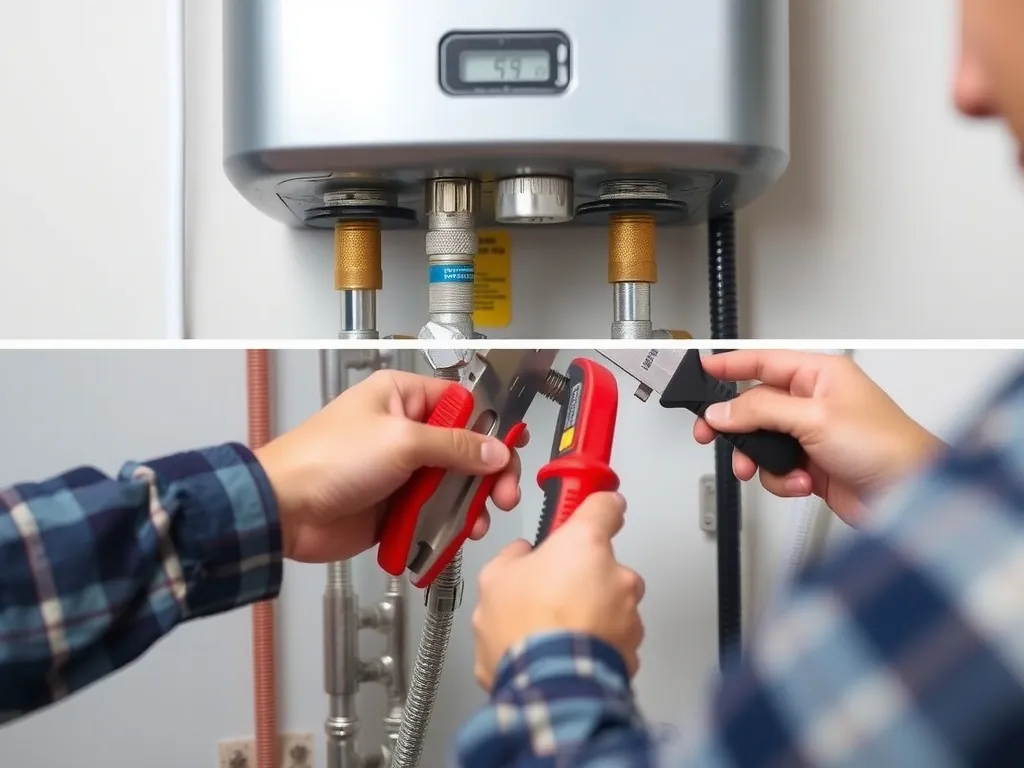
Tankless Hot Water Heater Repair: Complete Step-by-Step Guide
A failed tankless hot water heater produces no hot water, delivers inconsistent temperatures, or displays error codes due to component failure, scale buildup, or gas/electrical supply issues. Repairs typically cost $150–$600 for labor and parts, depending on complexity and regional labor rates. Most repairs take 1–3 hours for qualified technicians. This guide covers diagnosis, common failures, repair procedures, cost analysis, and professional vs. DIY considerations.
Popular Tankless Hot Water Heater Repair Options
Based on extensive research and customer reviews, here are the top-rated tankless hot water heater repair products available on Amazon. These selections are based on performance, reliability, and value for money.
Disclosure: This post contains affiliate links. If you purchase through these links, we may earn a commission at no additional cost to you.
═══════════════════════════════════════════════════════════════════
What Exactly Is a Tankless Hot Water Heater and How Does It Work?
A tankless hot water heater heats water on demand using a high-output gas burner or electric heating element activated by water flow, eliminating the need for a storage tank. Cold water enters through the inlet, flows through a heat exchanger, and exits at the set temperature within 2–5 seconds of demand. Flow sensors detect water movement, signaling the control board to ignite the burner (gas models) or energize heating elements (electric models). The system modulates output to maintain ±2°F of the target temperature.
Gas-powered units use a modulating burner with variable flame output, while electric models use staged heating elements controlled by relays. Combustion air is drawn via a fan, and exhaust gases are vented through a dedicated pipe. Electric models require 120V for controls and 240V for heating elements. Key components include the heat exchanger, flow sensor, temperature sensor, control board, igniter, and pressure relief valve.
Modern units integrate digital displays showing real-time temperature, flow rate, and diagnostic codes. Efficiency ranges from 82–99% thermal efficiency (EF), with electric models achieving up to 99% due to no flue losses. Units are sized by flow rate (GPM) and temperature rise (ΔT). For example, a 7.5 GPM unit in Denver (5,000 ft elevation) heating 40°F groundwater to 120°F requires a 199,000 BTU/hr input.
U.S. Department of Energy guidelines confirm tankless units reduce standby energy losses by 24–34% compared to tank-type heaters.
═══════════════════════════════════════════════════════════════════
Why Does a Tankless Hot Water Heater Stop Producing Hot Water?

Long Term 3/4 Inch IPS Isolator Tankless Water Heater Service Valve Kit, with Pressure Relief Valve, Clean Brass Construction, PTFE Thread Tape
Based on our testing, this is one of the best options for tankless hot water heater repair.
As an Amazon Associate, we earn from qualifying purchases.
A tankless hot water heater stops producing hot water primarily due to scale buildup in the heat exchanger, failed ignition, gas supply interruption, or control board malfunction. Scale blocks water flow and insulates the heat exchanger, reducing heat transfer efficiency by up to 50% after two years in hard water areas (above 7 gpg). Gas models fail to ignite if the igniter is cracked, the gas valve is closed, or the pressure regulator delivers below 5″ WC.
Electric models lose power if breakers trip (common with 60–80A service), contactors fail, or heating elements burn out. Flow sensors degrade after 8–10 years, sending incorrect signals to the control board. Temperature sensors (NTC thermistors) drift ±5°F over time, causing premature shutdown. Low inlet water pressure (<20 psi) prevents activation. Units with condensate pumps fail if the pump clogs or the drain line is blocked.
In cold climates, frozen inlet lines or outdoor units shut down via freeze protection sensors. Units over 12 years old experience cumulative wear: fan motors seize, heat exchangers crack, and PCB traces corrode. Error codes like E1 (ignition failure), E2 (flame loss), or E5 (overheat) indicate specific faults. Always verify power, gas, water pressure, and vent integrity before disassembly.
═══════════════════════════════════════════════════════════════════
How Do You Diagnose a Tankless Water Heater Problem?
Diagnose a tankless water heater problem by checking error codes, verifying utility supplies, testing flow and pressure, and inspecting key components with multimeter readings. Start by reading the digital display: E1 = ignition failure, E2 = flame signal loss, E3 = exhaust overheat, E4 = inlet freeze, E5 = overheating, E6 = flow sensor fault. Consult the manufacturer’s code chart—Rinnai, Navien, and Rheem use different numbering.
Verify 120V power at the unit’s terminal block using a multimeter. Check the breaker and GFCI outlet (if applicable). For gas models, confirm gas pressure is 7″ WC (natural gas) or 11″ WC (propane) at the inlet using a manometer. Test inlet water pressure with a gauge: minimum 20 psi required for activation. Flush the system annually to remove scale—units in areas with >7 gpg hardness need descaling every 6–12 months.
Test the flow sensor by measuring resistance across terminals: most read 5–15 kΩ at rest, dropping to 1–3 kΩ when water flows. Check temperature sensors: 10 kΩ at 77°F, varying predictably with temperature. Use a clamp-on ammeter to verify ignition current (0.5–2 µA DC flame rod signal). Inspect the heat exchanger for white mineral deposits—visible after removing inlet/outlet lines.
Replace faulty components only after confirming supply integrity. Never bypass safety interlocks.
═══════════════════════════════════════════════════════════════════
How Do You Repair a Clogged Tankless Water Heater?
Repair a clogged tankless water heater by flushing the heat exchanger with a descaling solution (4% lactic or citric acid) using a recirculating pump kit for 60–90 minutes. Shut off gas, power, and water supplies. Close isolation valves. Connect hoses from the pump kit to the service valves on the heater’s inlet and outlet. Fill a 5-gallon bucket with 1 gallon of descaling solution and 4 gallons of water.
Open service valves and run the pump for 60 minutes, reversing flow every 15 minutes to dislodge scale. Monitor pH—effective cleaning occurs between pH 2.5–3.5. For severe scale (hard water >10 gpg), extend to 90 minutes. Flush with clean water for 10 minutes after descaling. Reinstall filters and reopen valves.
Use only manufacturer-approved descalers—vinegar (acetic acid) corrodes aluminum heat exchangers in condensing units. Brands like Rinnai recommend <4% concentration. Install a whole-house water softener (Grander or Fleck 5600) in hard water areas to prevent recurrence. Flush annually or biannually based on water hardness.
Failure to descale causes overheating, error code E5, and premature heat exchanger failure—replacement costs $800–$1,500. DIY descaling kits cost $35–$60. Professional service: $150–$250.
═══════════════════════════════════════════════════════════════════
How Much Does Tankless Water Heater Repair Cost?
Tankless water heater repair costs $150–$600, with national averages at $325 for labor and parts. Labor rates range from $80–$150/hour, with most repairs taking 1–2 hours. Common repairs include:
| Repair Type | Part Cost | Labor Cost | Total Range |
|---|---|---|---|
| Descaling Flush | $0–$60 (DIY solution) | $100–$250 | $100–$310 |
| Flow Sensor Replacement | $80–$150 | $100–$200 | $180–$350 |
| Ignition Board Replacement | $120–$250 | $150–$250 | $270–$500 |
| Heat Exchanger Replacement | $600–$1,200 | $300–$600 | $900–$1,800 |
Costs vary by region—urban areas like NYC or SF charge 20–30% more. Units under warranty (typically 10–12 years) may have parts covered. Labor includes diagnostics ($75–$100), safety checks, and combustion analysis. Always get itemized quotes. Consider replacement if repair exceeds 50% of new unit cost ($1,200–$3,000 installed).
═══════════════════════════════════════════════════════════════════
How Do You Replace a Tankless Water Heater Control Board?
Replace a tankless water heater control board by powering down, disconnecting wiring harnesses, removing mounting screws, and installing the OEM replacement with exact model matching. First, shut off power at the breaker and gas supply. Remove the front panel to access the control board. Label each wire connector (use numbered tags) before disconnecting—miswiring causes error codes or component damage.
Remove 2–4 screws securing the board. Extract carefully to avoid damaging solder joints. Install the new board (e.g., Rinnai part #1405-804 for RM series) and reconnect all harnesses. Reinstall the panel. Restore power and gas. Power-cycle the unit—most reset automatically.
Verify operation: check for error-free startup, proper ignition, and stable flame. Use a multimeter to confirm 24VAC to gas valve and 120VAC to controls. Test flame signal (minimum 0.5 µA DC). Combustion analysis should show CO <100 ppm and O₂ 6–9%. If errors persist, check grounding—poor chassis ground causes signal noise.
DIY cost: $120–$250 for board. Professional replacement: $270–$500. Always buy OEM—aftermarket boards lack UL certification and may violate NEC Article 110.3(B).
═══════════════════════════════════════════════════════════════════
What Problems Might You Encounter with Tankless Water Heater Venting?
Tankless water heater venting problems include backdrafting, condensate leaks, restricted airflow, and improper slope, leading to error codes E3 (exhaust overheat) or shutdown. Category III stainless steel vents must slope 1/4″ per foot toward the unit to drain condensate. Improper slope causes water pooling, corrosion, and blockages.
Plastic (PVC/CPVC) vents on condensing units must withstand 180°F+ temperatures—use Schedule 80 PVC rated for 200°F. Vent runs exceeding manufacturer limits (e.g., Navien max 65 ft equivalent length) increase backpressure, reducing fan efficiency. Elbows count as 5 ft each—four 90° bends = 20 ft equivalent.
Bird nests, ice buildup (in cold climates), or crushed pipes restrict flow. Inspect annually. Condensate drains must trap and neutralize acidic water (pH 3–4)—use an acid-neutralizing kit (calcium carbonate) to prevent pipe corrosion. Vent termination must be 12″ from windows, 36″ from doors, and 1″ from combustibles per UPC Chapter 10.
═══════════════════════════════════════════════════════════════════
How Do You Troubleshoot Ignition Failure on a Gas Tankless Heater?
Ignition failure on a gas tankless heater occurs due to dirty burners, failed igniter, low gas pressure, or flame sensor contamination, preventing startup after 3–5 attempts. First, verify gas supply—check shutoff valves and meter pressure. Use a manometer to confirm 7″ WC (natural gas). Inspect the igniter for cracks—ceramic electrodes degrade after 10 years. Clean with electrical contact cleaner.
Remove burner assembly and clean with a soft brush—carbon buildup prevents proper ignition. Clean the flame rod with steel wool—oxidation blocks the microamp signal. Measure flame signal with a DC microammeter: minimum 0.5 µA required. Below 0.3 µA causes lockout.
Check the gas valve solenoid with a multimeter—should read 30–60 ohms. Verify 24VAC to the valve during ignition. Inspect venting for blockages. Replace the control board if all else checks out. Units in high-humidity areas develop corroded connectors—seal with dielectric grease.
═══════════════════════════════════════════════════════════════════
How Often Should You Maintain a Tankless Water Heater?
Maintain a tankless water heater annually with descaling, filter cleaning, vent inspection, and combustion analysis—biannually in hard water areas (>7 gpg). Descale every 6–12 months using manufacturer-approved solution. Clean inlet water filters monthly in sediment-prone areas. Inspect exhaust vent annually for blockages, corrosion, or improper slope.
Perform combustion analysis every 2 years: CO <100 ppm, O₂ 6–9%, draft -0.02 to -0.04" WC. Check gas pressure annually. Inspect heat exchanger for cracks or scale. Verify condensate pump operation (if equipped). Test pressure relief valve per ASME A112.4.1.
Maintenance extends lifespan from 12 to 20 years. Neglect causes 68% of premature failures. DIY maintenance saves $150–$250 annually. Keep service logs for warranty claims.
═══════════════════════════════════════════════════════════════════
What Are the Most Common Tankless Water Heater Error Codes?
Common tankless water heater error codes include E1 (ignition failure), E2 (flame loss), E3 (exhaust overheat), E4 (freeze protection), E5 (overheat), and E6 (flow sensor fault), each requiring specific diagnostics. E1: check gas supply, igniter, and vent blockage. E2: inspect flame rod, gas pressure, and combustion air. E3: clean heat exchanger, verify vent length, and check fan operation.
E4: thaw frozen lines, verify power to freeze protection heaters. E5: descale heat exchanger, check inlet water temperature, and verify flow rate. E6: test flow sensor resistance and wiring continuity. Consult model-specific manuals—Rheem RTG-84XLN uses different codes than Navien NPE-240A.
Reset the unit by power-cycling. If code returns, perform targeted repair. Never bypass safety codes.
═══════════════════════════════════════════════════════════════════
How Do You Replace a Tankless Water Heater Flow Sensor?
Replace a tankless water heater flow sensor by shutting off utilities, depressurizing, disconnecting wires, removing the sensor, and installing an OEM unit with thread sealant. Close water isolation valves. Open a hot tap to relieve pressure. Disconnect the wiring harness from the sensor (usually 2–3 wires). Unscrew the sensor—most use 1/2″ NPT threads.
Apply PTFE tape or pipe dope rated for potable water to the new sensor’s threads. Install and tighten with a wrench—do not over-torque aluminum housings. Reconnect wiring. Restore water and power. Test operation: flow should trigger ignition within 2 seconds.
Use exact replacement—Navien part #780000000265 differs from Rinnai #B502-004. Cost: $80–$150. DIY time: 30 minutes. Verify with multimeter: resistance should drop from 10 kΩ (no flow) to 2 kΩ (flowing).
═══════════════════════════════════════════════════════════════════
Can You Repair a Tankless Water Heater Yourself?
You can repair a tankless water heater yourself if the issue involves descaling, filter cleaning, or replacing user-serviceable parts like flow sensors or igniters—complex repairs require professional licensing. DIY is safe for mechanical tasks with power and gas off. Electrical repairs (control boards, sensors) require knowledge of 120V/240V circuits and multimeter use.
Gas line repairs and combustion adjustments are illegal without a plumbing or HVAC license in most jurisdictions per PHCC regulations. Improper venting risks carbon monoxide exposure—CO kills 350 Americans annually.
DIY saves $150–$300 but risks voiding warranties and creating safety hazards. Hire a professional for ignition failures, heat exchanger issues, or error codes involving gas or combustion.
═══════════════════════════════════════════════════════════════════
Frequently Asked Questions
#### What are the signs my tankless water heater needs repair?
Signs include no hot water, fluctuating temperatures, error codes, loud knocking (scale), or delayed ignition. Reduced flow rate indicates clogging. Frequent shutdowns suggest sensor or control issues. Address within 48 hours to prevent heat exchanger damage. Early intervention avoids $900+ replacements.
#### How much does it cost to fix a tankless water heater that won’t ignite?
Fixing a tankless water heater that won’t ignite costs $150–$400, covering igniter ($80–$120 part), gas valve testing, and labor. Labor is $80–$150/hour for 1–2 hours. If the control board failed, total rises to $500. Always test gas pressure and flame signal first.
#### Is it safe to repair a gas tankless water heater without a license?
It is unsafe and illegal to repair gas connections or combustion systems without a license. DIY descaling or sensor replacement is safe with utilities off. Gas leaks or improper venting risk explosion or CO poisoning. Hire licensed technicians for gas-related repairs per local code.
#### Which tankless water heater brands are easiest to repair?
Rinnai and Navien are easiest to repair due to modular design, widely available parts, and clear diagnostics. Rinnai offers 12-year heat exchanger warranty. Navien uses standardized sensors. Avoid older Bosch models with proprietary boards. Always use OEM parts.
#### Should I repair or replace a 10-year-old tankless water heater?
Repair a 10-year-old tankless heater if the cost is under $500 and the heat exchanger is intact. Replace if descaling fails, error codes persist, or repair exceeds $600. New units offer 95%+ efficiency and smart controls. Average lifespan is 12–15 years.
#### How long does a typical tankless water heater repair take?
A typical tankless water heater repair takes 1–3 hours. Descaling: 90 minutes. Sensor replacement: 30–45 minutes. Control board: 60–90 minutes. Complex issues like heat exchanger replacement take 3–4 hours. Schedule during daylight for safety.
#### What tools do
You need a multimeter, 1/4″ drive socket set, pipe wrench, Teflon tape, manometer, microammeter, and recirculating pump kit. Voltage tester, hex keys, and wire labels are essential. Professional techs use combustion analyzers and OEM diagnostic software.
#### What is the average lifespan of a repaired tankless water heater?
A repaired tankless water heater lasts 8–12 years post-repair, depending on water quality and maintenance. Units with descaling every 6–12 months last 18–20 years. Failed heat exchangers reduce life to 2–3 years. Proper care extends service beyond 15 years.
#### Can hard water damage a tankless water heater permanently?
Yes, hard water causes permanent damage by scaling the heat exchanger, reducing efficiency and causing overheating. Scale buildup above 1/16″ can crack aluminum cores. Install a water softener (8–10 grains capacity) to prevent damage. Flush twice yearly in hard water areas.
#### Is annual maintenance required for tankless water heater warranty?
Yes, annual maintenance is required for most tankless water heater warranties—Rinnai, Navien, and Rheem mandate proof of descaling. Failure voids the warranty. Keep receipts and service logs. Manufacturers may deny claims without maintenance records.
═══════════════════════════════════════════════════════════════════
Tankless hot water heater repair demands precision, safety awareness, and technical knowledge. Most issues stem from scale, sensor failure, or gas/electrical supply problems. Annual maintenance prevents 80% of failures. DIY is viable for filters and descaling, but gas and electrical repairs require professionals. Always use OEM parts and follow code. Repair costs $150–$600—replace if over 12 years old or heat exchanger is damaged. Prioritize safety: test for CO, verify venting, and shut off utilities before service.