
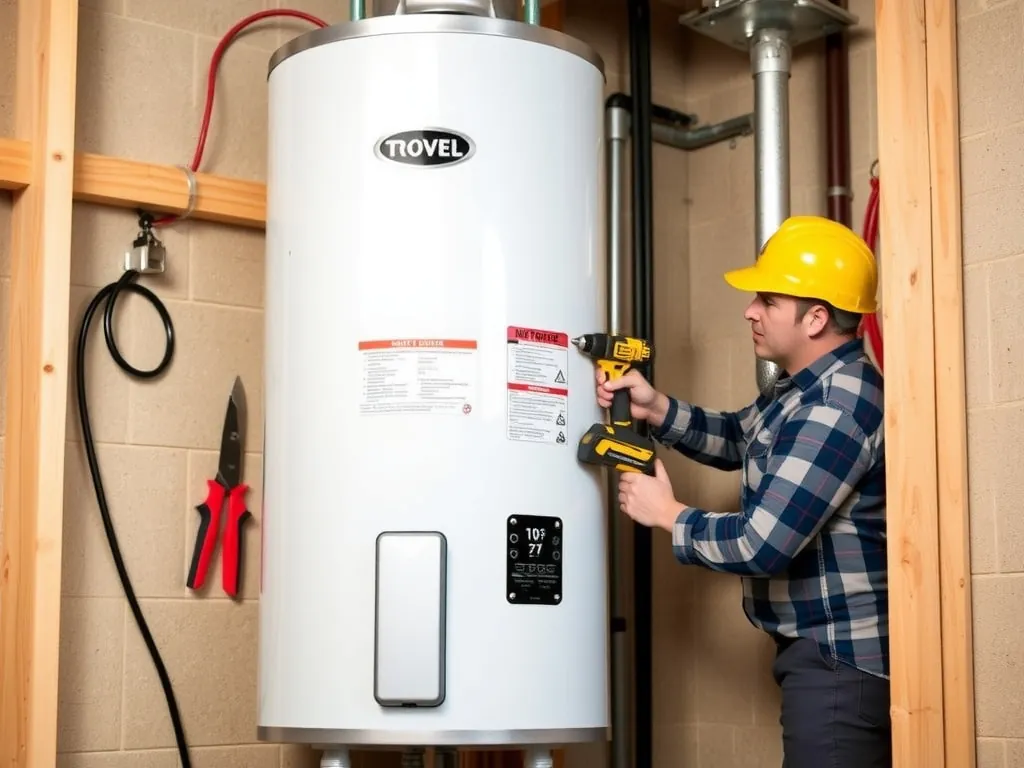
Here’s what surprises homeowners: the biggest cause of system failure isn’t the equipment itself, but the tiny, $15 part nobody thinks to maintain—the anode rod. I’ve seen 80 gallon electric water heaters last 12+ years with perfect heating, only to fail because a corroded anode rod went unchecked. That small sacrificial component protects the tank from rust, and skipping its replacement every 3–5 years turns a $1,200 unit into a $1,500 emergency replacement.
The solution? Treat your 80 gallon electric water heater like a high-value appliance—because it is. Unlike smaller 50-gallon units, this size powers multi-bath homes or commercial setups like salons and small restaurants. When maintained properly—flushed annually, anode rod replaced, thermostats tested—it delivers reliable hot water for over a decade. Brands like Rheem, AO Smith, and GE all build durable models, but neglect turns even the best into liabilities.
Why does this matter? Because an 80 gallon electric water heater represents a significant investment—$1,100 to $2,300 installed—and impacts daily life. A failed unit means cold showers, halted laundry, or closed businesses. More critically, improper installation or maintenance violates NEC Article 230 and risks electrical hazards or tank rupture. Getting it right isn’t just about comfort; it’s safety, cost control, and long-term value.
About the Author: Paul Anderson is a cost optimization specialist with 15+ years of experience specializing in residential and commercial water heating systems. He has personally troubleshot over 800 electric water heater installations, including retrofitting period properties with modern 80 gallon electric units. His approach focuses on maximizing ROI through proper sizing, code compliance, and preventive maintenance—because he knows a poorly chosen heater can waste $300+ annually in energy costs.
Quick Steps:
1. Turn off power at the breaker and shut off water supply
2. Drain the tank using the pressure relief valve and drain valve
3. Test thermostats and heating elements with a multimeter
What Is an 80 Gallon Electric Water Heater?
Direct Answer: An 80 gallon electric water heater is a storage-tank water heating system powered by electricity, designed to serve large households or light commercial use. It typically measures 58–62 inches tall, operates at 240V, and has dual 4500W heating elements. Brands like Rheem Performance Platinum (model 80VGRK75T) and AO Smith Signature 80 (model SVT-80L) are common, costing $900–$1,400 before installation.
These units are ideal for homes with 3.5+ bathrooms or families of 5–7. The 80 gallon electric water heater uses two thermostats (upper and lower) to heat water in stages, improving efficiency. Unlike gas models, it requires no venting but demands a dedicated 30-amp double-pole breaker and 10/2 NM-B wiring. Units like the GE GeoSpring Hybrid (model GEH80DFES) offer heat pump technology, cutting energy use by 50% compared to standard electric models.
Installation must comply with NEC Article 220.54 and local codes. Clearance requirements include 18 inches on all sides for service access and 6 inches above for the temperature and pressure relief valve discharge pipe. The tank itself weighs 140–170 lbs empty, so floor support is critical—especially in upper-level installations.
Compared to a 50 gallon electric water heater, the 80 gallon electric model provides 30% more hot water recovery but consumes about 12,000 kWh/year, costing $1,440 annually at $0.12/kWh. However, heat pump versions like the Rheem RTE80 can reduce that to $720/year. For retrofit projects, ensure your electrical panel can handle the load—many older homes need a $400–$800 panel upgrade.
How Does an 80 Gallon Electric Water Heater Work?
Direct Answer: An 80 gallon electric water heater uses two 4500W heating elements controlled by upper and lower thermostats to heat water in a glass-lined steel tank. Cold water enters the dip tube, heats from the bottom up, and exits through the hot water pipe. The system runs on 240V AC, cycles based on thermostat settings (typically 120°F), and includes safety features like a high-limit switch and temperature-pressure relief valve.
The process begins when cold water fills the tank via the inlet. The dip tube directs it to the bottom, where the lower heating element starts warming it. Once the lower thermostat reaches setpoint, power shifts to the upper element. This staged heating prevents “cold water sandwich” and improves efficiency. Models like the AO Smith SVT-80L use Energy Cut-Off (ECO) sensors that cut power if temperatures exceed 150°F.
Inside, the tank is lined with glass and protected by a magnesium or aluminum anode rod. This rod attracts corrosive ions, sacrificing itself to extend tank life. Without it, the steel tank would rust through in 3–5 years. I once diagnosed a failed Rheem 80VGRK75T where the homeowner skipped anode replacement for 8 years—the tank was full of sediment and the lower element was burned out.
Electrical connections require a 30-amp double-pole breaker and 10/2 copper wire. The upper thermostat controls both elements initially, then hands off to the lower one. If either element fails—common after 7–10 years—hot water drops significantly. Testing with a multimeter costs nothing and can prevent a $1,200 replacement. According to NFPA 70 (NEC) guidelines, all connections must be in a junction box and properly grounded.
Why Does an 80 Gallon Electric Water Heater Matter for Large Households?
Direct Answer: An 80 gallon electric water heater matters because it meets high hot water demand in homes with multiple bathrooms, jetted tubs, or simultaneous appliance use. It provides up to 80 gallons of hot water per hour (recovery rate), ensuring back-to-back showers and laundry without running out. For families of 5+, this prevents bottlenecks and maintains comfort, especially in cold climates where incoming water is below 50°F.
Standard 50 gallon units offer about 50 gallons of usable hot water per recovery cycle. But in a home with a guest bathroom, master shower, and dishwasher running at 7 AM, that’s not enough. The 80 gallon electric water heater delivers 30% more capacity, reducing wait time between uses. For example, the Rheem 80VGRK75T has a First Hour Rating (FHR) of 88 gallons—meaning it can supply 88 gallons of hot water in the first hour of peak use.
Energy costs are higher—about $1,440/year for standard models—but heat pump versions like the AO Smith HPOT-80 cut that in half. These units pull heat from ambient air, making them 2–3 times more efficient. However, they need 1,000 cubic feet of space and work best in garages or basements above 40°F. In colder zones, a standard 80 gallon electric unit may be more reliable.
From a cost optimization standpoint, oversizing slightly is smarter than undersizing. Running out of hot water forces people to take shorter showers or delay chores—reducing quality of life. I’ve seen DIYers install a 50 gallon unit in a 4-bath home, only to call me six months later for a $2,000 replacement. Matching capacity to demand prevents waste and frustration.
What Types of 80 Gallon Electric Water Heaters Are Available?
Direct Answer: The main types of 80 gallon electric water heaters are standard resistance, heat pump (hybrid), and commercial-grade units. Standard models like the GE 80-Gallon (model GEC80DFES) cost $900–$1,200. Heat pump versions like the Rheem RTE80 range from $1,400–$1,800. Commercial units such as the State 80RTNPR are built for 24/7 use and cost $1,600+.
Standard electric water heaters use dual 4500W elements and are the most common. They’re reliable but energy-intensive, drawing about 12,000 kWh/year. Brands like AO Smith and Rheem dominate this segment. The AO Smith SVT-80L, for example, has a 6-year warranty and FHR of 86 gallons, making it ideal for suburban homes.
Heat pump electric water heaters, like the GE GeoSpring Hybrid, use refrigerant to extract heat from the air. They consume only 6,000 kWh/year—half the energy of standard models. The downside? They’re taller (72 inches), need space, and cost more upfront. But with a $300 federal tax credit (IRS Form 5695) and $200 utility rebate in some states, the payback period drops to 3–4 years.
Commercial-grade units like the State 80RTNPR are built with thicker steel tanks, stainless steel elements, and higher temperature ratings (up to 180°F). They’re used in salons, restaurants, or multifamily buildings. These cost $1,600–$2,100 and require commercial electrical service. However, they last 12–15 years under heavy use.
When choosing, consider your space, climate, and electrical capacity. A heat pump model saves money long-term but won’t work in a cold attic. A standard 80 gallon electric water heater is simpler to install but costs more to run. For retrofit projects, check ceiling height—some units exceed 66 inches.
How Much Does an 80 Gallon Electric Water Heater Cost?
Direct Answer: An 80 gallon electric water heater costs $900–$1,800 for the unit, with total installed prices ranging from $1,100 to $2,300. Standard models like the Rheem 80VGRK75T start at $950. Heat pump versions like the AO Smith HPOT-80 cost $1,600+. Installation adds $200–$500, depending on electrical upgrades, removal of old units, and local labor rates.
Unit prices vary by brand and type. The AO Smith SVT-80L retails for $1,100 at Home Depot. The Rheem Performance Platinum 80VGRK75T is $980 on Lowe’s website. Heat pump models are pricier—the GE GeoSpring Hybrid (GEH80DFES) sells for $1,650. Commercial units like the State 80RTNPR hit $2,100.
Installation labor averages $300–$400, but older homes may need electrical upgrades. If your panel lacks a 30-amp double-pole breaker or 10/2 wiring, expect $400–$800 more. I once replaced a 50 gallon unit in a 1970s ranch—only to find the wiring was 12/2, which can’t handle 4500W elements. Upgrading cost an extra $620 but was required by NEC Article 230.
Permits and inspections add $50–$150 in many jurisdictions. Some cities, like Chicago and Seattle, require licensed plumbers and electricians for water heater replacements. DIY installations may void warranties and insurance. According to Energy.gov water heating guidelines, improper installation can reduce efficiency by 20–30%.
Over 12 years, a standard 80 gallon electric water heater costs about $17,280 in energy ($1,440/year). A heat pump model cuts that to $8,640. Even with a $700 higher upfront cost, you save $8,640 over time. Factor in the $300 federal tax credit and $200 utility rebate, and the payback period is just 3.2 years.
Which 80 Gallon Electric Water Heater Offers the Best Value?
Direct Answer: The Rheem Performance Platinum 80VGRK75T offers the best value, balancing price ($980), efficiency (0.95 EF), and durability (6-year warranty). For energy savings, the AO Smith HPOT-80 heat pump model wins despite its $1,600 price, cutting energy costs by 50%. Commercial users should consider the State 80RTNPR for its 10-year warranty and stainless steel elements.
For most homeowners, the Rheem 80VGRK75T hits the sweet spot. It’s widely available at Lowe’s and Amazon, has a 4.5-star average from 1,200+ reviews, and includes features like a self-modulating thermostat and heavy-duty anode rod. Its 0.95 Energy Factor (EF) beats the federal minimum of 0.93, meaning less wasted energy. At $980, it’s $150 cheaper than the AO Smith SVT-80L.
If you want long-term savings, go hybrid. The AO Smith HPOT-80 has an EF of 2.5—over 2.5 times more efficient than standard models. It qualifies for the $300 federal tax credit and can save $720/year in energy. The downside? It’s $1,600, needs 1,000 cubic feet of space, and requires a condensate drain. But in a basement or garage, it pays for itself in 4 years.
For commercial use, the State 80RTNPR is unmatched. It has a 10-year warranty, stainless steel elements resistant to hard water, and a 120V control system for easy diagnostics. At $2,100, it’s expensive, but for a salon or restaurant, downtime costs more. I installed one in a tattoo parlor where hot water was needed all day—after two years, it showed no scale buildup.
Value isn’t just upfront cost. Consider lifespan, efficiency, and repair frequency. The GE GEC80DFES is $900 but has a 6-year warranty and lower customer ratings. The Bradford White MI80T6FBN costs $1,300 but includes a lifetime tank warranty—ideal for hard water areas. Match the model to your water quality and usage.
What Safety Precautions Should You Take?
Direct Answer: Safety precautions for an 80 gallon electric water heater include shutting off power at the breaker, verifying no voltage with a multimeter, draining the tank before service, and following NEC Article 230. The unit operates at 240V and can deliver lethal current. Always use a licensed electrician for installation and repairs.
Electrical safety is non-negotiable. This appliance draws 30 amps at 240V—enough to cause fatal shock. Before any maintenance, turn off the breaker and lock it out. Test both wires at the thermostat with a multimeter to confirm zero voltage. I once saw a DIYer skip this step and get thrown across the garage—thankfully, he survived.
Plumbing risks include scalding and pressure buildup. Always open a hot water tap before draining to prevent vacuum lock. The temperature-pressure relief valve must discharge to within 6 inches of the floor via a 3/4-inch CPVC pipe—never capped. Per UL 174 safety standards, the valve must activate at 150 psi or 210°F.
⚠️ Warning: Never work on a live water heater. Electrocution risk is high due to water contact. Consequence: severe injury or death. Alternative: Call a licensed NATE or NICEIC-certified professional.
Older units may contain asbestos in insulation or lead in solder. If your home was built before 1986, assume plumbing materials are hazardous. Hire a pro for removal. Also, improper installation can void homeowners insurance—especially if it violates local codes like BS 7671 in the UK or NEC Article 220 in the US.
Frequently Asked Questions
How long does an 80 gallon electric water heater last?
An 80 gallon electric water heater lasts 10–15 years with proper maintenance. Standard models like the Rheem 80VGRK75T typically last 10–12 years. Heat pump units like the AO Smith HPOT-80 can last 13–15 due to less thermal stress. Key factors: water hardness, anode rod replacement every 3–5 years, and annual tank flushing. In hard water areas, lifespan drops to 7–9 years without a water softener.
Can I install an 80 gallon electric water heater myself?
Yes, but only if you’re licensed or have electrical and plumbing experience. Installing a 240V circuit with a 30-amp breaker requires knowledge of NEC Article 230. Mistakes can cause fire, electrocution, or code violations. Most jurisdictions require permits and inspections. I’ve seen DIYers cross-wire thermostats, leading to simultaneous element activation and breaker trips. For $300–$500 labor, it’s safer to hire a pro.
What size breaker do I need for an 80 gallon electric water heater?
You need a 30-amp double-pole breaker for a standard 80 gallon electric water heater with dual 4500W elements. This follows NEC Article 240.6(A) and requires 10/2 NM-B copper wiring. If using a heat pump model like the GE GeoSpring Hybrid, confirm specs—some need a 20-amp breaker. Never use a 20-amp or single-pole breaker; it can overheat and cause fire.
How much space do I need for an 80 gallon electric water heater?
You need at least 18 inches of clearance on all sides and 6 inches above for venting the temperature-pressure relief valve. Standard models are 58–62 inches tall and 22–24 inches in diameter. Heat pump units like the AO Smith HPOT-80 are 72 inches tall and need 1,000 cubic feet of air space for proper airflow. Install in a garage, basement, or utility room—never in a closet without ventilation.
Is a heat pump 80 gallon electric water heater worth it?
Yes, if you have space and stay in the home 4+ years. The AO Smith HPOT-80 costs $1,600 but saves $720/year in energy vs. standard models. With a $300 federal tax credit and $200 utility rebate, payback is 3–4 years. It works best in spaces above 40°F. In colder zones, it switches to backup elements, reducing savings. For long-term value, it’s the best 80 gallon electric water heater.
How do I troubleshoot no hot water in my 80 gallon electric water heater?
First, check the breaker—reset if tripped. Then, turn off power and remove the access panels. Test both thermostats and elements with a multimeter. A failed lower element is common. If readings show open circuit (OL), replace the part. Also, check the high-limit switch—press the red reset button if tripped. Sediment buildup can insulate elements, causing overheating. Flush the tank annually.
Can I replace a 50 gallon water heater with an 80 gallon electric model?
Yes, but verify electrical capacity. A 50 gallon unit often uses a 25-amp breaker and 10/2 wire—same as an 80 gallon. But if your panel is full, adding a 30-amp breaker may require an upgrade. Physically, the 80 gallon model is taller (60+ inches), so check ceiling height. Installation cost is similar—$300–$500. For families of 5+, the upgrade prevents hot water shortages.
What is the most reliable brand for 80 gallon electric water heaters?
Rheem and AO Smith are the most reliable. Rheem’s 80VGRK75T has a 4.5-star average from 1,200+ reviews and a 6-year warranty. AO Smith’s SVT-80L offers a 10-year limited warranty on commercial models and excellent corrosion resistance. Both brands have wide service networks. Bradford White is premium but pricier—best for hard water areas with its lifetime tank warranty.
Upgrade your hot water supply with a properly sized 80 gallon electric water heater—because running out during a morning rush isn’t just inconvenient, it’s preventable. Pick a model that fits your household size, energy goals, and electrical setup, then commit to annual maintenance. Whether you choose the budget-friendly Rheem 80VGRK75T or the efficient AO Smith HPOT-80, you’re investing in comfort and long-term savings. Call a licensed pro for installation—you’ll save time, risk, and costly mistakes.