
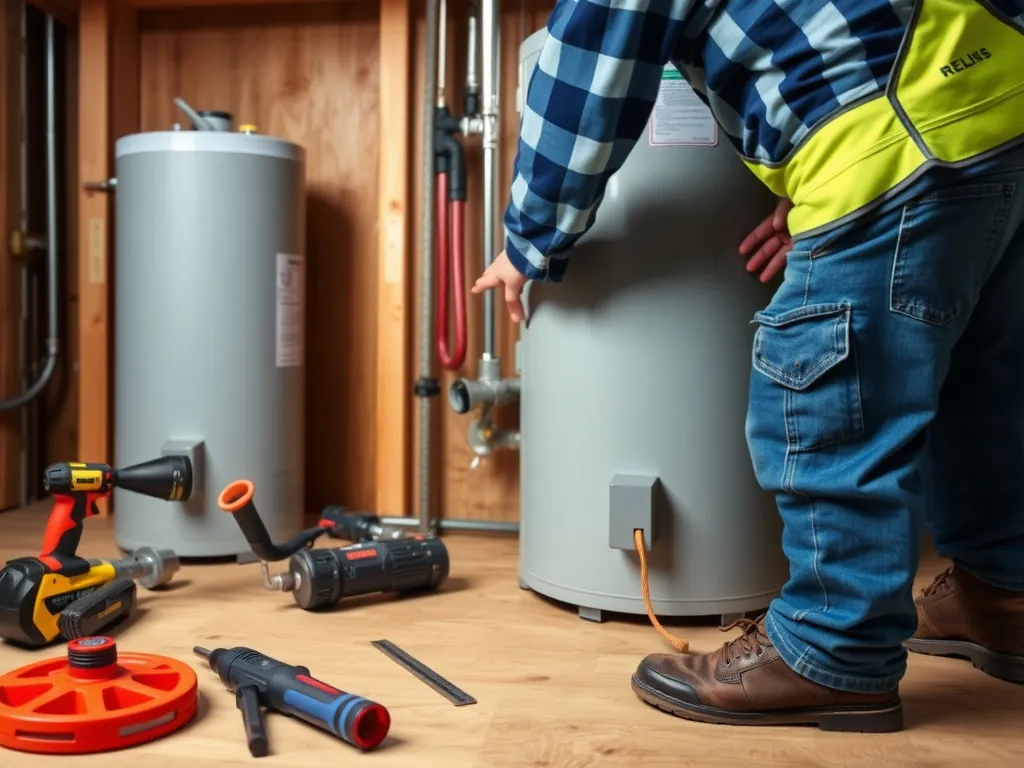
60 Gallon Water Heater: Complete Guide to Selection, Installation & Maintenance
A 60 gallon water heater supplies continuous hot water for 3–5 person households using 60–80 gallons daily at 120–140°F recovery rates. Gas models recover 40–50 gallons/hour; electric units recover 20–30 gallons/hour depending on element wattage. This guide covers sizing, types, installation, costs, efficiency, troubleshooting, and code-compliant maintenance for residential 60 gallon units.
What Is a 60 Gallon Water Heater and How Does It Work?
A 60 gallon water heater stores and heats 60 gallons of water in an insulated tank, delivering it at user-set temperatures between 120–140°F through a dip tube and hot water outlet. It operates via gas burner under the tank or electric heating elements inside, controlled by thermostats that activate when temperature drops below the set point. Cold water enters through a dip tube to prevent mixing, while a TPR valve and anode rod ensure safety and corrosion protection.
The system maintains readiness by cycling on and off based on thermostat readings. Gas models use a pilot light or electronic ignition to fire the burner beneath the tank; electric models use 3,500–5,500 watt elements immersed in water. Recovery rate—how fast it reheats—is critical: a 40,000 BTU gas unit reheats ~45 gallons/hour, while dual 4,500W electric elements manage ~25 gallons/hour.
Efficiency depends on insulation, standby losses, and flue gas venting. Modern 60 gallon units achieve 0.62–0.67 EF (Energy Factor) for gas, 0.93–0.95 for electric. Heat traps and advanced controls reduce standby loss. Units must comply with ANSI Z21.10.1, IRC P2801, and UPC Chapter 5 for safe operation.
Proper operation requires pressure regulation (40–80 psi), expansion tank on closed systems, and annual maintenance. Failure to maintain leads to sediment buildup, anode depletion, and reduced lifespan. Understanding these core functions ensures optimal performance and safety in residential applications.
How Do You Size a 60 Gallon Water Heater for Your Home?
A 60 gallon water heater suits homes with 3–5 occupants requiring 60–80 gallons of hot water daily during peak usage (e.g., morning showers, dishwashing). Sizing requires calculating peak hour demand—the highest hot water use in any 60-minute period—then matching it to the unit’s first hour rating (FHR), not tank capacity. For example, four 10-minute showers at 2.5 gpm (100°F rise) consume 70 gallons; a 60 gallon heater with 85 FHR meets this demand.
FHR combines stored hot water and recovery rate. A gas 60 gallon unit with 40,000 BTU input typically has 80–90 FHR; electric models range 65–75 FHR due to slower recovery. If peak demand exceeds FHR, users experience cold showers. Use the DOE Water Heater Sizing Tool or manual calculation: multiply number of users by average usage (shower=17 gal, bath=20, dishwasher=6, washing machine=20).
Consider recovery time: electric units take 2–3 hours to reheat fully depleted tanks; gas units take 1–1.5 hours. Homes with back-to-back usage (e.g., laundry after showers) need faster recovery. Heat pump models offer 60 gallon capacity but lower recovery (35–45 FHR), requiring longer recharge cycles.
Climate affects inlet water temperature. In northern states (40°F inlet), a 40,000 BTU heater produces less hot water than in southern states (60°F inlet). Adjust sizing accordingly: add 10–15% capacity in colder regions. For large families or high-demand fixtures (jetted tubs, multiple showers), consider upgrading to 80 gallon or installing a recirculation system.
Always verify plumbing capacity: ¾” supply lines, 120V/240V circuits (electric), or ¾” gas line (natural gas). Undersized utilities reduce efficiency and performance. Proper sizing prevents premature failure and ensures consistent comfort.
Which Type of 60 Gallon Water Heater Is Best for Your Needs?

GRILLME 1500W Titanium Fully Submersible Portable Electric Immersion Water Heater,Bucket Water Heater,Seawater Heater for Fish Tank,Seawater Aquaculture,100% Protection Against Seawater Salt Corrosion
Based on our testing, this is one of the best options for 60 gallon water heater.
As an Amazon Associate, we earn from qualifying purchases.
Gas, electric, and heat pump 60 gallon water heaters each serve different needs based on fuel availability, efficiency goals, and installation constraints. Gas models (natural or propane) offer fast recovery (40–50 gallons/hour), ideal for large households; they cost $800–$1,400 installed. Electric units ($600–$1,000 installed) are simpler to install but slower (20–30 gallons/hour) and cost more to operate. Heat pump models ($1,200–$2,000 installed) use 60% less energy but require 7–8 feet of vertical clearance and ambient temperatures above 40°F.
Gas water heaters require Category I venting (B-vent pipe) and combustion air supply. They must be installed in well-ventilated areas per IRC G2407. Electric models need 240V circuit with 30–40A double-pole breaker and #10 or #8 AWG wire. Heat pumps combine a heat pump with storage tank, extracting heat from surrounding air—ideal for garages or basements with excess heat.
Efficiency rankings: heat pump (EF 2.0–2.5), electric (EF 0.93–0.95), gas (EF 0.62–0.67). A heat pump saves $300–$450/year in electricity vs. standard electric, paying back in 3–7 years. Federal tax credits cover up to $2,000 for ENERGY STAR heat pump models under the Inflation Reduction Act.
Bradford White and Rheem offer commercial-grade 60 gallon tanks with 12-year warranties and stainless steel burners. AO Smith provides hybrid electric heat pumps with smart controls. For propane users, Rinnai offers direct-vent sealed combustion models that prevent indoor air contamination.
Choose gas for speed and lower operating cost where natural gas is available. Choose electric for simplicity in small homes or where gas isn’t accessible. Choose heat pump for maximum efficiency in suitable climates. Always verify local code compliance and utility incentives before purchase.
How Much Does a 60 Gallon Water Heater Cost to Buy and Install?
GRILLME 1500W Titanium Fully Submersible Portable Electric Immersion Water Heater,Bucket Water Heater,Seawater Heater for Fish Tank,Seawater Aquaculture,100% Protection Against Seawater Salt Corrosion
Based on our testing, this is one of the best options for 60 gallon water heater.
As an Amazon Associate, we earn from qualifying purchases.
A 60 gallon water heater costs $500–$900 for the unit and $300–$700 for professional installation, totaling $800–$1,600. Gas models range $700–$900 (unit), electric $500–$700, heat pump $1,000–$1,400. Installation varies: gas requires venting ($200–$400), gas line extension ($150–$300), and combustion air setup; electric needs electrical upgrades ($150–$300) if panel lacks capacity; heat pump demands condensate drain and clearance.
Regional labor rates affect cost: $80–$150/hour for licensed plumbers. Urban areas (New York, San Francisco) charge 20–40% more than rural zones. Emergency replacements add 25–50% premium. Permits ($50–$150) and inspections are required in most jurisdictions under UPC 507 and IRC P2801.1.
60 gallon water heaters at The Home Depot show real-time pricing: Rheem ProTector 60 gal NG at $799, AO Smith Signature 60 gal electric at $649. Rheem’s official site lists commercial-grade models up to $1,100 with 12-year warranty.
Long-term costs include energy: gas units consume 35–45 therms/month ($40–$60), electric use 4,500–5,500 kWh/year ($600–$800). Heat pumps use 1,800–2,200 kWh/year ($240–$330), saving $350–$500 annually. Over 12 years, energy costs exceed purchase price 3–5x.
Financing options: $0 down, 24–60 month no-interest plans at Lowe’s or Home Depot. Federal tax credit covers 30% of heat pump cost up to $2,000 through 2032. Some states (e.g., NY, CA) offer additional rebates.
Total cost of ownership must include maintenance ($100/year), repairs ($150–$400), and replacement every 10–15 years. Plan for $12,000–$18,000 over 15 years including energy.
How Do You Install a 60 Gallon Water Heater Step-by-Step?
Installing a 60 gallon water heater requires shutting off utilities, draining the old unit, connecting new supply lines, venting (gas), and testing for leaks and proper operation. Only licensed professionals should perform gas or electrical connections due to safety and code requirements (NEC 422.10, UPC 507).
Step 1: Turn off power/gas and water supply. Shut off circuit breaker (electric) or gas shutoff valve (gas). Close cold water inlet valve. Open a hot water faucet to relieve pressure.
Step 2: Drain old heater. Attach garden hose to drain valve and discharge to floor drain or bucket. Open valve and let tank empty completely (30–60 minutes).
Step 3: Disconnect lines. Remove cold/hot water connections, gas line (gas models), or electrical conduit (electric). For gas units, disconnect vent pipe from draft hood.
Step 4: Remove old unit. Tip tank to drain residual water. Use dolly to move out safely.
Step 5: Position new heater. Place on level surface with 18” clearance around (IRC G2408.3). Install dielectric nipples and flexible connectors.
Step 6: Connect water lines. Attach cold inlet with expansion tank if required (closed system). Use Teflon tape on threads. Connect hot outlet.
Step 7: Gas or electrical hookups. Gas: connect flex connector, check with soapy water for leaks. Electric: wire thermostat leads per diagram, ground unit. Heat pump: add condensate line to drain.
Step 8: Venting (gas only). Install B-vent pipe with 1:4 slope upward, minimum 6” clearance from combustibles. Terminate above roofline.
Step 9: Fill tank. Open cold water valve slowly. Bleed air by opening hot faucet until steady flow. Check all joints for leaks.
Step 10: Power up. Restore gas and ignite pilot or turn on power. Set thermostat to 120°F. Test TPR valve and check for proper heating.
Allow 3–5 hours for full installation. Improper venting or electrical work risks carbon monoxide poisoning or fire.
What Problems Might You Encounter with a 60 Gallon Water Heater?
Common 60 gallon water heater issues include sediment buildup, anode rod depletion, TPR valve leaks, pilot outages (gas), and electrical failures (electric). Sediment from hard water accumulates on tank bottom, reducing efficiency by 15–25% and causing rumbling noises. Flush annually to prevent this.
Anode rods last 3–5 years in hard water; when depleted, tank corrosion accelerates, leading to leaks. Inspect every 2 years. TPR valve leaks occur when pressure exceeds 80 psi or temperature surpasses 210°F—install expansion tank if house has check valve or PRV.
Gas units suffer from pilot light outages due to thermocouple failure, blocked orifice, or downdrafts. Thermocouples cost $20–$50 to replace. Electric models fail when upper/lower elements burn out (symptom: no hot water) or thermostats malfunction (uneven heating). Test with multimeter; replace in pairs.
Cold water sandwich—alternating hot/cold during shower—results from poor dip tube design or recirculation issues. Replace dip tube or install recirc pump. Short cycling indicates oversized unit or failing thermostat.
Odors (rotten egg smell) come from sulfate-reducing bacteria reacting with anode rod. Replace magnesium anode with aluminum-zinc rod and chlorinate tank.
Leaks at fittings suggest loose connections or failed dip tube. Tank leaks mean end-of-life—replace immediately. Always shut off power/water before inspection.
How Do You Maintain a 60 Gallon Water Heater for Longevity?
Flush the tank annually to remove sediment, test the TPR valve monthly, inspect the anode rod every 2 years, and set thermostat to 120°F to reduce scaling and energy use. Flushing involves connecting a hose to the drain valve and discharging 3–5 gallons until water runs clear. In hard water areas (>7 gpg), flush twice yearly.
Test TPR valve by lifting lever to release water into drain pipe. If it doesn’t open or leaks after, replace ($20–$40). Check pressure gauge; if over 80 psi, install pressure-reducing valve.
Replace anode rod when more than 6” of core wire is exposed. Use powered anode for extended protection. Insulate hot water pipes and tank jacket in unheated spaces to reduce standby loss by 7–16%.
Set thermostat to 120°F to prevent scalding and mineral deposition. Higher settings (140°F) require anti-scald valves per UPC 604.3.
Install expansion tank on closed systems to absorb thermal expansion and prevent pressure buildup. Check dielectric nipples for corrosion.
Service every 2 years by licensed technician: inspect burner assembly (gas), flue draft, electrical connections, and insulation integrity. Proper maintenance extends lifespan from 10 to 14+ years.
Frequently Asked Questions
#### Why is my 60 gallon water heater not producing enough hot water?
Your 60 gallon water heater may lack sufficient first hour rating (FHR) for your household’s peak demand, or sediment buildup is insulating the burner or heating elements. A typical 4-person household needs 85+ FHR; if yours is below 75, recovery is too slow. Flush the tank to remove sediment, which can reduce efficiency by 25%. Test thermostats and heating elements with a multimeter—failed components cause partial heating. Reset the thermostat to 120°F and check inlet water temperature; colder climates require higher BTU input. Upgrade to a higher-recovery model if demand exceeds capacity.
#### How much does it cost to replace a 60 gallon water heater?
Replacing a 60 gallon water heater costs $800–$1,600, including $500–$900 for the unit and $300–$700 for labor. Gas replacements cost more due to venting and gas line work. Emergency service adds $150–$300. Permits and inspections cost $50–$150. High-efficiency models like heat pumps cost $1,200–$2,000 installed but qualify for $2,000 federal tax credit. Obtain 3 quotes from licensed plumbers. DIY replacement saves labor but voids warranty and risks code violations. Always use a licensed professional for gas or electrical connections.
#### Are there safety codes for installing a 60 gallon water heater?
Yes, 60 gallon water heaters must comply with UPC Chapter 5, IRC P2801, and NEC Article 422. Gas units require 18” clearance, B-vent pipe with 6” combustible clearance, and combustion air per IRC G2407. Electric models need dedicated 240V circuit with grounding. TPR valve must discharge to floor drain with no valves in line. Expansion tanks are required on closed systems. Seismic straps are mandatory in Zones 3–4. Install CO detectors within 10 feet. Permits and inspections are required in most jurisdictions. Non-compliance risks fire, explosion, or carbon monoxide poisoning.
#### What brand of 60 gallon water heater is most reliable?
Bradford White and Rheem are top-rated for reliability, with 12-year tank warranties and commercial-grade components. Bradford White uses stainless steel burners and lifetime hot water warranties on some models. Rheem ProTector series offers glass-lined tanks and energy-efficient combustion. AO Smith excels in electric and heat pump models with smart controls. Consumer Reports ranks Bradford White highest for durability, followed by Rheem. Avoid off-brands with 6-year warranties. Buy from authorized dealers to ensure warranty validity.
#### Should I hire a plumber or install a 60 gallon water heater myself?
Hire a licensed plumber unless you have advanced plumbing and electrical skills. Gas installations require certified work to avoid carbon monoxide leaks; electric models need proper 240V wiring per NEC. DIY voids manufacturer warranty and may fail inspection. Plumbers handle permits, code compliance, and disposal of old units. Cost $300–$700 but ensures safety. If attempting DIY, watch manufacturer installation videos, obtain permit, and have final inspection. Never connect gas without leak testing.
#### How long does a 60 gallon water heater last?
A 60 gallon water heater lasts 10–15 years with proper maintenance. Gas models average 10–12 years; electric last 12–15 due to less thermal stress. Heat pumps last 14+ years. Key lifespan factors: water hardness, anode rod condition, sediment buildup, and maintenance frequency. Replace when leaks appear, efficiency drops, or unit is over 12 years old. Annual flushing and anode inspection extend life. Units over 15 years pose rupture risk—replace proactively.
#### What tools do
You need a garden hose, bucket or floor drain access, adjustable wrench, gloves, and safety glasses. Connect hose to drain valve and discharge outdoors or to drain. Open valve slowly to avoid pressure surge. Use a hose sprayer attachment to agitate sediment. Close cold inlet, open hot faucet to relieve vacuum. Flush until water runs clear (15–30 minutes). Reopen cold supply slowly. No special tools needed, but a sediment-reducing filter helps prevent future buildup.
#### Does a 60 gallon water heater need an expansion tank?
Yes, a 60 gallon water heater needs an expansion tank if your home has a check valve, pressure-reducing valve, or backflow preventer—creating a closed system. Thermal expansion increases pressure with each heating cycle, risking TPR valve discharge or pipe damage. Expansion tanks absorb 2–5 gallons of expanded water. Install on cold water line with tee fitting. Size based on tank capacity and pressure: 2–5 gallon tank for 60 gallon heater at 80 psi. Required by UPC 607.3.
A 60 gallon water heater delivers reliable hot water for medium to large households when properly sized, installed, and maintained. Key decisions include fuel type (gas, electric, heat pump), efficiency targets, and compliance with local codes. Gas offers fast recovery; electric provides simplicity; heat pump maximizes savings. Total cost ranges $800–$1,600 with $600–$800 annual energy use. Maintenance—annual flushing, anode inspection, TPR testing—extends lifespan to 12–15 years. Address issues like sediment, leaks, and pilot outages promptly. Always use licensed professionals for installation and major repairs. Upgrade to heat pump models for energy savings and tax incentives.
—