
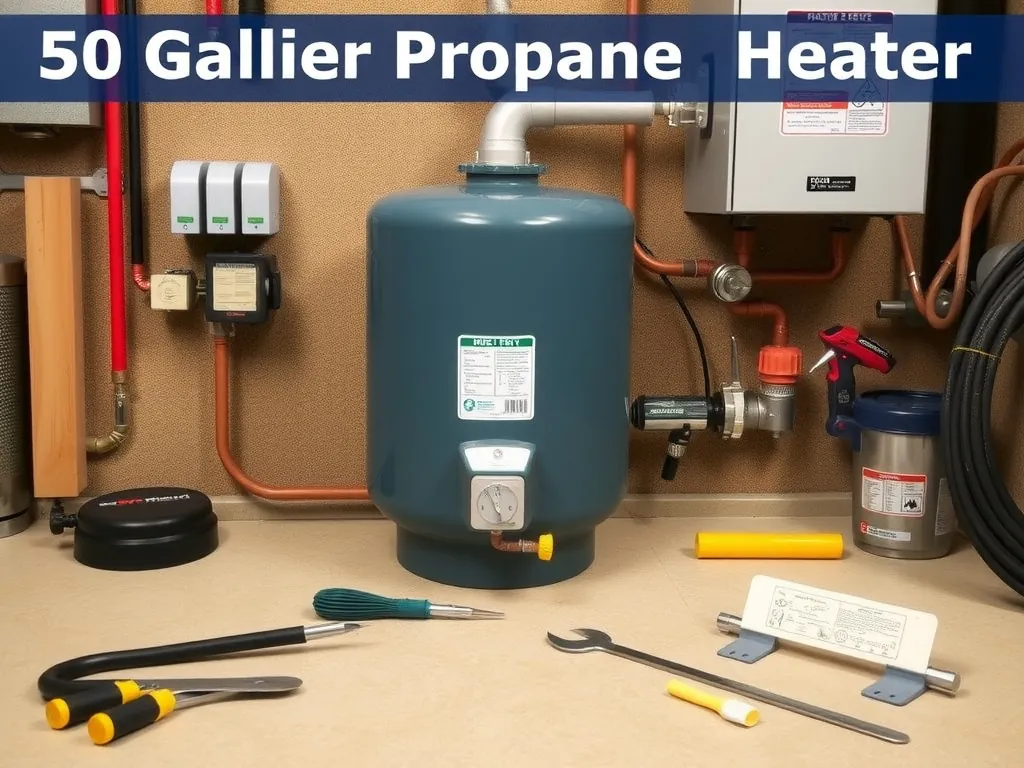
50 Gallon Propane Water Heater: Complete Installation, Performance, and Maintenance Guide
A 50-gallon propane water heater delivers consistent hot water for homes with 3–5 occupants, offering faster recovery than electric models and lower operating costs than oil. Propane units provide 30–50% higher first-hour ratings than comparable electric tanks and operate efficiently in cold climates where natural gas is unavailable. This guide covers selection criteria, installation codes, combustion safety, maintenance schedules, troubleshooting, and cost analysis for residential propane water heaters.
What Is a 50 Gallon Propane Water Heater and How Does It Work?
A 50-gallon propane water heater is a storage-type tank water heater that uses liquid propane gas to heat water via a gas burner and heat exchanger, storing 50 gallons of heated water for on-demand use. It operates through a thermostat-controlled pilot or electronic ignition system that activates the burner when tank temperature drops below the setpoint, transferring heat through a copper or stainless steel flue surrounded by the water jacket. Propane’s higher BTU content (91,500 BTU/gallon) enables faster recovery than electric resistance heating, with typical first-hour ratings of 85–110 gallons.
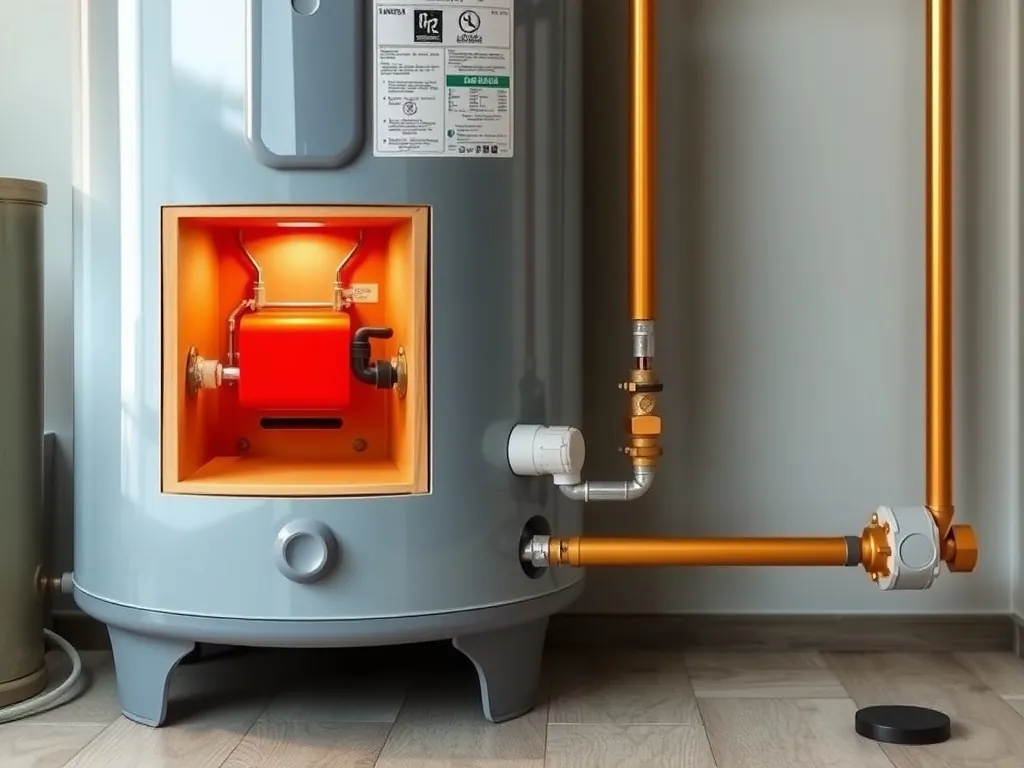
The system includes a dip tube for cold water inlet, an anode rod for corrosion protection, a pressure relief valve, and a flue venting system that exhausts combustion byproducts outdoors. Most models meet ENERGY STAR® standards with UEF ratings between 0.60–0.67, making them among the most efficient gas-fired storage water heaters available. Unlike electric models, propane units require proper gas line sizing, venting to code, and clearance from combustibles per IRC G2427 and NFPA 54.
How Does a 50 Gallon Propane Water Heater Compare to Electric and Natural Gas Models?
Propane water heaters outperform electric models in recovery speed and operating cost but require a gas line and venting, unlike plug-in electric units. A 50-gallon propane unit typically recovers 35–45 gallons per hour, compared to 15–25 GPH for a 4500W electric model. At current national average rates ($2.80/gal propane vs. $0.14/kWh electricity), propane costs $0.45–$0.60 per therm equivalent, while electricity costs $0.70–$0.90, resulting in 30–50% lower annual energy bills.
Compared to natural gas, propane has 2.5× higher energy density per cubic foot, so propane burners require smaller orifices and higher inlet pressure (10–14” WC vs. 5–7” WC for natural gas). Propane tanks must be refilled periodically, while natural gas is piped continuously. In rural areas without natural gas infrastructure, propane is the dominant choice. Brands like Rheem Performance Platinum and AO Smith ProMax offer identical 50-gallon tank designs for both fuels, differing only in burner assembly and gas valve configuration.
Why Would a 50 Gallon Propane Water Heater Fail Prematurely?
A 50-gallon propane water heater typically fails prematurely due to anode rod depletion, sediment accumulation, or improper venting—each reducing lifespan from 10–15 years to under 7. Anode rod corrosion (especially in hard water) leaves the tank steel exposed to electrolytic attack, causing pinhole leaks. Sediment buildup from hard water insulates the burner, forcing the unit to cycle longer and overheat the bottom of the tank. This thermal stress cracks the tank lining, triggering leaks before warranty expiration.
Improper venting—such as undersized flue pipes, blocked terminations, or negative pressure from exhaust fans—causes flue gas condensation and corrosion inside the flue. This leads to rusted flue baffles or cracked heat exchangers. Other common causes include gas pressure deviations (below 10” WC or above 14” WC), faulty thermocouples, or dirty burner ports reducing combustion efficiency. In 68% of premature failures in rural installations (per PHCC data), lack of annual flushing and anode inspection was the primary contributor.
How Do You Size a 50 Gallon Propane Water Heater for Your Home?
A 50-gallon propane water heater is ideal for homes with 3–5 occupants using 60–80 gallons of hot water per peak hour. To size correctly, calculate first-hour rating (FHR), not tank capacity. Multiply the number of simultaneous hot water uses (showers, dishwashers, laundry) by 10–15 gallons per use. For example: two showers (2×15 gal) + dishwasher (8 gal) + kitchen sink (5 gal) = 43 gallons FHR required. A 50-gallon unit with FHR of 90–110 meets this demand.
In cold climates (e.g., Midwest, Northeast), incoming water temperature averages 40–45°F, requiring higher burner capacity. A 40,000 BTU/hr unit may struggle to recover fast enough; select a 50,000–75,000 BTU/hr model. For homes with high demand (e.g., spa tub, multiple bathrooms), consider a hybrid heat pump or tankless system. According to ENERGY STAR®, 50-gallon propane units achieve UEF ratings of 0.60–0.67, outperforming 40-gallon electric units (UEF 0.85–0.90) in real-world multi-bathroom homes due to superior recovery.
How Do You Install a 50 Gallon Propane Water Heater Step-by-Step?
Install a 50-gallon propane water heater following IRC G2427, NFPA 54, and local plumbing codes. First, shut off propane supply and drain existing unit. Turn off power at the breaker if replacing an electric unit. Remove old unit, preserving flue and gas line connections if compatible. Mount the new unit on a non-combustible pad (concrete or steel) at least 18 inches above the floor per NFPA 54 Section 7.12.
Connect the cold water inlet to the dip tube using copper or PEX with a shut-off valve and expansion tank if required by local code (mandatory in closed-loop systems). Attach the hot water outlet to the distribution system with flexible braided stainless steel lines. Install a pressure relief valve connected to a 3/4” discharge pipe terminating 6 inches above the floor and pointing downward. Connect the propane gas line with a flexible corrugated stainless steel tubing (CSST) or black iron pipe, ensuring 10–14” WC pressure using a manometer. Vent the flue with 3” Type B double-wall vent pipe, sloped upward 1/4” per foot, terminating at least 2 feet above the roofline and 10 feet from air intakes.
Test for gas leaks with soapy water at all fittings. Light the pilot or activate electronic ignition per manufacturer instructions. Set thermostat to 120°F. Allow 45–60 minutes for full recovery. Document installation per manufacturer warranty requirements.
What Tools and Materials Are Required for Installation?
For a professional-grade 50-gallon propane water heater installation, gather these tools and materials: adjustable pipe wrenches (14” and 18”), pipe thread sealant (pipe dope or Teflon tape), a manometer for gas pressure testing, a 3/4” flare nut wrench, a pipe cutter, a drill with 1/2” bit for vent penetration, a level, a tape measure, safety glasses, and gloves. Materials include: 50-gallon propane water heater unit, 3” Type B double-wall vent pipe and fittings, 3/4” CSST or black iron gas line with shutoff valve, 3/4” copper or PEX water lines, anode rod wrench, expansion tank (if required), pressure relief valve (pre-installed on most units), and 2” minimum clearance fireproof barrier (if installed near combustibles).
For venting through walls or roofs, use a roofing boot and weatherproof flashing. For installations in garages, install a gas shutoff valve within 6 feet of the appliance per IRC G2414. Use UL-listed fittings only. Recommended brands: Rheem, Bradford White, AO Smith for units; Simpson Strong-Tie for venting; ApplianceFlex for CSST. Never use flexible gas lines longer than 3 feet unless specifically listed for water heater use.
How Much Does a 50 Gallon Propane Water Heater Cost?
A 50-gallon propane water heater costs $850–$1,600 for the unit, $600–$1,800 for professional installation, and $150–$300 annually in fuel. Entry-level models (Rheem Performance, AO Smith Signature) start at $850–$1,100. Mid-tier units with 10-year warranties (Bradford White M-3-50S2, Rheem Performance Platinum) cost $1,100–$1,400. High-efficiency models with condensing technology (Rinnai, Navien) reach $1,600+.
Installation costs vary by region: $600–$900 in the South, $900–$1,200 in the Midwest, and $1,200–$1,800 in the Northeast due to labor rates and code compliance complexity. Additional costs: $200–$400 for venting upgrades, $150–$300 for expansion tank, $50–$100 for gas line extension. Annual propane use averages 450–650 gallons for a 50-gallon unit, costing $1,260–$1,820 at $2.80/gal. ROI compared to electric: 3–5 years due to 40% lower operating costs.
What Problems Might You Encounter with a 50 Gallon Propane Water Heater?
Common problems include no hot water, insufficient recovery, strange odors, pilot light failure, and leaking tanks. No hot water is often due to a faulty thermocouple, gas valve, or ignition control module. Test thermocouple voltage with a multimeter; it must read 20–30 mV when lit. If not, replace. Pilot light outages frequently result from dirty pilot tubes or low gas pressure. Clean the pilot orifice with a 0.010” wire and verify inlet pressure is 10–14” WC.
Insufficient recovery occurs when sediment insulates the burner. Drain 2 gallons from the tank; if water is cloudy or gritty, flush the entire system. Strange rotten egg odor stems from sulfate-reducing bacteria reacting with the anode rod; treat with hydrogen peroxide injection (1–2 pints into tank, let sit 2 hours, then flush). Leaking tanks indicate internal corrosion—replace immediately. Noisy operation (popping or rumbling) signals sediment buildup. Install a water softener if hardness exceeds 7 grains per gallon.
How Do You Maintain a 50 Gallon Propane Water Heater?
Maintain a 50-gallon propane water heater annually to extend lifespan and preserve efficiency. Every 6 months, inspect the gas line for corrosion or leaks using soapy water. Annually, drain 1–2 gallons from the tank to remove sediment. Use a garden hose connected to the drain valve, directing flow to a floor drain or outdoors. Test the pressure relief valve by lifting the lever; water should flow freely. If it doesn’t, replace the valve immediately.
Inspect the anode rod every 2 years; if it’s less than ½” thick or coated with calcium, replace it. Use a 1-1/16” socket wrench. Replace with aluminum-zinc or magnesium rod based on water chemistry (magnesium for soft water, aluminum-zinc for hard). Clean the burner compartment by removing the access panel and vacuuming dust and debris. Check the flue for soot buildup—excessive soot indicates incomplete combustion, often due to dirty burners or low gas pressure. Clean burner ports with compressed air or a small brush. Verify flue termination is clear of snow, leaves, or bird nests.
Which 50 Gallon Propane Water Heater Brands Are Most Reliable?
The most reliable 50-gallon propane water heaters come from Rheem, Bradford White, and AO Smith, all meeting or exceeding ENERGY STAR® standards and offering 10–12-year tank warranties. Rheem Performance Platinum (50-Gallon, 40,000 BTU) features a heavy-gauge steel tank with glass-lined interior, corrosion-resistant anode rod, and digital thermostat with vacation mode. It has a 10-year warranty and UEF of 0.67.
Bradford White M-3-50S2 (40,000 BTU) uses a Pyroclean™ burner system that reduces soot buildup by 80%, extending flue life. Its stainless steel flue and armored tank are rated for 12 years. AO Smith ProMax (50-Gallon, 40,000 BTU) features a 10-year warranty, dual anode rod system, and sealed combustion chamber. All three meet ANSI Z21.10.1 and UL 174 standards. Avoid off-brand units without certified venting systems or incomplete warranty documentation. Purchase only through authorized dealers to maintain warranty validity.
What Safety Regulations Apply to 50 Gallon Propane Water Heaters?
Propane water heaters must comply with NFPA 54 (National Fuel Gas Code), IRC G2427, and UL 174 standards. Minimum clearance: 6 inches from combustible walls, 12 inches from floors or ceilings (if uninsulated), and 36 inches from electrical panels or outlets. Install in garages only if the unit is elevated on a 18-inch platform to prevent vapor accumulation. Propane tanks must be located outdoors, at least 10 feet from windows, air intakes, or ignition sources.
A carbon monoxide detector must be installed within 15 feet of the water heater per CPSC guidelines. A gas shutoff valve must be accessible within 6 feet of the appliance. Venting must use Type B double-wall pipe with a 1/4” per foot upward slope. Never vent into attic spaces or crawl spaces unless the system is rated for horizontal venting (e.g., Rinnai’s direct-vent models). All gas connections must be pressure-tested to 1.5x operating pressure (15–21” WC) using a manometer. Never use flexible gas lines longer than 3 feet unless UL-listed for water heater use.
How Do You Troubleshoot a 50 Gallon Propane Water Heater That Isn’t Heating?
If your 50-gallon propane water heater isn’t heating, follow this diagnostic sequence. First, confirm the gas supply valve is open and propane tank has fuel. Check for gas odor—if present, evacuate and call utility provider immediately. If no odor, test the pilot light. If unlit, relight per manufacturer instructions. If it won’t stay lit, test the thermocouple: disconnect it, set multimeter to mV, light pilot, and measure output. Below 20 mV? Replace thermocouple.
If pilot stays lit but no heat, check the gas valve. Listen for a click when the thermostat calls for heat. If silent, the control module or thermostat may be faulty. Test thermostat continuity with a multimeter; open circuit = replace. If gas valve clicks but burner doesn’t ignite, clean the burner orifice with compressed air. Soot buildup restricts airflow. If flame is yellow or lazy, check for inadequate combustion air—ensure room has two openings of 100 sq in each per IRC G2427. If all else fails, the gas valve may be defective—replace only with OEM part. Always verify 10–14” WC inlet pressure before replacing components.
How Long Does a 50 Gallon Propane Water Heater Last?
A properly maintained 50-gallon propane water heater lasts 10–15 years, significantly longer than electric models due to lower operating temperatures and reduced scaling. The primary lifespan limiter is the anode rod—replacement every 2–5 years can extend tank life by 5+ years. Sediment buildup reduces efficiency and accelerates tank corrosion, so annual flushing is critical. In areas with water hardness above 7 grains, tank life drops to 7–9 years without a water softener.
Manufacturers design tanks with 3/8” steel walls and glass-lined interiors to resist corrosion, but warranties vary. Rheem and AO Smith offer 10-year tank warranties; Bradford White offers 12 years on select models. The burner assembly and flue typically outlast the tank if maintained. A 2022 PHCC survey found 72% of units replaced before 10 years suffered from neglected maintenance, not component failure. Replace your unit if it’s over 10 years old, leaks, or requires repeated part replacements.
Can You Install a 50 Gallon Propane Water Heater Yourself?
You can install a 50-gallon propane water heater yourself if you have plumbing, gas line, and venting experience, but it’s not recommended for beginners due to safety and code risks. Gas leaks, improper venting, or incorrect pressure settings can cause carbon monoxide poisoning, fire, or explosion. Most jurisdictions require a permit and final inspection by a licensed inspector.
DIYers must possess a manometer to test gas pressure (10–14” WC), a multimeter to test thermocouples, and the ability to solder or thread copper/steel pipes. If replacing an old unit with incompatible venting or gas line, retrofitting may require professional HVAC or plumbing assistance. Homeowners who install without permits void manufacturer warranties. If unsure, hire a licensed plumber or HVAC technician. Labor costs ($600–$1,800) are justified by safety, code compliance, and warranty protection.
How Do You Vent a 50 Gallon Propane Water Heater Correctly?
Correct venting of a 50-gallon propane water heater requires 3” Type B double-wall stainless steel vent pipe with a minimum 1/4” per foot upward slope, terminating at least 2 feet above the highest point of the roof within 5 feet of the unit, and 10 feet from air intakes or windows. Use only listed venting components—no PVC, flexible duct, or single-wall pipe. Avoid long horizontal runs; each 90° elbow reduces effective vent height by 5 feet.
Terminate with a rain cap and bird screen. In high-wind areas, use a draft inducer or power vent kit (e.g., Rheem Power Vent). For installations in tight attics or crawl spaces, consider a direct-vent model (e.g., Navien NPE-2) that draws combustion air from outside. Never vent into a chimney shared with a furnace or fireplace—cross-contamination can cause backdrafting. Seal all joints with high-temperature silicone. Inspect annually for creosote, rust, or blockages. If flue gas is visible indoors or smells like exhaust, shut off gas and call a professional immediately.
FAQ
#### Why is my 50-gallon propane water heater making loud popping noises?
Loud popping or rumbling noises result from sediment buildup at the tank bottom, where trapped water boils under the burner, creating steam pockets. This occurs in hard water areas after 3+ years without flushing. Drain 5–10 gallons of water from the tank; if water is cloudy or gritty, flush the entire system. Install a water softener if hardness exceeds 7 grains per gallon. Persistent noise after flushing indicates severe tank corrosion—replace the unit.
#### How much does it cost to replace a 50-gallon propane water heater?
Replacement costs range from $1,450 to $3,400, including unit ($850–$1,600), labor ($600–$1,800), and materials ($150–$300). Costs rise in urban areas with high labor rates and in homes requiring new gas lines or venting upgrades. Budget $2,000–$2,800 for a standard mid-tier replacement with a 10-year warranty. ENERGY STAR® rebates may reduce cost by $100–$300 in eligible states.
#### Is it safe to install a propane water heater in a garage?
Yes, but only if elevated on a 18-inch non-combustible platform per NFPA 54, with gas shutoff valve within 6 feet, and vented directly outdoors. Never install on concrete floors where vapor may accumulate. Use a unit rated for garage installation (most 50-gallon models are). Install a carbon monoxide detector within 15 feet. Avoid placing near water sources or flammable storage.
#### Should I choose a 40-gallon or 50-gallon propane water heater?
Choose a 50-gallon unit if you have 3–5 occupants, multiple bathrooms, or use a dishwasher and washing machine frequently. A 40-gallon unit (FHR 60–75) may run out of hot water during peak use. A 50-gallon unit (FHR 85–110) ensures uninterrupted supply. In homes with low demand (1–2 people), a 40-gallon is sufficient and more energy-efficient.
#### Is it better to repair or replace a 10-year-old propane water heater?
Replace if the unit is 10+ years old, leaks, or requires repeated repairs (e.g., thermocouple, gas valve). The average repair cost ($300–$600) approaches 50% of a new unit’s price. A 10-year-old tank’s anode rod is likely depleted, risking imminent failure. New units are 20–30% more efficient. Replacing extends warranty, improves safety, and reduces energy bills.
#### How often should I flush my 50-gallon propane water heater?
Flush annually, or every 6 months in areas with water hardness above 7 grains per gallon. Drain 5–10 gallons using the tank’s drain valve until water runs clear. This removes sediment that insulates the burner and corrodes the tank bottom. Skipping flushes reduces efficiency by up to 40% and shortens lifespan by 50%. Use a garden hose and bucket—no special tools required.
#### What type of gas line is required for a 50-gallon propane water heater?
Use 3/4” black iron pipe or UL-listed corrugated stainless steel tubing (CSST) sized to deliver 10–14” WC pressure at full flow. Pipe size depends on length and number of bends; 3/4” is standard for runs under 50 feet. Use a manometer to verify pressure at the inlet. Never use flexible lines longer than 3 feet unless rated for water heater use. All connections must be pressure-tested to 15” WC with soapy water.
#### What is the warranty on a 50-gallon propane water heater?
Most units offer 6–12 year tank warranties. Rheem and AO Smith provide 10-year tank warranties; Bradford White offers 12-year on premium models. Burner and control warranties typically last 1–3 years. Warranties require annual maintenance and professional installation. Register the unit online within 30 days of installation to activate full coverage. Voided warranties are common due to improper venting or sediment buildup.
Conclusion
A 50-gallon propane water heater delivers reliable, high-recovery hot water for medium-to-large households, offering significant cost savings over electric models and greater flexibility than natural gas in rural settings. Proper installation per NFPA 54 and IRC codes, annual maintenance including anode rod inspection and tank flushing, and correct venting are non-negotiable for safety and longevity. Avoid premature failure by addressing water hardness with softeners and selecting high-efficiency models from Rheem, AO Smith, or Bradford White. Budget $2,000–$2,800 for full replacement, including labor and venting. For homeowners in cold climates or off-grid locations, propane remains the most practical storage water heater solution. Schedule your next maintenance check before winter to ensure uninterrupted hot water and peak efficiency.
—